You have a power of attorney in Portuguese that needs to reach Brazil this month. Or a property deed in Spanish for a real estate closing. Or immigration paperwork in a language the filing agency doesn’t read. You need a notary’s seal on it, but the document isn’t in English. Can a notary notarize a document in a foreign language if they can’t read it?
Yes. In most U.S. states, including Florida, a notary can notarize your signature on a foreign-language document. The notary verifies your identity and witnesses your signing, not the document’s content.
But “yes” comes with conditions. Florida law has a specific rule about signers who don’t speak English. The receiving country or agency may require a certified translation, an apostille, or both. And some notaries will turn you away out of caution even when the law is on your side. Below, we explain what Florida requires, how to prepare so nothing holds you up, and when you need more than a notarized signature.
The Notary Certifies You, Not What the Document Says
A notary public does not review, approve, or endorse the contents of your document. Whether the notarial act is an acknowledgment or a jurat, the notary’s role centers on you, the signer.
With an acknowledgment, the notary confirms your identity, that you appeared before them, and that you signed voluntarily. With a jurat, the notary also administers an oath or affirmation that the contents are true, and you sign in the notary’s presence. In both cases, the notary is certifying facts about you, not validating the text on the page.
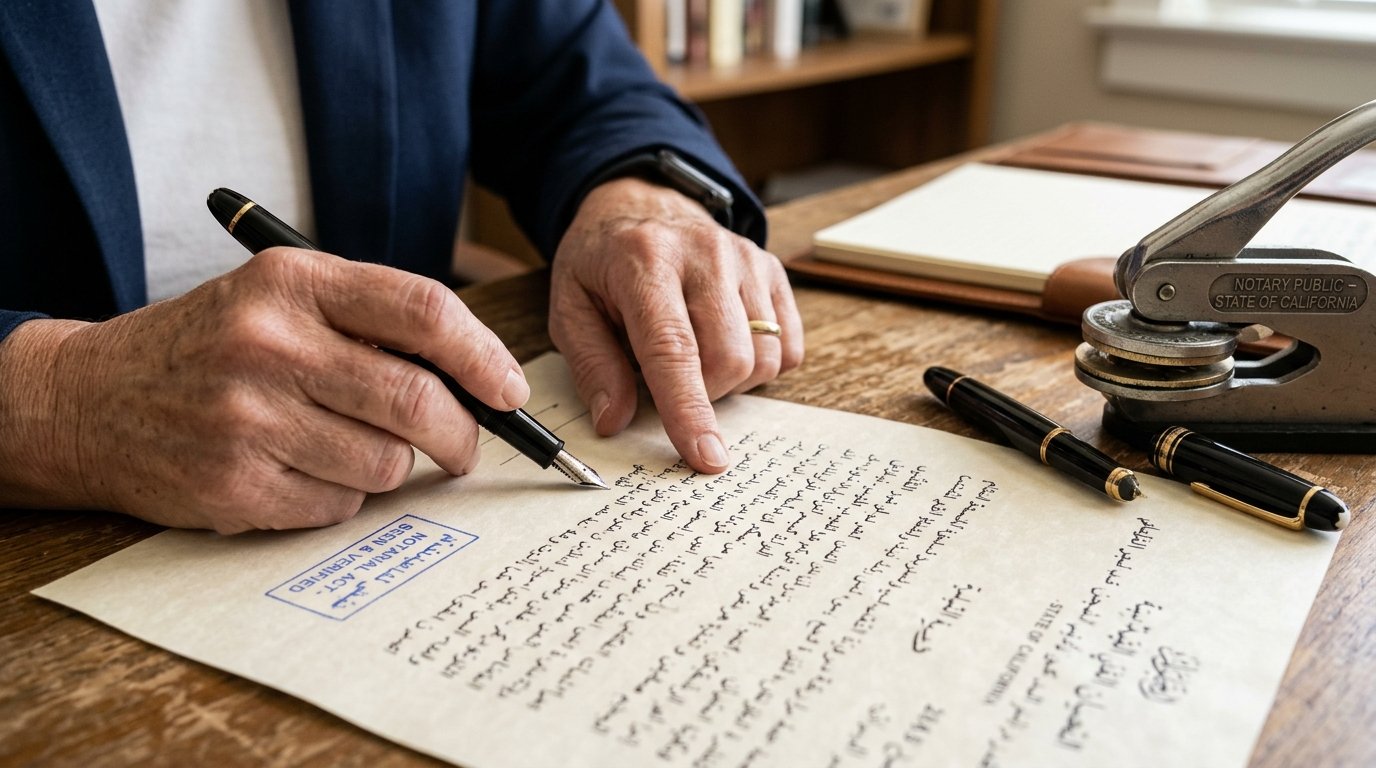
The document itself could be written in Spanish, Portuguese, Arabic, Mandarin, or Tagalog. What matters is that the notarial certificate (the official wording the notary attaches to the document) is in a language the notary reads and writes. In Florida, that means English.
California’s Notary Public Handbook states explicitly that a notary may notarize a signature on a document in a language the notary does not understand. Arizona’s notary reference manual permits it as long as the certificate is readable to the notary. Nevada’s Secretary of State says foreign-language documents can be notarized “in most instances.”
The document’s language is rarely the actual obstacle. The real questions are whether you and the notary can communicate and whether the rest of the paperwork is complete.
Florida’s Rule When the Signer Doesn’t Speak English
Florida Statute 117.107 adds a condition: a notary may not take an acknowledgment from a person who does not understand English unless the nature and effect of the instrument are translated into a language that person understands.
This rule protects you, the signer. It does not require the document to be translated into English before notarization. It requires that you understand what you’re signing.
If you speak Spanish and your document is in Spanish, you already understand it. Same for Portuguese, Creole, or any other language you read fluently. The notary performs the act and attaches an English-language certificate. No translation of the document itself is needed for the notarization to proceed.
The situation gets more complicated when the signer doesn’t speak English and can’t read the language the document is written in. Then someone must explain the instrument’s nature and effect in a language the signer understands before the notary can take the acknowledgment.
The cleanest solution is a bilingual notary. When the notary and signer share a language, the communication requirement is met naturally. No interpreter, no extra step. We handle notarizations in English, Spanish, and Portuguese across Orange, Seminole, Osceola, and Brevard counties, and foreign-language documents are a regular part of our work.
How to Prepare So You Don’t Get Turned Away
People get refused notary service on foreign-language documents more often than you’d think. It’s usually not because the law prohibits it. It’s because the notary isn’t confident about the rules, or because their employer’s corporate policy errs on the side of refusal. Walk-in locations at banks and shipping stores are the most common places this happens.
Census data shows that 22% of U.S. residents speak a language other than English at home. Foreign-language notarization is not rare. But the refusals are avoidable if you show up prepared.
Bring a valid photo ID. A passport works best for foreign-language transactions because it’s universally recognizable. A Florida driver’s license or state ID is also fine. The notary needs to read your name on the ID and match it to the name on the document.
Bring the complete document. Fill in every blank before the appointment. A notary should not notarize anything that appears incomplete, and understanding the rules around unsigned or incomplete documents helps avoid delays.
For more on this topic, see our guide: can a notary notarize a blank document.
Know which notarial act you need. For an acknowledgment, you confirm you signed voluntarily (you can sign before the appointment, but must still appear in person). For a jurat, you swear or affirm the contents are true and must sign in the notary’s presence. If you’re unsure which one your document requires, ask the receiving party: your attorney, the consulate, or the filing agency.
Have a communication plan. If you don’t speak English, book a notary who speaks your language rather than hoping for the best at a walk-in location. In Florida, a bilingual notary satisfies the statutory communication requirement without involving a third party.
When You Also Need a Certified Translation
Notarization and translation solve different problems. Confusing them costs time and money.
A certified translation includes the translator’s written statement that the translation is complete, accurate, and that the translator is competent. A notarized translation adds a notarial seal on the translator’s certification signature. The American Translators Association explains these are distinct functions: the notary does not guarantee the translation is correct. The notary only confirms the translator signed the certification.
For USCIS filings, any foreign-language document must be accompanied by a full English translation plus a translator certification of accuracy, completeness, and competence. Notarization of the translator’s signature is not required by USCIS, though some applicants add it.
For court proceedings, standards are set by each court, and defects carry real consequences. In a 2025 New York case (P.K. v M.P.), Greek property evidence was excluded because translations lacked proper translator affidavits: missing qualifications, unsigned certifications, even a notarization left blank on the page. In a September 2026 decision (Benidze v Liming Zhu), Georgian-to-English evidence was rejected because the translator never stated the translation was accurate and provided inadequate qualifications. The plaintiff lost the ability to use that evidence at summary judgment.
Before you pay, ask the receiving party exactly what they need. “Certified translation,” “notarized translation,” and “apostilled translation” are three different deliverables. Ordering the wrong one means starting over.
Sending Documents Abroad: Apostille and Authentication
If your notarized document is going to another country, you’ll likely need an apostille. This certificate, issued by the Secretary of State, authenticates the notary’s signature, seal, and commission. It tells the destination country’s authorities that the notarization was performed by a legitimate public official.
An apostille does not verify the document’s contents or confirm any translation is accurate. It authenticates the official, nothing more.
The apostille system is governed by the Hague Convention, which now covers over 125 member countries. As of early 2026, 59 countries had implemented at least one component of the electronic apostille program, gradually making the process faster for some destinations. If the receiving country isn’t a Hague member, you may need a different authentication chain through the U.S. Department of State.
In Florida, the only office that issues apostilles is the Secretary of State in Tallahassee. Filing directly costs $10 per document, but that means a trip to Tallahassee or mailing your originals. Through our apostille service, we notarize the document, courier it to Tallahassee, and return it to you. Turnaround with our courier option is typically up to 5 days. By mail, expect 7 to 10 business days. Regular mail without tracking can stretch to 6 weeks or more.
Rules Vary by State: A Quick Comparison
Everything above applies in Florida. But if you’re in another state, or if your document will be notarized in one state and used elsewhere, you should know that foreign-language notarization rules vary significantly.
| State | Foreign-Language Document? | Communication Rule |
|---|---|---|
| Florida | Yes. Certificate in English. | Signer must understand the instrument’s nature and effect, translated if needed. |
| California | Yes, even if the notary can’t read it. | Direct communication required. Handbook advises against interpreters. |
| Arizona | Yes, if the certificate is readable to the notary. | Translator may be physically present with signer and notary. |
| Colorado | Yes. | Remote interpreters must use the approved audio-video platform. No phone or apps. |
| Oregon | Guidance directs use of a translated copy. | Notary notarizes the translation, not the original. |
| Nevada | Yes, “in most instances.” | English notarial wording added if the notary can’t read the document. |
There is no single national answer. The result depends on the notary’s commissioning state, the notarial act, how the parties communicate, and what the receiving institution requires.
If you’re in Central Florida with a document in Spanish, Portuguese, or another language and a deadline approaching, we can come to you. Home, office, hospital, coffee shop. Call or text (689) 285-5579 to check available time slots.
Frequently Asked Questions
Does the document need to be translated into English before notarization?
Not as a general rule in Florida. The notary certifies your identity and signature, not the document’s content. But you must understand what you’re signing. If the document is in your language and you read it fluently, that requirement is met. The receiving party may separately require a certified English translation.
Can I bring a family member to interpret during the notarization?
Florida doesn’t explicitly prohibit it, but some states flag family relationships as a potential disqualifying interest. The safest path is to use a notary who speaks your language, which eliminates the need for any interpreter at all.
Is a certified translation the same as a notarized translation?
No. A certified translation includes the translator’s accuracy and completeness statement. A notarized translation adds a notary’s seal to the translator’s signature on that statement. The notary does not verify the translation is correct. Ask the receiving party which one they require before ordering.
Does a notarized document automatically work in another country?
Not automatically. Most countries require an apostille (for Hague Convention members) or a separate authentication process (for non-members). Translation requirements are set by the destination country, not by the U.S. notary.
What if the notary at my bank refuses my foreign-language document?
This is common. Bank and chain-store notaries frequently decline foreign-language work out of caution, even when the law permits it. A mobile notary who regularly handles multilingual documents is far less likely to refuse. Call or text us at (689) 285-5579.
Can a foreign-language document be notarized online?
Florida authorizes online notarization, and a Florida-commissioned online notary can perform the act even when the signer is in another state or country. The same identity and communication rules apply. Confirm that the receiving party accepts online notarization before relying on it, since some foreign governments still require an in-person seal.