
You have a document that needs notarization. Maybe it’s a loan closing this week, a power of attorney for a relative who can’t travel, or a birth certificate headed to another country. Whatever the reason, notarization follows specific, learnable rules. Understanding them before your appointment saves you a rejected document and a wasted trip.
This guide covers what notarization actually proves, which notarial act your document requires, how to prepare, what mistakes to avoid, and how much the whole thing costs.
What Notarization Actually Proves
Notarization is an identity check, not a truth check. A notary public verifies who you are, confirms you are signing voluntarily, and creates an official record of the transaction. That is the scope of the job.
The notary does not verify that the statements in your document are true. They do not confirm that a contract is fair, that a property claim is legitimate, or that your numbers add up. California’s prescribed acknowledgment notice makes this boundary explicit: the officer certifies the signer’s identity, not the document’s “truthfulness, accuracy, or validity.”
This distinction surprises people. Many assume a notary stamp means “government approved.” It does not. What it means is that a specific person appeared, proved their identity, and executed a specific document on a specific date, in front of a commissioned officer who recorded the event.
The National Notary Association describes notarization as a three-part process: vetting (confirming identity and willingness), certifying (performing the official act and completing the certificate), and record-keeping (documenting the transaction in a journal). Each part guards against a different kind of fraud. Skip one, and the whole thing loses its protective value.
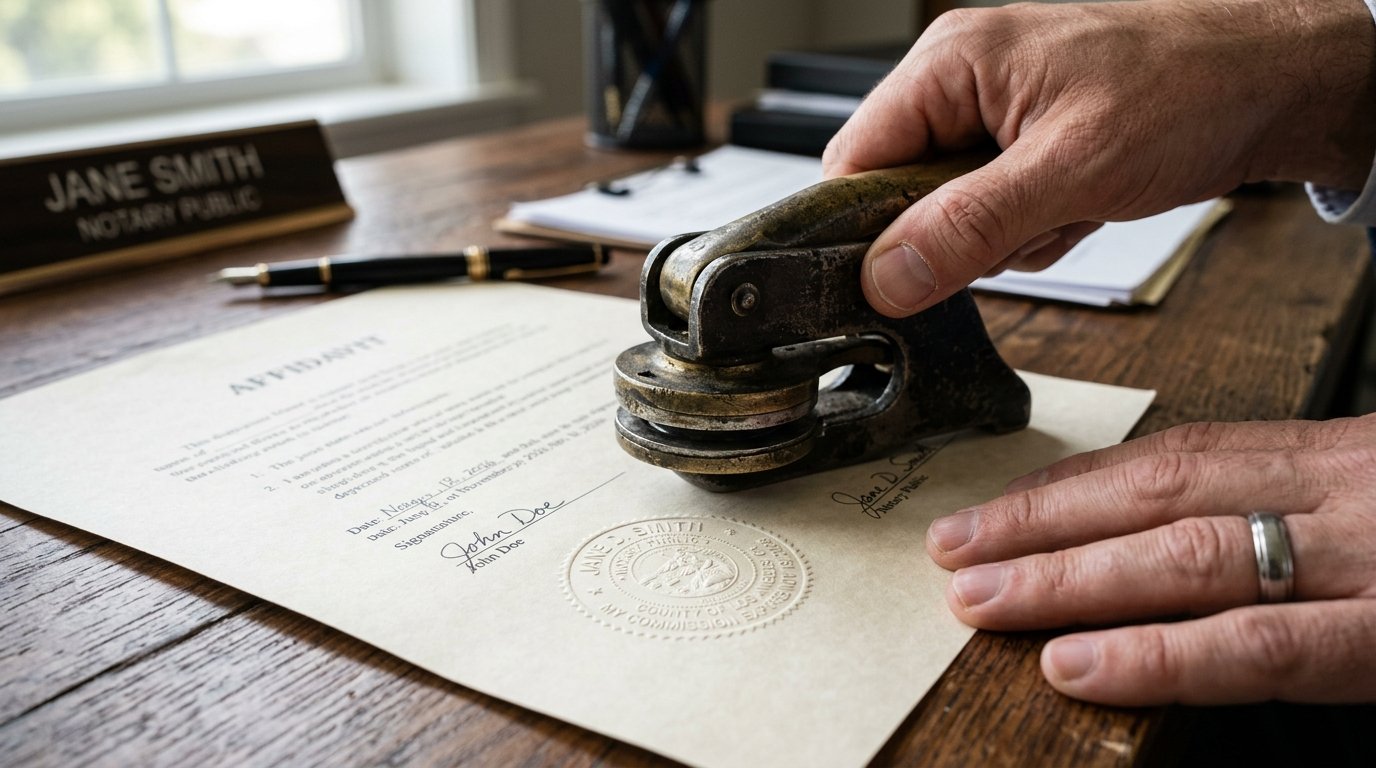
Acknowledgments and Jurats: Two Acts, Different Rules
Most notarizations fall into one of two categories. They are not interchangeable, and using the wrong one means starting over.
An acknowledgment records that the signer appeared before the notary and acknowledged executing the document. The signer does not have to sign in the notary’s presence. If you already signed at home, you can bring the document in and acknowledge it. The notary confirms your identity and that you signed willingly. Real estate deeds, powers of attorney, and many business contracts typically require acknowledgments.
A jurat has stricter requirements. You must sign the document in front of the notary, and you must take an oath or affirmation that the contents are true. The certificate wording differs between the two acts, and the notary must perform the one the document or the receiving party specifies. Affidavits, sworn statements, and certain court filings commonly require jurats.
If your document does not specify which act is needed, ask the institution that will receive it. A title company, court clerk, or consulate can tell you which notarial act they expect. Getting this right the first time prevents a second appointment.
What to Bring to Your Appointment
A smooth notarization appointment starts with preparation. Here is what you need:
- A valid, unexpired government-issued photo ID. A current driver’s license, state-issued identification card, or passport works in most situations. Florida accepts several forms, but a government-issued photo ID is the baseline.
- The document itself. If a jurat is required, do not sign it beforehand. Bring it unsigned. If an acknowledgment is required, you may have already signed, but you still must appear in person.
- Every person who needs to sign, each with their own identification. A notary cannot accept one spouse signing on behalf of another unless a properly executed power of attorney already exists.
- Witnesses, if the document requires them. In Florida, some documents (certain wills and healthcare directives, for example) require witnesses in addition to notarization. Those witnesses usually cannot be parties to the document. If you are unsure whether yours needs witnesses, ask the requesting party, or bring two disinterested adults to cover the requirement.
One detail that trips people up constantly: the name on your ID must match the name on the document. If your driver’s license says “Robert J. Smith” but the document says “Bob Smith,” the notary may flag the discrepancy. It does not always prevent notarization, but the inconsistency can cause the receiving institution to reject the document later.
Five Mistakes That Get Documents Rejected
A document can be properly notarized and still be rejected by the institution it is headed to. These are the most common reasons we see.
1. Signing before arriving when a jurat is required. If the document calls for a jurat, you must sign in the notary’s presence and take an oath. A pre-signed document cannot receive a valid jurat. The notary should refuse. If a less careful notary completes it anyway, the court or title company will kick it back.
2. Name mismatches between the ID and the document. Middle initials, maiden names, hyphens, suffixes: they all matter. If your deed says “Maria Garcia-Lopez” and your passport says “Maria Garcia,” the receiving party may require correction or additional documentation before they accept the filing.
3. Blank spaces or incomplete fields. A responsible notary will decline to notarize a document with significant blank areas. Those blanks can be filled in after the signature, changing the meaning of what you agreed to. Complete every required field before your appointment.
4. The wrong notarial act. An acknowledgment certificate on a document that required a jurat, or vice versa, will be rejected by institutions that know the difference. Courts and title companies check. Confirm which act applies with the receiving party before the appointment.
5. Expired identification. A notary who accepts an expired ID risks their commission. Most will decline the appointment entirely. Check your ID expiration date before you leave the house. If it is expired, renew it or bring a second valid form of government-issued photo identification.
Each of these mistakes means another appointment, another fee, and lost time. Checking all five takes two minutes and can save you a week.
How Much Notarization Costs
There is no single national price for notarization. The total depends on your state, your method, and whether travel or additional services are involved.
Florida law caps what a notary can charge per notarial act. For a standard acknowledgment or jurat, that statutory fee is small (a few dollars per signature). But the notarial act fee is often the smallest line on the bill. Here is what actually moves the total:
| Method | Typical Cost | What You Get |
|---|---|---|
| Bank or credit union | Often free for account holders | Basic notarization only; limited documents accepted; business hours only |
| Retail location (UPS Store, etc.) | Varies by location | Walk-in availability at many locations; may not handle wills, I-9s, or documents requiring witnesses |
| Mobile notary | Per-signature fee plus a travel fee | Comes to your location; flexible hours including evenings and weekends; handles most document types |
| Remote online notarization | Starting around $25 per session | Live video call with a commissioned notary; additional charges may apply for extra signers, stamps, or witnesses |
Free notarization at a bank sounds ideal, but it comes with limits. Many branches only notarize simple, single-signer documents during weekday hours. If your document is complex, requires witnesses, or you cannot visit a branch during business hours, “free” is not actually available to you.
A mobile notary costs more per appointment because you are paying for convenience and flexibility. If you are in a hospital bed, managing a household during a tight closing deadline, or coordinating signatures across multiple parties, the travel fee buys something valuable: the notary comes to you, on your schedule.
Four Ways to Get a Document Notarized
Your choice depends on the document, your timeline, and where you can physically be.
At a bank or credit union. If you hold an account, have a simple document, and can visit during business hours, this is the cheapest option. Call ahead. Not every branch has a notary on staff every day, and some will not handle real estate documents, wills, or anything requiring witnesses.
At a retail location. Retail shipping and office-supply stores often have a notary on staff at participating locations, with online appointment booking available. Bring your ID and the document. Confirm the location handles your specific document type before you make the trip.
With a mobile notary. A mobile notary public travels to wherever you need them: home, office, hospital, nursing home, even a coffee shop. Under Florida law, a notary public can perform six basic duties: administering oaths or affirmations, taking acknowledgments, attesting to photocopies of certain documents, solemnizing marriages, verifying vehicle identification numbers, and certifying the contents of a safe deposit box. A mobile notary handles these same duties but eliminates the signer’s travel. Travel distance and fees vary by location and urgency, so confirming coverage area in advance prevents scheduling delays.
This matters most when the signer cannot easily leave where they are. A parent in the hospital. A homebound elderly relative executing a power of attorney. A couple juggling a loan closing around demanding work schedules. The notary adapts to the signer’s situation instead of the other way around.
Through remote online notarization (RON). RON lets you appear before a notary on a live video call. As of 2026, 47 states and Washington, D.C. have laws authorizing remote online notarization, though “authorized” and “fully operational” are not the same thing. California, for example, passed its RON framework in September 2026 but tied it to a technology project that has not yet launched.
RON works well for straightforward documents when all parties have reliable internet, a webcam, and acceptable identification. For mortgage closings, check with your lender and title company first. Fannie Mae requires notarization to comply with the law where the property is located, not just where the platform operates.
When a Notarized Document Needs to Work Abroad
If your notarized document is headed to another country, the notary stamp alone is usually not enough. The receiving country needs proof that the notary who signed it actually had legal authority to do so. That proof is called an apostille.
An apostille is a certificate issued under the Hague Convention that authenticates the origin of a public document for international use. It does not verify the document’s contents. It confirms that the notary’s commission and signature are legitimate. Countries that participate in the Hague Convention accept apostilles in place of the older, slower process of full embassy legalization.
In Florida, apostilles come from one place: the Secretary of State’s office in Tallahassee. The state filing fee is $10 per document if you walk in personally. For most people in Central Florida, though, the practical option is a service that handles the notarization, courier to Tallahassee, and return delivery. Typical turnaround through a courier runs up to five business days. Mailing documents yourself takes seven to ten business days, and regular mail can stretch past six weeks.
If the destination country is not a Hague Convention member, you will need embassy or consulate legalization instead, which is a separate and typically longer process. U.S. embassies abroad can notarize documents for Americans overseas, but they charge $50 per consular seal and require an in-person appointment.
The sequence matters: notarize first, then obtain the apostille. An apostille cannot be attached to a document that has not been properly notarized.

Frequently Asked Questions
Can a notary refuse to notarize my document?
Yes. A notary must refuse if they cannot verify the signer’s identity, if the signer appears unwilling or confused, if the document contains significant blank spaces, or if the notary has a direct financial interest in the transaction. These refusals protect you. A notarization performed despite red flags can be challenged or invalidated later.
Does notarization expire?
The notarization itself does not carry a universal expiration date. The notary’s certificate is a permanent record of an event on a specific date. However, the document being notarized may have time limitations imposed by the receiving party. A lender, court, or government agency may require a recently notarized version. Always confirm with whoever is receiving the document.
Can a notary notarize documents for a family member?
In Florida, a notary cannot notarize a document if they are a party to the transaction or have a direct financial interest in it. Notarizing a spouse’s deed when you are also on the title, for example, creates a disqualifying conflict. Family relationship alone does not automatically bar the notary, but it introduces risk. The safest practice is to use an independent notary for any family document.
What is the difference between notarization and an apostille?
Notarization verifies the signer’s identity and willingness. An apostille verifies that the notary who performed the act had legal authority to do so. Notarization comes first. The apostille is a second layer of authentication required when the notarized document will be used in a country that participates in the Hague Convention.
Do I need witnesses in addition to notarization?
It depends on the document and on Florida law. Certain documents, including some wills and healthcare directives, require witnesses separate from the notary. Those witnesses generally cannot be beneficiaries or parties to the document. Confirm witness requirements with the requesting party before your appointment so you are not searching for qualified witnesses at the last minute.
Can I get a document notarized outside of business hours?
Banks and retail locations operate on fixed schedules. A mobile notary can often meet you evenings, weekends, or in urgent situations. If your closing is tomorrow morning or a family emergency requires a power of attorney signed tonight, a mobile notary is typically the fastest option available.
If you are in Orange, Seminole, Osceola, or Brevard County and need a document notarized, we can meet you wherever works best: home, office, hospital, or anywhere in between. We work in English, Spanish, and Portuguese and are reachable 24/7. Call or text (689) 285-5579 to check available time slots.