
Your closing is Thursday. Your father needs a power of attorney signed before surgery. A document headed overseas needs a notary seal before the apostille process begins. You need a mobile notary at home, and you need one soon.
The good news: a mobile notary eliminates the trip. A commissioned notary public comes to your kitchen table, your living room, or your hospital bedside and performs the exact same legally recognized act you’d get in any office. Same seal, same journal entry, same legal weight. The only difference is who did the driving.
Below, we cover what happens during the appointment, what you should have ready so nothing stalls, how sensitive situations work, and what the visit realistically costs in Central Florida.
What a Mobile Notary Does (and Does Not Do)
A mobile notary holds the same state commission as one stationed at a bank or an attorney’s office. The National Notary Association defines “mobile” simply as a notary willing to travel to the signer. There is no separate mobile license. There is no expanded authority. The difference is logistics, not legal power.
Under Florida law, a notary public has six authorized duties: administer oaths and affirmations, take acknowledgments, attest to photocopies of certain documents, solemnize marriages, verify vehicle identification numbers, and certify safe deposit box contents. When we arrive at your home, those are the acts we’re authorized to perform.
What we cannot do: draft your legal documents, advise you on which document to sign, or recommend one notarial act over another. We are not licensed to practice law in Florida. No notary is, regardless of where the signing happens. Your attorney, lender, or title company handles content and instructions. We handle the notarization.
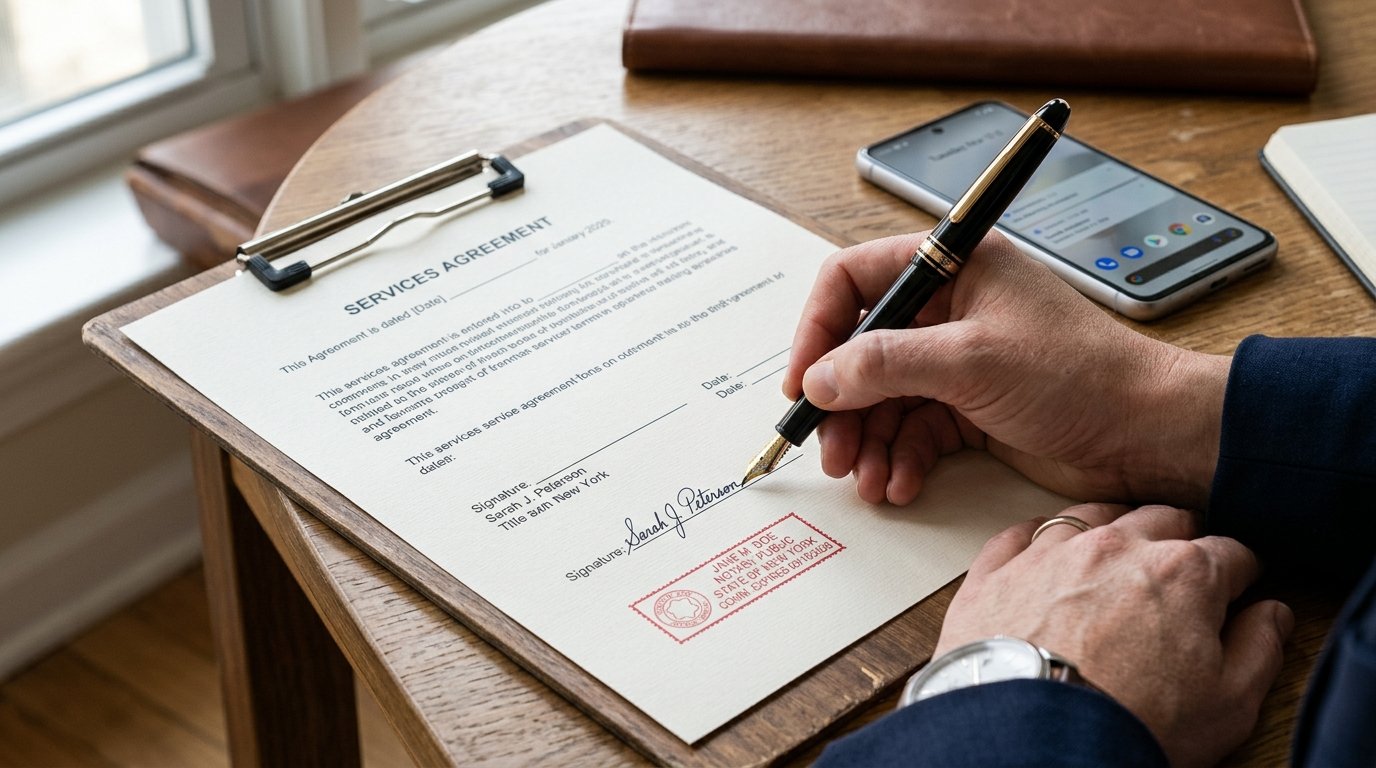
When a Home Visit Is the Right Call
Most people contact us because one of four situations makes an office visit impractical.
The most common is a loan closing. Mortgage packages run 100 to 200 pages. A notary signing agent brings the entire stack to your dining table, walks you through the signing, and returns everything to the title company or lender. Refinances, purchases, VA loans, FHA loans: the process works the same way.
Second is a family situation. A parent recovering from surgery needs to sign a power of attorney. A spouse in a nursing home needs documents executed before a filing deadline. These signings can’t wait for someone to feel well enough to drive across town.
Third is a scheduling conflict. Your work hours, your child’s school pickup, or a tight legal deadline makes a 9-to-5 notary office unreachable. A mobile notary after hours works around your availability, including evenings, weekends, and holidays.
Fourth is a document that needs a seal before another process can start. Apostille certification through the Florida Secretary of State, for example, requires the document to be notarized first. The sooner the seal goes on, the sooner the apostille process begins.
How to Prepare Before the Notary Arrives
The notarial act itself is quick. Most delays happen because something wasn’t ready when the notary walked in. Ten minutes of preparation beforehand can save everyone an hour of rescheduling.
Valid photo identification
Florida requires identity verification before any notarial act. Acceptable forms include a current U.S. passport, a state-issued driver’s license or identification card, or another government-issued photo ID. If your only identification is expired, mention that when you call so we can discuss alternatives before making the trip.
The complete, final document
The NNA advises against presenting documents with blank spaces. Names, dates, addresses, and all other substantive fields should be filled in before we arrive. If an attorney or lender prepared the document, confirm it’s the final version. Notarizing an incomplete document creates problems that are much harder to fix after the seal is on the page.
The correct notarial act
The two most common acts are an acknowledgment and a jurat. In an acknowledgment, you confirm you signed the document willingly. In a jurat, you swear or affirm under oath that the contents are true, and you must sign the document while the notary watches. Most documents specify which act is required near the signature line. If yours doesn’t, ask the person or entity that prepared it before the appointment.
Witnesses, if the document requires them
Certain documents under Florida law (some powers of attorney, living wills, and other instruments) require one or two witnesses in addition to the notary. Witnesses generally cannot be parties to the document. Line them up before the notary arrives. We can sometimes provide a witness, but confirming that in advance saves a wasted trip.
A table, two chairs, and decent light
The notary needs a flat surface to spread pages, apply a seal, and complete a journal entry. Good lighting helps both of you read fine print and verify the photo on your ID. A kitchen table works perfectly. A dimly lit couch does not.
What Happens During the Appointment
Once everything is in place, the signing follows a short, predictable sequence:
- The notary checks your photo ID against the document and confirms your identity.
- The notary reviews the document for completeness and confirms the correct notarial certificate is attached. (This is a procedural check, not a legal review of the document’s content.)
- You perform the notarial act. For an acknowledgment, you confirm your signature is voluntary. For a jurat, you take an oath or affirmation and sign while the notary watches.
- The notary completes the certificate wording, applies the official seal, and makes a journal entry recording the transaction.
For a single document like an affidavit or a vehicle title, expect 15 to 20 minutes. A power of attorney signing typically takes 20 to 45 minutes depending on page count and the number of signers. A full mortgage closing, with its thick stack of disclosures and agreements, can run 45 minutes to well over an hour.
Signings for Vulnerable or Bedridden Signers
A bedside signing for a parent, a grandparent in a nursing home, or a spouse recovering from surgery is where the “mobile” part of this work matters most. It’s also where the process demands the most care from everyone in the room.
The NNA’s guidance published earlier this year on vulnerable signers leaves no room for shortcuts: the notary speaks directly with the signer, not through a family member standing nearby. The signer must show awareness of the document and willingness to sign. A notary cannot diagnose mental capacity (that requires a physician), but we do observe whether the person in front of us understands what’s happening.
When family members hover, we may ask them to step out of the room. That’s not personal. It’s how we confirm the signer is acting freely and without pressure.
Physical limitations and mental participation are separate questions. If someone cannot hold a pen, Florida law provides for signature by mark with witnesses present. But if someone is unresponsive, confused about the document’s purpose, or unable to communicate, the notarization cannot go forward. Stopping in that moment protects the signer. It also protects every other document they’ve already signed from being challenged later.
If you’re arranging a signing for someone with health challenges, call us first. Describe the situation honestly. We can tell you what to expect, what accommodations might help, and whether the appointment is realistic given the signer’s condition.
What About Online Notarization?
Florida authorizes remote online notarization (RON), which lets you complete a notarization through a secure audio-video connection without anyone traveling. Florida’s RON statute requires identity verification through credential analysis and knowledge-based authentication, plus a recorded session the notary must store for at least ten years.
RON works well for straightforward documents when the signer is comfortable on camera and (this is the part many people overlook) the receiving party accepts electronically notarized documents. Not all do. Some county recorders, foreign governments, and title companies still require wet ink and a physical seal.
A physical home visit is usually the better fit when the signer is elderly or uneasy with technology, when the document package is large, when the recipient requires traditional execution, or when multiple signers are at the same address.
The industry is heading digital, but adoption lags behind availability. A 2025 survey of 100 lending professionals found that 90% offered digital closings, yet only 14% of those with the technology closed more than 80% of their loans digitally. Paper and ink remain the default for most residential transactions.
Not sure which approach your document needs? Call or text us and we’ll help you figure it out before anyone gets in a car.
What the Visit Actually Costs
Home-visit pricing has two layers. Understanding both prevents surprises at the door.
The first is the statutory notary fee: what Florida law allows per notarial act. This is a small, regulated amount, just a few dollars per signature.
The second is the service fee: travel time, fuel, scheduling flexibility, after-hours availability, and the simple fact that the notary came to you. This is where the real cost of a mobile appointment lives. It follows the same logic as any house call. You’re paying for convenience and time, not just the notarial act itself.
For a single-document notarization in Orange, Seminole, Osceola, or Brevard County, the total will be meaningfully higher than the statutory fee alone. Loan signing packages carry higher fees because they involve longer appointments, specialized training, and coordination with lenders and title companies. Hospital or late-night visits may include an additional charge.
Our advice: get the full number before you confirm. Ask about travel, extra signers, witnesses, printing, and cancellation terms. A provider who quotes transparently before the appointment is one worth opening the door for.
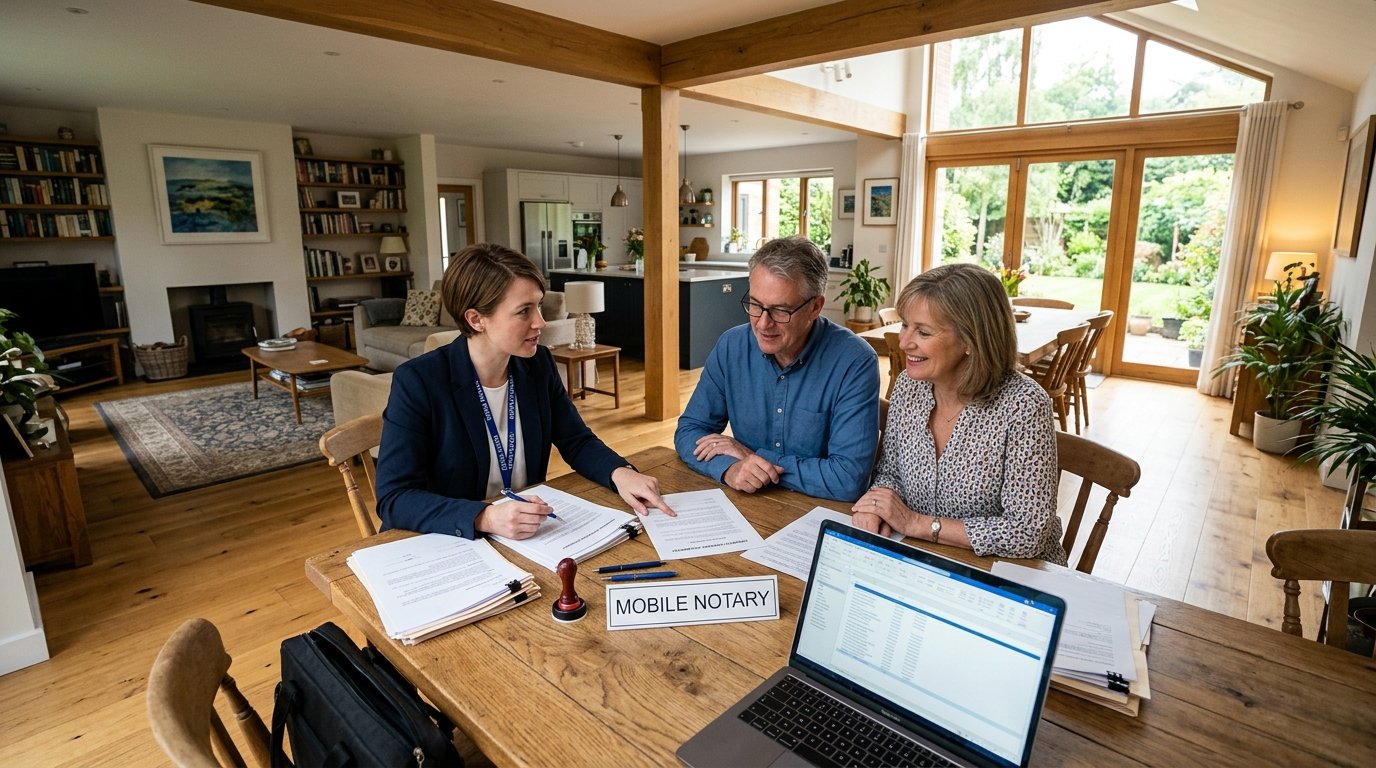
We serve Orange, Seminole, Osceola, and Brevard counties and work in English, Spanish, and Portuguese. If you need a notary at home, at your office, or at a hospital, call or text us at (689) 285-5579 to check available time slots. We’re reachable 24/7.
Frequently Asked Questions
Can a mobile notary come to my home the same day I call?
In most cases, yes. Same-day appointments depend on the notary’s schedule and your location within our service area. When you call or text, we’ll confirm the earliest available slot. For urgent situations like hospital signings or closing deadlines, we prioritize speed.
Is a document notarized at home legally valid?
Yes. A mobile notary holds the same state commission and follows the same procedures as one working in a fixed office. The signing location does not affect the legal weight of the notarial act, provided all requirements (proper identification, correct act, completed certificate) are met.
What if the signer can’t physically write their name?
Florida law allows signature by mark (such as an “X”) with witnesses present. The notary still verifies the signer’s identity and confirms awareness and consent. If the signer cannot communicate or demonstrate understanding of the document, the notarization may not proceed.
Does the notary bring the documents?
For general notarizations, no. You or your attorney provide the completed documents. The exception is a mortgage closing, where the notary signing agent receives the loan package from the title company or lender and brings it to your table.
Can you notarize a document in Spanish or Portuguese?
We communicate with clients in English, Spanish, and Portuguese to explain the process and answer questions. The notarial certificate itself follows Florida’s legal requirements. Whether the underlying document can be in another language depends on its intended use and the receiving party’s acceptance rules.
What’s the difference between an acknowledgment and a jurat?
In an acknowledgment, you confirm you signed the document voluntarily. You may have signed before or during the appointment. In a jurat, you swear under oath that the document’s contents are true and must sign while the notary watches. The certificate language on your document indicates which act is required.