
Your document came back rejected, or someone just spotted a mistake after everything was already signed, stamped, and sealed. Either way, you need to know how to correct a notarized document without creating a bigger problem than the one you started with.
A single error rarely voids the entire document. Pennsylvania’s Uniform Notarial Acts statute, for example, preserves many notarial acts despite procedural failures. But the right correction method depends on what went wrong, where the error sits in the document, and which state’s rules apply. A fix that works in Colorado can violate Florida statute.
Identify Where the Error Actually Lives
Every notarized document has two distinct layers, and confusing them is the fastest way to waste time.
The document body is the contract, affidavit, deed, or power of attorney you signed. It contains names, dates, dollar amounts, property descriptions, and legal terms. If a name is misspelled here or an address is wrong, the person or company that prepared the document is responsible for the correction. The notary did not draft it and cannot rewrite it.
The notary certificate is the section with the notary’s signature, seal, venue (county/state), and date. It records what happened during the notarial act: who appeared, what type of notarization was performed (acknowledgment or jurat), and when. If the notary wrote the wrong date or misspelled your name in this section, the notary who performed the original act is the one who handles it.
| Error location | Who fixes it | Common examples |
|---|---|---|
| Document body | Preparer, attorney, or signer | Wrong address, misspelled name, incorrect dollar figure, missing page |
| Notary certificate | Original notary | Wrong date, incorrect venue, missing seal, name misspelled in certificate |
| Both | Both, separately | Name misspelled everywhere, wrong property description that also appears in the certificate |
This split matters in practice: content problems go back to the sender or preparer, while missing notarial elements (signatures, seals, dates, initials) go to the notary. Asking the wrong person to fix the wrong layer wastes time and can introduce new legal issues.
Correcting the Notary Certificate
When the error is limited to the certificate, two approaches are common.
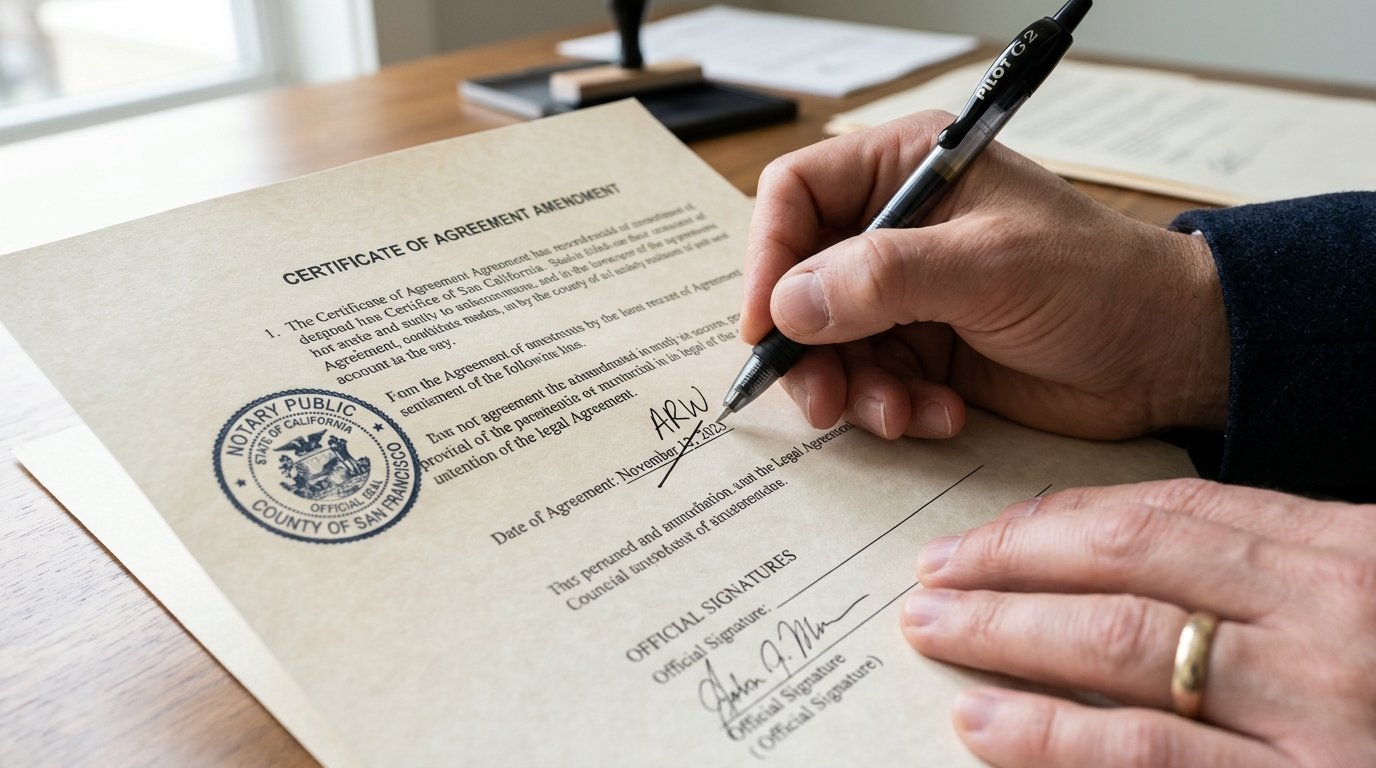
Line-through correction. In states that permit it, the notary draws a single line through the mistake (never white-out, never a heavy scribble), writes the correction nearby, then adds their initials and the date of the correction. Colorado’s Secretary of State publishes this method and assigns clear roles: only the signer changes the document body, only the notary corrects the certificate.
Replacement certificate. When the error is too large to fix with a line-through, or when the receiving party demands a clean certificate, the NNA’s correction guide describes a replacement certificate procedure. The new certificate is attached to the original document, identifies the original notarial act, and follows applicable state rules about whether to retain the original act’s date or use a new one.
One rule is consistent across states: only the notary who performed the original act should correct their own certificate. A second notary can perform an entirely new notarization, but editing someone else’s certificate is off-limits.
When a New Notarization Is the Only Fix
Some problems can’t be patched with initials and a line through the old entry. You need a completely new notarial act when errors affect critical documents like guardianship paperwork, or in these situations:
- The signer never actually appeared before the notary (a procedural failure, not a typo).
- A jurat was required but the oath or affirmation was never administered.
- The document itself has been revised, corrected, or reprinted since the original signing.
- State law offers no post-completion correction procedure.
California is the strictest example. The state’s 2026 Notary Public Handbook provides no procedure for correcting a completed notarial act. If an error surfaces after the signing, the notary must perform a new act with a new certificate, a new date, and a new journal entry. Using the old date to make the new act look like the original one is prohibited.
When a document has been changed since the original notarization, the NNA says signers must reappear, acknowledge the changes in person, and receive a new certificate. This applies to revised loan documents, corrected affidavits, or any instrument where the language you’re signing is different from what was originally notarized.
Florida’s Correction Rules
Florida is direct about this. Section 117.107 of the Florida Statutes prohibits a notary from changing anything in a written instrument after anyone has signed it.
In practice, that means:
- If the error is in the document body (a wrong name on your power of attorney, an incorrect property address in a deed), the preparer or attorney corrects the document, and you sign and notarize again from scratch.
- If the error is in the notary certificate only, some certificate-level corrections may still be possible depending on how the act was completed. But the safest path under Florida law is usually a fresh notarization, especially when the document is headed to a lender, a court, or a government agency.
Florida caps the per-act notary fee at $10 for traditional notarizations. A new notarization to fix an error should not cost more than that for the notarial act itself, though a mobile notary’s travel or service fee is separate.
If a title company or lender rejected your document, get the rejection notice before you schedule a new appointment. Sometimes the problem is something you can resolve with a phone call to the preparer. Other times you need a new signing. Reading the rejection first saves you from paying for two appointments when one would do.
Recorded Documents Need a Separate Remedy
A notarized deed that has been recorded with the county creates a public record. Correcting your personal copy does nothing to the public record, and the public record is what everyone relies on.
For recorded conveyances, states provide correction-instrument procedures. Texas distinguishes nonmaterial corrections (a misspelled name that doesn’t change ownership) from material corrections (a wrong percentage of ownership or an incorrect legal description). Material corrections require the original transaction parties to execute and record a correction instrument. The Texas Secretary of State also clarifies that a notary may correct an acknowledgment certificate to reflect the facts, but is not authorized to alter or draft the underlying instrument.
The Texas Supreme Court affirmed this framework in Broadway National Bank v. Yates Energy Corp. (2021), holding that original parties could execute a correction deed even after interests had been assigned to third parties. That decision is a structured legal remedy, not casual permission to edit a recorded document at home.
If you are dealing with a recorded deed or mortgage document in Central Florida, the county recorder’s office and the title company involved in the transaction will tell you what corrective instrument they need. This is typically where an attorney gets involved.
Corrections Before an Apostille or International Filing
An apostille authenticates the notary’s signature, seal, and authority. It does not verify that the information in the document is correct. California’s Secretary of State states this explicitly in its apostille FAQ.
If your notarized document has an error and needs to travel abroad under the Hague Convention, correct the document and get it properly re-notarized before applying for the apostille. Sending a flawed document through the apostille process just produces an officially authenticated flawed document, which the foreign authority will likely reject anyway.
Timing matters. Filing directly with the Florida Secretary of State in Tallahassee (the state’s only Secretary of State office) costs $10 per document and can be processed same-day if you walk in. By mail, expect 7 to 10 business days. Regular mail without a courier can stretch to six weeks or more. We handle the full sequence, from notarization through apostille filing and return delivery, with a courier option that typically takes up to five days.
The same principle applies to powers of attorney being sent abroad. If a POA is for a relative overseas or a property transaction in another country, the foreign institution will scrutinize every detail. A misspelled name, an incorrect date of birth, or a missing middle name can cause the entire document to be rejected at the consulate or foreign notary office. Getting it right before the apostille saves weeks of back-and-forth.
Preventing Errors at the Signing Table
Most notarization errors are preventable with two extra minutes of review before the stamp goes down.
- Compare your ID to the document. The name on your government-issued ID must match the name in the document. Watch for middle names, suffixes (Jr., III), and hyphens. If your ID says “Catherine” and the document says “Katherine,” flag it before signing.
- Check the notary certificate. Verify the venue (the county/state where you are physically present), the date, and that your name is spelled correctly in the certificate language.
- Confirm the right notarial act. An acknowledgment means you are confirming you signed voluntarily. A jurat means you are swearing under oath that the contents are true, and you must sign in the notary’s presence. Using the wrong one can get the document rejected.
- Count the pages. Missing pages are surprisingly common, especially in loan packages. Flip through the document before anything gets notarized.
- Read the printed name under the signature line. If it says the wrong person’s name, stop. This happens more often than you’d expect with auto-filled templates.
When we meet clients for a mobile notary appointment, we walk through each document’s certificate and confirm the details before completing the notarial act. That review is part of the job, and it is the single most effective way to avoid corrections later.

Frequently Asked Questions
Can I use white-out or correction fluid on a notarized document?
No. White-out obscures the original entry, which makes the document look altered and can lead to rejection by courts, lenders, and government agencies. Where corrections are permitted, the standard method is a single line through the error with initials and a date, keeping the original text visible.
Does the signer have to appear again for a correction?
It depends on the error and the state. If the document body has changed, the signer typically must reappear, re-sign, and receive a new notarization. For certificate-only corrections made by the original notary, some states allow the fix without the signer present. California requires a full new act with a new appearance.
Who pays for the new notarization when the notary made the mistake?
There is no universal rule. Many notaries will correct their own certificate errors at no charge. If the error was in the document itself (prepared by an attorney or title company), the correction cost is typically between the preparer and the client. Ask upfront who covers the fee and any travel charges before scheduling the appointment.
Does a certificate error automatically invalidate my contract or deed?
Usually not. A notarial defect and a void contract are different things. Pennsylvania law, for instance, preserves many notarial acts despite procedural failures. However, a lender, recorder, or foreign government may refuse to accept the document until the certificate is corrected, which creates a practical deadline even if the document is legally valid.
Can a different notary fix the original notary’s certificate?
A different notary should not alter the first notary’s certificate. They can, however, perform an entirely new notarization with their own certificate. If the original notary is unavailable (moved, retired, or unreachable), a new notarization by a different notary is typically the correct path. Confirm with the receiving party that they will accept a new act.
What if the error is on a document that already has an apostille?
The apostille authenticates the notary’s official capacity, not the document’s content. You will likely need to correct and re-notarize the document, then apply for a new apostille. Contact the receiving country’s authority or consulate to confirm what they require before you start the process over.
If you have a document that needs correcting and re-notarizing in Orange, Seminole, Osceola, or Brevard County, we can come to you. Call or text us at (689) 285-5579 to check available time slots. We work in English, Spanish, and Portuguese, and we are reachable 24/7, including evenings and weekends when correction deadlines don’t wait for business hours.