You have a document in front of you. Maybe a deed, an affidavit, or a power of attorney. Near the bottom, there is a notary block with wording you did not choose: “subscribed and sworn before me” or “acknowledged before me.” Those two phrases point to two different notarial acts, an acknowledgment and a jurat, and they are not interchangeable. Use the wrong one and the court, the county recorder, or the lender can reject your document outright.
Below, we break down what each act does, how to identify which one your paperwork requires, and what actually happens when someone mixes them up.
What an Acknowledgment Does
An acknowledgment is a formal declaration that you signed a document and that the signature represents your voluntary act. You appear before a notary, the notary confirms your identity, and you state something to the effect of: “Yes, I signed this. I meant to sign it.”
No swearing. No oath. No promise about whether the document’s contents are true or accurate. The notary is not reading your document or evaluating your transaction. The notary is confirming one narrow thing: a person with verified identity appeared and acknowledged a signature.
In Florida and many other states, you can sign the document before you meet the notary. You still must appear in person (or through an authorized remote session), but you do not need to put pen to paper at the appointment. Texas notary training makes the same point: the signer may have signed earlier, then appears to acknowledge the signature as their own.
The certificate language typically reads “personally appeared before me and acknowledged” or “acknowledged the foregoing instrument to be his/her voluntary act and deed.”
Documents that commonly call for an acknowledgment include deeds, mortgages, powers of attorney, trust instruments, and other recorded paperwork where the receiving party needs proof of voluntary execution.
What a Jurat Does
A jurat ties your signature to an oath or affirmation. Two things happen in a jurat that do not happen in an acknowledgment:
- The notary administers an oath (“Do you swear that the statements in this document are true?”) or an affirmation (the same question, without the religious element).
- You sign the document in the notary’s presence, after taking the oath.
Both steps are required. A notary who watches you sign but skips the oath has not completed a jurat. A signature alone, even with a notary stamp next to it, is not a sworn statement.
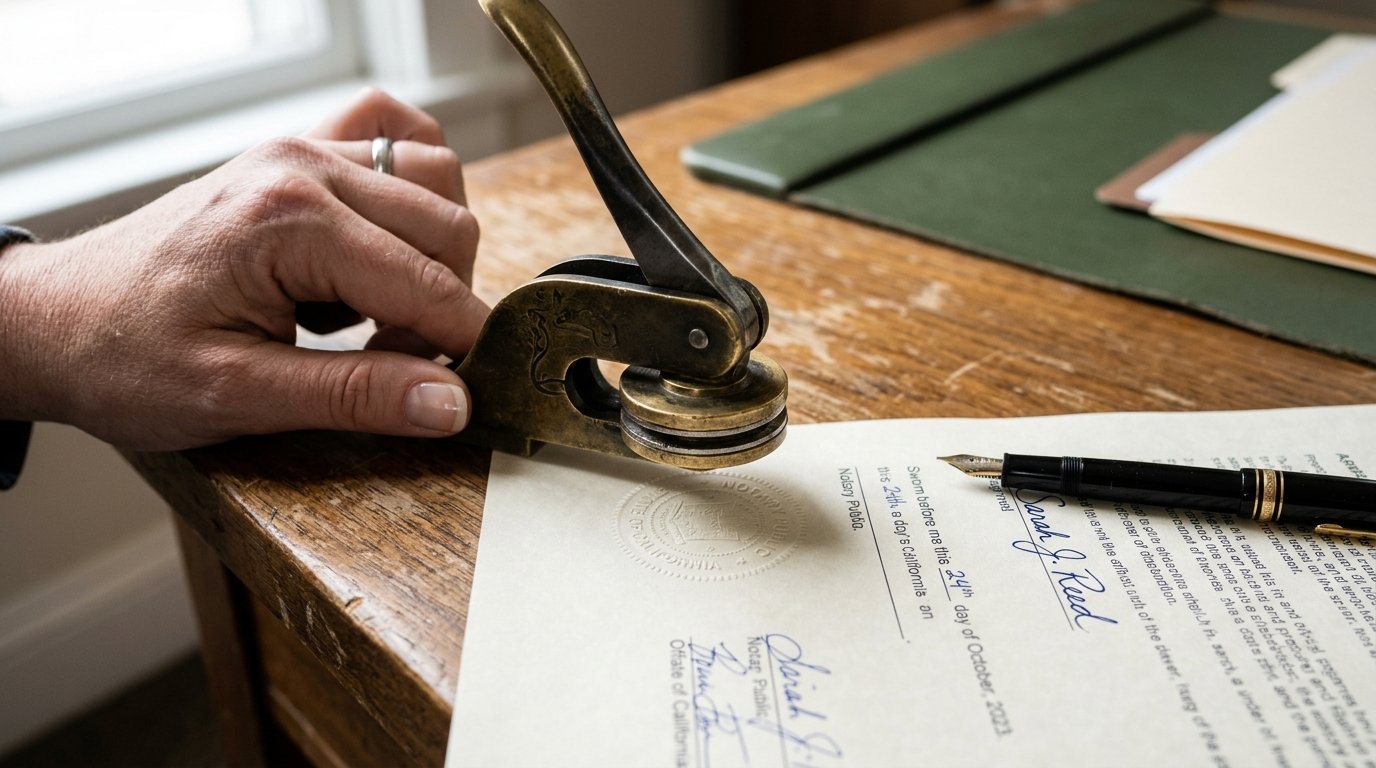
The jurat certificate typically reads “subscribed and sworn to (or affirmed) before me” followed by the date, the notary’s signature, and the seal.
Affidavits and sworn declarations are the most common jurat documents. The U.S. State Department defines an affidavit as a statement made under oath or affirmation, requiring the signer to appear, swear or affirm, and sign before the officer. Courts, government agencies, and immigration offices regularly require sworn statements, and a jurat is how the law creates one.
One point that trips people up: even with a jurat, the notary is not verifying that your statements are accurate. California’s 2026 notary handbook says it plainly: the notary does not certify the truth, accuracy, or validity of the document’s contents. The oath makes you legally accountable for what you wrote. The notary’s job is to confirm you actually took that oath.
If you have moral or religious objections to swearing, an affirmation carries the same legal weight. The notary replaces “swear” with “affirm.” You are not required to invoke a deity, and the resulting jurat is equally valid. This matters especially for signers whose first language is not English: the oath or affirmation must be understood, not just recited. When we notarize documents in Spanish or Portuguese, we make sure the signer genuinely comprehends what they are affirming before they sign.
Key Differences at a Glance
| Acknowledgment | Jurat | |
|---|---|---|
| What the signer declares | “I signed this document as my voluntary act.” | “The statements in this document are true” (under oath or affirmation). |
| Oath required? | No. | Yes. The notary must administer it. |
| When can you sign? | Before or during the appointment, depending on the state. | In the notary’s presence, after taking the oath. |
| Certificate language | “Acknowledged before me” | “Subscribed and sworn (or affirmed) before me” |
| Typical documents | Deeds, mortgages, powers of attorney, trusts. | Affidavits, sworn statements, court declarations. |
| What it proves | A named person appeared and confirmed their signature. | A named person swore to the truth of a statement and signed before the notary. |
How to Tell Which One Your Document Needs
Start with the notary block on the document itself. Most prepared forms include a certificate, either at the bottom of the last page or on an attached sheet. The wording tells you and the notary which act to perform.
If you see “subscribed and sworn before me,” “affirmed before me,” or “under oath,” the document calls for a jurat.
If you see “acknowledged before me,” “personally appeared and acknowledged,” or “executed as a free and voluntary act,” it calls for an acknowledgment.
When the document has no notary block at all, check with whoever needs it. The court clerk, the title company, the lender, or the attorney who drafted the form can tell you which act is required.
What the notary cannot do: choose for you. Selecting the notarial act is a decision about the legal effect of your document, and making that decision for a client crosses into unauthorized practice of law. Florida’s Department of State guidance reinforces this point: the certificate should reflect whether the document was acknowledged or sworn to, and that determination comes from the form or the requesting party, not from the notary’s judgment about what might work better.
What Happens When Someone Gets It Wrong
Getting the wrong act applied is not a hypothetical problem. Courts have addressed it directly, and the results are not forgiving.
In In re Anzaldua, a 2024 bankruptcy case in Michigan, an attorney filed a document titled “affidavit.” The problem: the Oklahoma notary performed an acknowledgment instead of a jurat. No oath was administered. The court noted that the document was likely not a sworn statement at all and explicitly warned practitioners and notaries against confusing the two acts. The motion failed for separate procedural reasons, but the mismatch was flagged on the record.
In Haigler v. Singh (In re Stevenson), a 2025 South Carolina bankruptcy decision, a Florida notary verified the signer’s identity and witnessed a signature on a confession of judgment. But the court found no written oath, no recorded verbal oath, and no declaration under penalty of perjury. South Carolina law required verification under oath. Without it, the document was treated as unverified, and the trustee won the preference claim.
Compare those with A to Z Supply Services v. State Farm, a 2025 New York case. There, the defendants’ affidavits bore a “sworn to before me” jurat and a notarial stamp. The court accepted them without issue. The certificate matched what the notary actually did.
The pattern is consistent. Courts look at whether the notary performed the correct act, not just whether a seal sits on the page. For you as a signer, the practical cost of a mismatch is delay and expense. A rejected document means scheduling another notarization appointment, possibly re-drafting paperwork, and in a real estate closing, that delay can ripple through the entire chain of transactions.
How Florida Handles Acknowledgments and Jurats
Florida law requires the notary to include in every certificate whether the instrument was sworn to or acknowledged, along with the date, the signer’s name, and how identity was verified. The Florida Department of State’s published guidance details these requirements.
For in-person notarization, the signer must be physically present. Identity is confirmed through personal knowledge or acceptable identification, typically a current government-issued photo ID.
Florida also authorizes remote online notarization (RON). The notary conducts the session through a two-way audiovisual connection, verifies identity through credential analysis and knowledge-based questions required by Florida statute, and maintains an electronic journal and unedited recording of the session. Whether you are completing an acknowledgment or a jurat remotely, the legal distinction still applies: an acknowledgment involves no oath, and a jurat requires one. RON changes the delivery channel, not the act itself.
If your notarized document is headed abroad, it may also need an apostille from the Florida Secretary of State. That is a separate certification step that authenticates the notary’s commission for use in countries that participate in the Hague Convention. We handle both: notarization and apostille processing in a single appointment when the timeline allows.
Common Documents and Their Usual Notarial Act
| Document | Typical act | Why |
|---|---|---|
| Deed or mortgage | Acknowledgment | Recording offices need proof of voluntary execution. |
| Power of attorney | Acknowledgment | The principal confirms granting authority to an agent. |
| Affidavit | Jurat | The receiving party requires a sworn statement. |
| Court declaration | Jurat (usually) | Courts often require sworn or affirmed testimony. |
| Living trust | Acknowledgment | Establishes that the settlor executed the trust voluntarily. |
| Loan closing package | Mixed | Some pages need acknowledgments, others need jurats. Follow each form’s instructions. |
A loan closing package is a good example of why you cannot assume one act covers everything. A single stack of papers may include a deed of trust (acknowledgment), an occupancy affidavit (jurat), and multiple disclosures that only require signatures with no notarization at all. A notary signing agent working a mortgage closing identifies the correct act for each document based on the certificate language and lender instructions.
If you are signing a power of attorney, the notary block almost always calls for an acknowledgment. You are confirming that you willingly grant authority to another person. Some POA packets include a separate affidavit page with its own jurat, though, so read the entire document before the appointment.

Frequently Asked Questions
What is the simplest way to remember the difference?
An acknowledgment confirms you signed the document as your voluntary act. A jurat confirms you swore or affirmed the content is true and signed it in front of the notary. If there is an oath, it is a jurat. If there is no oath, it is an acknowledgment.
Can I sign a document before meeting the notary for an acknowledgment?
In Florida and most states, yes. You still must appear before the notary and present identification, but the signature itself can already be on the page. For a jurat, the rule is different: you sign in the notary’s presence after taking the oath.
Does the notary guarantee my affidavit is true?
No. The notary confirms your identity, administers the oath, and certifies that the formal act occurred. The truth of your statements is your responsibility. If you swear to something false, you face potential perjury consequences.
Can a notary decide which act my document needs?
No. That decision is based on the document’s certificate language and the instructions from the requesting party (court, lender, title company, attorney). A notary who selects the act for you would be crossing into legal advice, which is not permitted under Florida law.
What if my document has no notary block?
Contact the party that needs the document and ask which notarial act they require. The notary can then attach the correct loose certificate. Do not guess. A wrong certificate means re-doing the entire notarization.
Can acknowledgments and jurats be done through remote online notarization?
In Florida, yes. The notary conducts the session over a secure audiovisual connection and follows identity verification procedures required by state statute. The oath in a jurat is still administered verbally during the live session. Not every state permits RON, so confirm eligibility if you are outside Florida.
If you have a document that needs notarizing and you are not sure whether it calls for an acknowledgment or a jurat, bring it to the appointment and we will walk through the certificate language with you. We are mobile notaries serving Orange, Seminole, Osceola, and Brevard counties, available 24/7 and working in English, Spanish, and Portuguese. We come to you: your home, your office, or a hospital room. Call or text us at (689) 285-5579 to check available time slots.