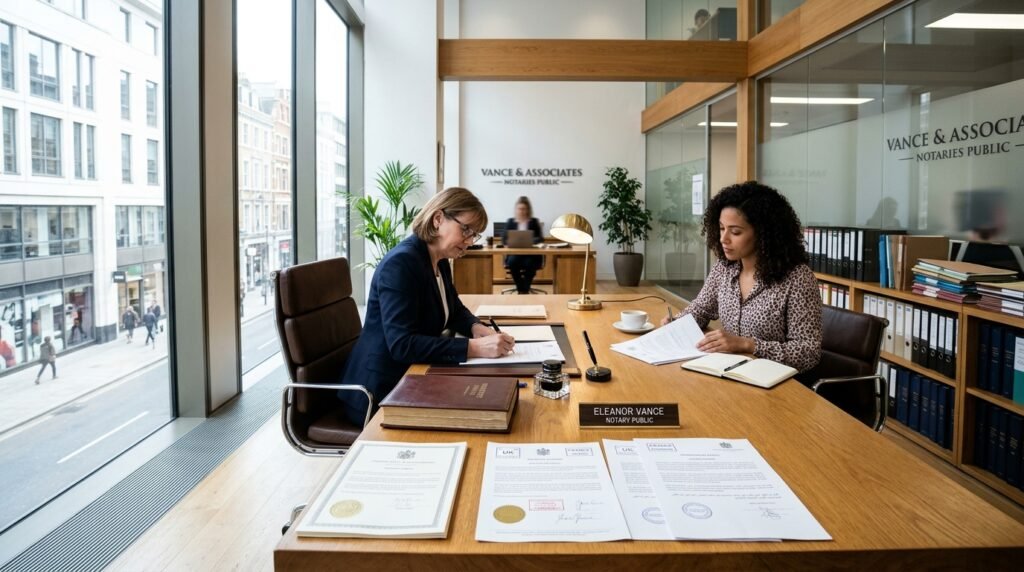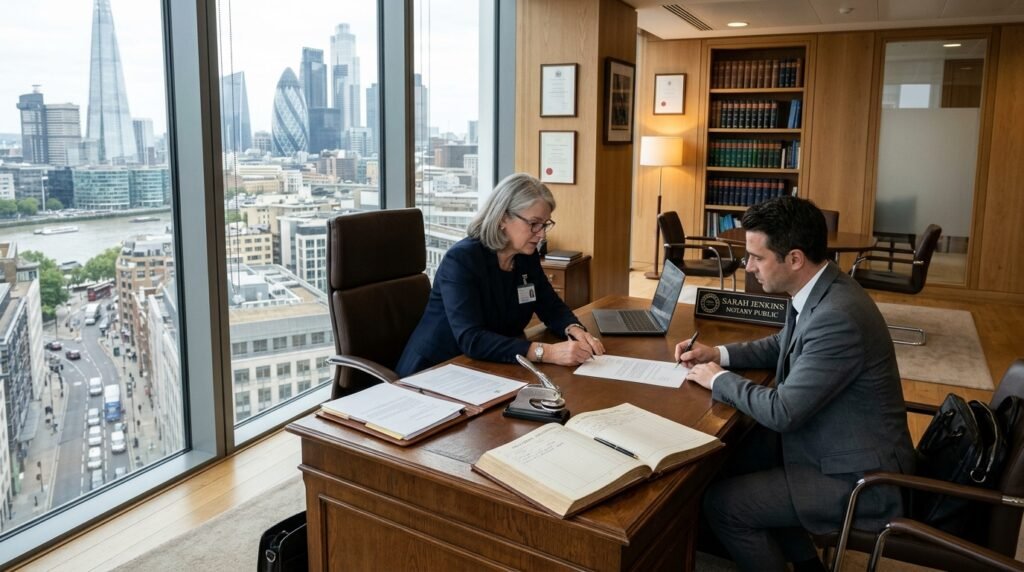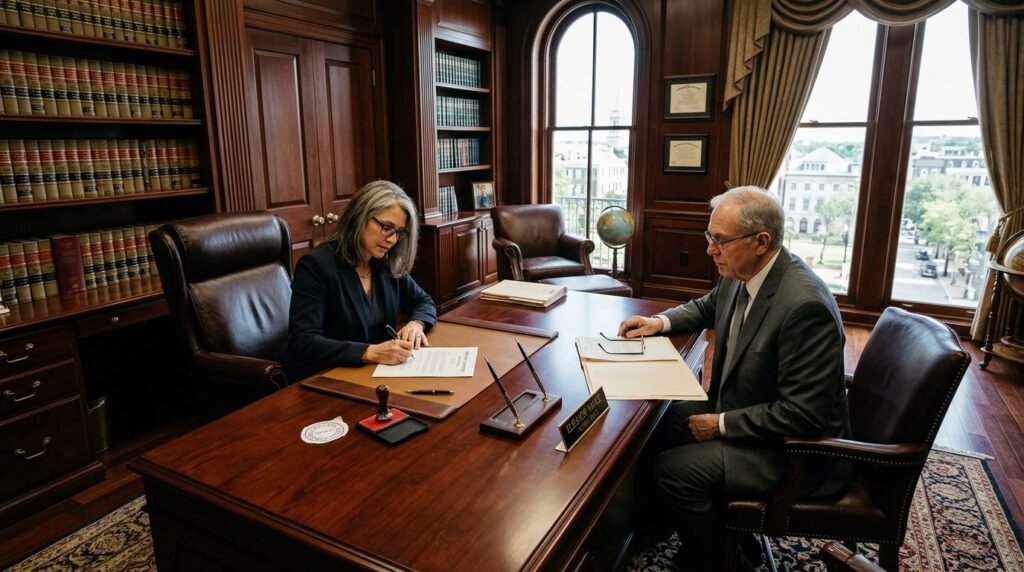
Someone hands you a document and says “get this notarized with a jurat.” Maybe it’s an affidavit for court, a sworn financial statement for your lender, or a declaration for an immigration case. You’re wondering: what is a jurat, exactly? Did you need to wait before signing? What happens when you sit down with the notary?
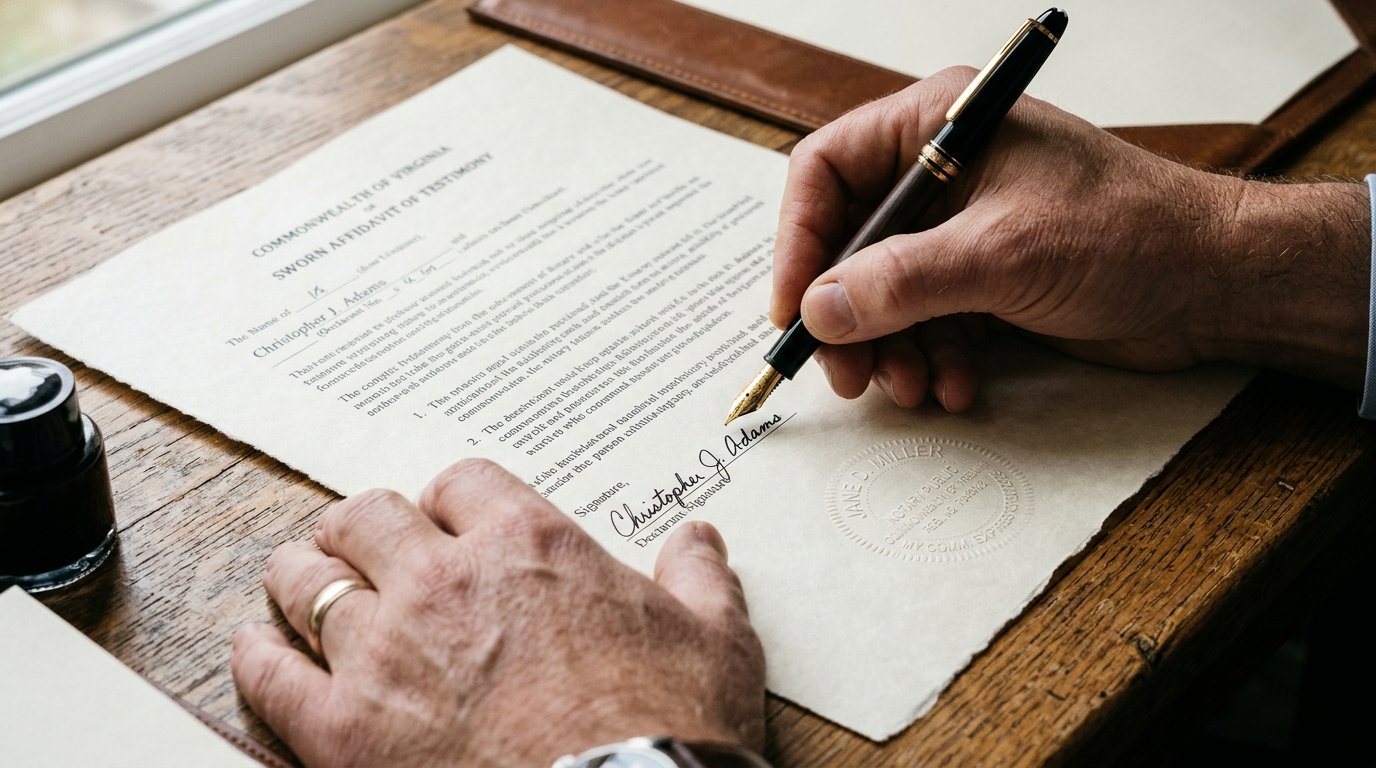
A jurat is the certificate a notary public completes after you appear in person, take an oath or affirmation that your statement is true, and sign the document right there in front of them. Cornell’s Legal Information Institute defines it as the officer’s certification that a sworn or affirmed statement was made before them. You’ll recognize it by wording along the lines of: “Subscribed and sworn to (or affirmed) before me on [date] by [name].”
The word comes from the Latin juratum, meaning “it has been sworn.” Merriam-Webster records its first known English use in 1796, though the practice of making statements under oath goes back much further. What matters today is simpler: a jurat isn’t just a stamp. It records a verbal ceremony where you personally committed, under penalty of perjury, to the truth of what that document says.
How a Jurat Actually Works
From your side of the table, a jurat follows a predictable sequence. Knowing the steps in advance prevents the most common headaches.
- Bring your document and valid ID. The notary needs to confirm your identity using government-issued photo identification. Do not sign the document before you arrive. For a jurat, signing must happen in the notary’s presence.
- The notary verifies your identity. They check your ID against the name on the document. If something doesn’t match (a middle name missing, a maiden name versus married name), this is where things stop until the discrepancy is resolved.
- You take an oath or affirmation. The notary will ask something like: “Do you solemnly swear that the statements in this document are true and correct?” You answer yes, out loud.
- You sign the document. Only now, after the oath, do you put your signature on the document while the notary watches.
- The notary completes the certificate. They fill in the jurat wording (venue, date, your name, their signature, and official seal), creating the official record of what just happened.
The whole thing takes a few minutes for a single document. What catches most people off guard is step three: the verbal oath. Nobody warns you about it, and then a notary is asking you to raise your right hand.
If the word “oath” makes you uncomfortable for religious or personal reasons, you have an option. An affirmation carries the same legal weight. The U.S. Department of State’s Foreign Affairs Manual offers both “swear” and “affirm” formulations and requires an affirmative response to either. The notary should ask which you prefer, or you can state your preference at the start. Either way, the verbal “yes” is what counts. A nod won’t do.
Jurat vs. Acknowledgment: Two Different Acts
This is the distinction that trips up most signers and even some notaries. Both are notarial acts. Both involve a notary, a seal, and your signature. But they serve different legal purposes and follow different rules.
| Jurat | Acknowledgment | |
|---|---|---|
| Purpose | You swear or affirm the document’s contents are true | You acknowledge that you signed the document voluntarily |
| Oath required? | Yes | No |
| Must you sign in front of the notary? | Yes | Not necessarily; you can bring a pre-signed document in many states |
| Common documents | Affidavits, sworn financial statements, court declarations | Deeds, powers of attorney, contracts |
| What the notary verifies | Your identity, your oath, and that you signed in their presence | Your identity and that you acknowledge the signature as yours |
The practical consequence: if your document needs a jurat and you walk in having already signed it, the notary cannot simply stamp it. Texas Secretary of State training materials make this explicit. For a jurat, the signature must be made in the notary’s presence after the oath. For an acknowledgment, a pre-signed document may be acceptable.
Not sure which act your document requires? Look at the notarial certificate wording printed on the document itself. “Sworn to before me” or “subscribed and sworn” points to a jurat. “Acknowledged before me” points to an acknowledgment. When there’s no pre-printed certificate, ask the person or institution requesting the document. A notary who is not also an attorney cannot choose the notarial act for you, because doing so crosses into legal advice.
Documents That Typically Need a Jurat
A jurat appears whenever the truthfulness of a document’s content matters legally, not just whether a particular person signed it. Common examples:
- Affidavits for court proceedings, insurance claims, or immigration petitions
- Sworn financial statements for loan applications or divorce cases
- Depositions and interrogatory answers
- Government compliance filings and regulatory affidavits
- Sworn statements for fraud investigations or contested insurance claims
How much does the distinction matter in practice? In a 2025 New York case, the Civil Court admitted insurer affidavits bearing “sworn to before me” jurat certificates and rejected arguments that they were defective for lacking acknowledgment-style language. The court drew a clean line: a jurat is judged by jurat standards, not acknowledgment standards. The affidavits stood, and the case was dismissed with prejudice.
The takeaway for you as a signer: the receiving party (court, lender, agency) determines which act your document needs. A properly completed jurat is not defective because it doesn’t resemble an acknowledgment.
Mistakes That Get Jurat Documents Rejected
Most rejections don’t stem from obscure legal problems. They come from simple procedural errors, all preventable.
Signing before you meet the notary
This is the single most common mistake. You receive the document at home, sign it at the kitchen table, then bring it to the notary expecting a stamp. For a jurat, that sequence doesn’t work. The signature must happen in the notary’s presence, after the oath. If you’ve already signed, the notary will need you to sign again, or the document may need to be reprinted entirely.
Bringing the wrong notarial certificate
Some documents come with pre-printed notarial wording at the bottom. If that wording says “acknowledged” but the receiving party requires a sworn statement, you have a mismatch. The notary performs the act described in the certificate. When the certificate doesn’t match what’s actually needed, the notary can typically attach a separate, correct certificate (called a loose certificate). But first, you need to know which act the receiving party requires.
Incomplete documents
California’s 2026 Notary Public Handbook prohibits notarizing an incomplete document. Florida follows the same principle. If your affidavit has blank fields, dates you haven’t filled in, or sections left empty, the notary should not proceed with documents containing missing information. Complete every required field before the appointment.
Mismatched names
The name on your ID must match the name on the document. If your ID reads “Roberto dos Santos” and the document reads “Robert Santos,” the notary may not be able to complete the act. Resolve name discrepancies with the document preparer before scheduling.
Can a Jurat Be Completed Online
In many states, yes. Remote Online Notarization (RON) allows a notary to perform notarial acts through a live, two-way audio-video session using regulated identity verification technology. A February 2026 National Notary Association report found that 48 states had adopted RON legislation by 2025, up from 22 at the start of the pandemic.
“Adopted” and “available” are different things, though. California signed AB 1977 into law in September 2026 but prohibits online notarial acts until the state’s required rules are finalized. Legislation and operational availability don’t always move at the same speed.
Florida has permitted RON since 2020. If you’re in Central Florida and the receiving party accepts remote notarization, an online jurat is a legitimate option. The oath still happens verbally (over video), you still sign (electronically), and the notary still completes the certificate. The ceremony doesn’t go away because the medium changed.
That said, an ordinary FaceTime or Zoom call is not RON. Remote notarization requires a compliant platform with credential analysis, identity proofing, session recording, and tamper-evident technology. And plenty of situations still call for in-person notarization: the receiving party may not accept remote notarization, or you may have original paper documents that can’t easily be converted.
Does Every Sworn Statement Need a Notarized Jurat
No. Federal law provides an alternative that eliminates the notary entirely for certain purposes. 28 U.S.C. § 1746 allows a signed, dated declaration under penalty of perjury to replace a sworn statement in many federal proceedings. The declaration must use specific language and include the date of execution.
Some state courts have moved in this direction too. New York expanded its rules in 2024 and 2025 to allow qualifying affirmations in place of notarized affidavits for many court filings.
But “sometimes” and “in some jurisdictions” are the operating words. If the institution requesting your document specifically asks for a notarized jurat, a self-declaration won’t satisfy them. Always confirm with the requesting party what they’ll accept before you schedule anything.
If your notarized document is headed overseas, you may also need an apostille from the Secretary of State to authenticate the notary’s signature and seal for international use. An apostille is a separate step from the jurat itself and doesn’t replace it.

Frequently Asked Questions
Is a jurat the same as getting a document notarized?
A jurat is one type of notarization. “Getting a document notarized” could mean a jurat, an acknowledgment, or another notarial act. The difference depends on whether you’re swearing to the truth of the contents (jurat) or acknowledging your signature (acknowledgment). The requesting party determines which act you need.
Can I sign at home and then bring the document to the notary?
Not for a jurat. You must sign in the notary’s presence after taking the oath or affirmation. If you’ve already signed, the notary will likely need you to sign again or you’ll need a new copy of the document. Wait to sign until you’re with the notary.
What happens if I lie on a document with a jurat?
You’re exposed to perjury charges. The oath places you under penalty of perjury, which is a criminal offense. The notary doesn’t verify whether your statements are factually true, but a court, agency, or opposing party can challenge them.
Does the notary check whether my document is accurate?
No. The notary confirms your identity, administers the oath, and watches you sign. They don’t review the document for factual accuracy or legal validity. California’s official jurat certificate includes a printed notice stating exactly this.
How long does a jurat appointment take?
For a single document, five to ten minutes once the notary has your ID and the document is complete. Time increases with additional documents or if name discrepancies or incomplete fields need to be resolved first.
Can a jurat be done through a regular video call?
No. Remote Online Notarization requires a compliant platform with identity verification, session recording, and tamper-evident technology. An ordinary video call on FaceTime, Zoom, or WhatsApp does not meet legal requirements. Florida permits RON through approved platforms, but the receiving party must also accept remotely notarized documents.
If you have a document that needs a jurat and you’re in Central Florida (Orange, Seminole, Osceola, or Brevard County), we come to you: home, office, hospital, wherever works. We speak English, Spanish, and Portuguese and are available 24/7. If your document is in a foreign language, we can help you understand notarization requirements for documents in other languages. Call or text us at (689) 285-5579 to check available time slots, and we’ll walk you through what to bring so nothing holds up your signing.