
You have a waiver in front of you. Maybe a liability release for a gym, a lien waiver from a contractor, or a form from a government agency. The question hits: does a waiver need to be notarized for it to actually count?
For most standard liability waivers, no. No law says a recreational activity release, event waiver, or fitness liability form must carry a notary seal to be valid. But “waiver” is a word that gets stuck on very different documents, and some of those documents absolutely do require notarization. The difference comes down to what kind of waiver you are holding, what state you are in, and whether anyone in the chain specifically required a notary.
We notarize documents across Central Florida every day, and this question comes up constantly. Here is what actually determines the answer.
The Default Rule for Standard Liability Waivers
A typical liability waiver (the kind you sign before a zip-line tour, at a CrossFit box, or ahead of a kids’ trampoline party) does not need notarization. The signature is the operative act. What gives the document legal weight is the clarity and specificity of the language: courts look for plain wording, unambiguous risk descriptions, and, in some states, an express reference to negligence.
A perfectly notarized waiver with vague terms can still be struck down. A well-drafted waiver without a notary stamp, signed in front of zero witnesses, can still hold up. The document’s substance controls enforceability. The notary’s role, when present, is limited to confirming identity and voluntary signing.
So if someone handed you a standard activity release and you are wondering whether you wasted your time by not finding a notary first: you almost certainly did not.
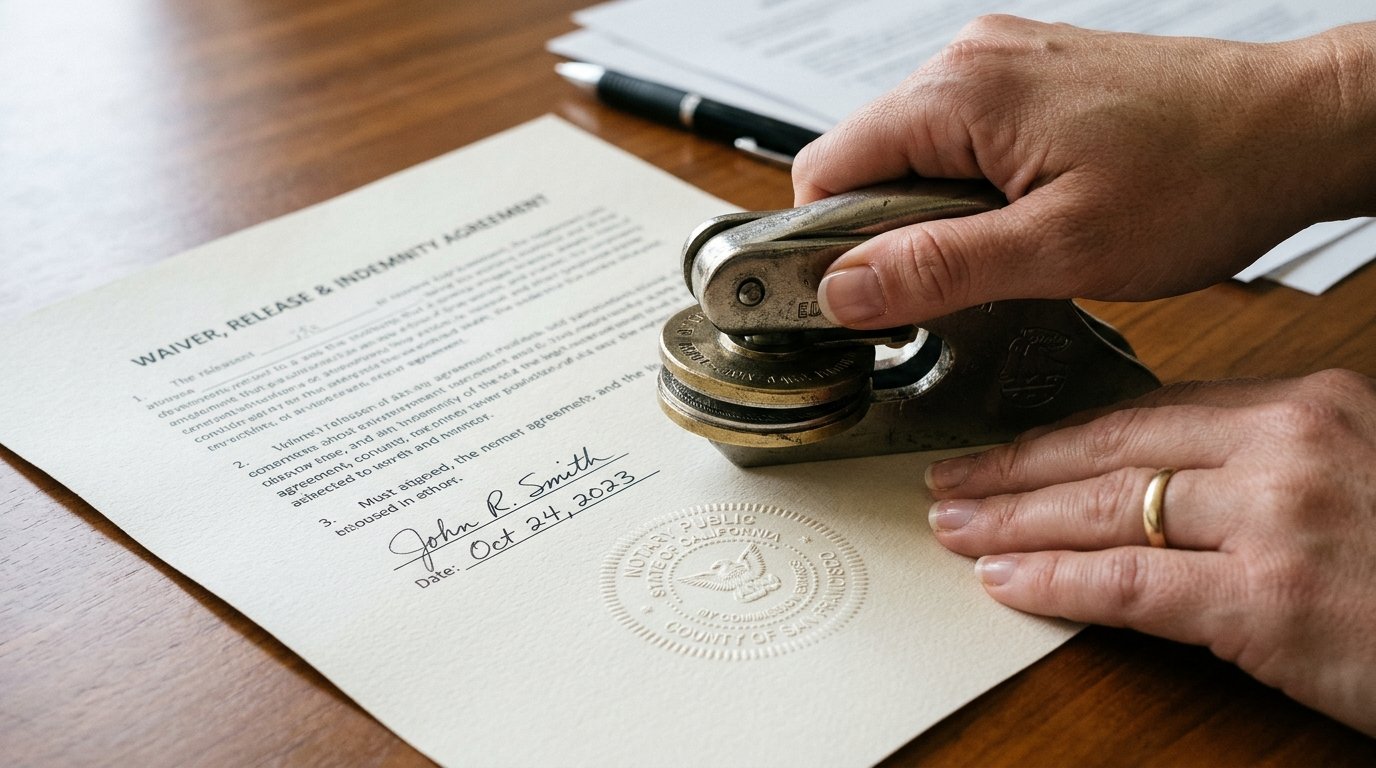
Not Every “Waiver” Is a Liability Release
This is where the confusion starts. People say “waiver” to mean at least half a dozen different documents, each governed by its own rules.
| Type of “waiver” | What it does | Notarization typically required? |
|---|---|---|
| Liability/activity release | Releases claims for injury during an activity | Usually no |
| Construction lien waiver | Releases a lien against property after payment | Depends on state form and recording rules |
| HIPAA authorization | Authorizes release of protected health information | No (per HHS) |
| Probate/estate waiver | Waives rights in an estate proceeding | Often yes, or sworn under oath |
| Settlement release | Releases legal claims in exchange for compensation | Only if the agreement requires it |
| Government/employment form | Authorizes background checks or releases agency liability | Sometimes (follow the agency’s printed instructions) |
Take HIPAA as an example. The Privacy Rule does not require that an authorization be notarized or include a witness signature. That comes directly from HHS. A provider might have their own intake forms, but the federal rule itself imposes no notary obligation. If you are specifically wondering whether a medical authorization needs to be notarized, the answer follows the same logic.
Construction lien waivers sit at the other end. In Florida, Chapter 713.20 provides statutory forms for progress-payment and final-payment lien waivers. Those prescribed forms do not include a notary block. But if the release or a related instrument needs to be recorded in county records, the recording office may require a notarial acknowledgment.
Before you spend time looking for a notary, figure out which category your document belongs to.
When a Waiver Does Need to Be Notarized
Several situations make notarization either legally required or necessary as a practical matter.
Documents going into public records present the clearest case. Property-related releases, deed modifications, and certain lien waivers that will be filed with a county clerk need a notarial acknowledgment. Texas law, for instance, requires a property instrument to be acknowledged, sworn to with a jurat, or proved according to law before it can be recorded.
Some forms come with a notary block already printed on them. Government agencies and courts create prescribed forms where the notary section is part of the document. If a notary block is on the form, treat it as mandatory. The Los Angeles County Sheriff’s Department, as one example, requires applicants to have their background-check waiver notarized as part of the hiring process.
Sworn statements are another trigger. If the document includes language like “sworn to and subscribed before me” or references an oath, it requires a notarial act called a jurat. This is different from an acknowledgment. With a jurat, the notary administers an oath and you are swearing under penalty of perjury that the contents are true.
Court orders and settlement agreements can also require notarization. In the 2025 Georgia case Wright v. Spearman, a party added a notarization condition to a proposed settlement release. The court treated that addition as a counteroffer rather than an acceptance of the original terms. If the original offer does not mention a notary, unilaterally adding one can change the entire agreement.
Finally, the requesting party may simply require it. An insurance company, lender, or employer can make notarization a contractual condition even when no statute demands it. Their authority comes from the agreement between you, not from notary law. If they say “get it notarized,” you usually need to comply to keep the process moving.
What Notarization Does to a Waiver (and What It Cannot Fix)
A notary public verifies that the person signing is who they claim to be and that they are signing voluntarily. That is the job. The notary does not review the document for legal accuracy, does not confirm that the terms are fair, and does not make a defective waiver enforceable.
This confusion works both ways. Some people assume their waiver is ironclad because a notary stamped it. Others panic because they signed one without a notary and think it means nothing.
Neither is true.
Notarization adds authentication. It creates an official record (complete with a journal entry and seal) proving that a specific person appeared, showed valid ID, and signed. That evidence becomes valuable when someone later says “I never signed that” or “my signature was forged.” But notarization cannot cure:
- Vague language a court would strike down
- Terms that violate state public policy
- Situations where the signer lacked mental capacity
- Fraud or misrepresentation about what the document actually does
Notarization locks the front door (identity and willingness). It says nothing about whether the building behind it was built to code.
State Law Can Override a Notary Seal
Even the most carefully notarized waiver is subject to the state law that governs it. And states have strong opinions about what people can and cannot waive.
New York General Obligations Law section 5-326 declares that negligence waivers from paid pools, gyms, and recreational facilities are void and unenforceable. The document is dead on arrival regardless of its notarization status. If you operate a fitness studio in New York and hand clients a negligence waiver, the notary seal does not change the outcome.
California’s Civil Code section 1668 takes a broader stance: contracts that exempt someone from responsibility for fraud, willful injury, or violation of law are against public policy. The state will not enforce them whether notarized or not.
In New Mexico, the Court of Appeals ruled in 2024 that state public policy allows a parent to sign a prospective-negligence waiver on behalf of a minor child. That is a New Mexico decision. A parent in another state may face different rules entirely.
Florida, where we work, follows its own framework for evaluating waivers and releases. We are not attorneys and cannot advise on whether your specific waiver will hold up in court. What we can tell you is that if your document needs a Florida notarization, we can handle it across Orange, Seminole, Osceola, and Brevard counties, often the same day you call.
E-Signatures, Witnesses, and Notarization Are Three Different Things
These terms are not interchangeable. Confusing them can mean your document fails to meet the actual requirement.
An electronic signature (typing your name in a box, clicking “I agree,” drawing with a stylus) records your intent to sign. The federal ESIGN Act says a signature or record cannot be denied legal effect solely because it is electronic, for most covered transactions. But ESIGN preserves other substantive requirements. If another law says the document must be notarized, an e-signature alone does not check that box.
A witness is a person who watches you sign and then signs the document confirming they observed the act. A witness is not a notary. Witnesses do not verify identity through government-issued ID, do not administer oaths, and do not hold a state commission.
Notarization, whether done in person or through a remote online notarization platform, is a formal act by a commissioned notary public. It includes identity verification, a journal entry, and an official seal. Remote online notarization (RON) laws now exist in nearly every state, expanding access significantly. But both the notary and the platform must be authorized for the specific state and type of notarial act.
When you look at your waiver, check the exact words. “Signed” is not “witnessed.” “Witnessed” is not “notarized.” Each word triggers a different procedure.
When Voluntary Notarization Makes Sense
Even when no law requires it, there are situations where paying a small notary fee now saves significant headaches later.
Consider notarizing a waiver voluntarily when the signer is a stranger and you want airtight proof of identity. Or when the financial exposure is large enough that any dispute will be worth litigating. Or when the signer is elderly, in poor health, or might later claim they were pressured or confused. A notary’s journal entry and seal create an independent, contemporaneous record that is very hard to challenge.
The cost is modest. The peace of mind can be substantial.
That said, do not add a notarization requirement to a document unless you are ready for the other party to treat it as a new term. As the Wright v. Spearman case showed, inserting a notary condition where the original offer did not include one was enough to derail the settlement entirely.
Practical Steps When Someone Tells You to Get It Notarized
If an employer, court, agency, or business hands you a waiver and says it must be notarized, here is what to do.
Read the document and find the notary block. It will say either “Acknowledgment” (you confirm your identity and that you signed voluntarily) or something like “Sworn to and subscribed before me” (you will take an oath that the contents are true). The notary needs to know which act to perform.
Do not sign the document before you see the notary, unless you are certain the act required is an acknowledgment and your state allows pre-signing for acknowledgments. For a jurat, you must sign in the notary’s presence after the oath is administered. When in doubt, wait.
Bring valid, unexpired photo ID. A driver’s license, state-issued ID, or passport works. Expired identification will be rejected.
Confirm how the finished document needs to be delivered. Some agencies want the original with a wet ink seal. Others accept a scanned copy. Know this before the appointment so you do not need a second trip.
Then schedule the notary. If you cannot get to an office during business hours, a mobile notary comes to you. We cover Orange, Seminole, Osceola, and Brevard counties and can typically meet the same day at your home, office, hospital, or any location that works.
If the form does not include a notary block but someone is verbally telling you it needs notarization, ask them to point you to the specific rule, statute, or written instruction. That saves everyone time and prevents an unnecessary expense.

Frequently Asked Questions
Does a gym or sports waiver need to be notarized?
Almost never. Standard liability releases for fitness centers, sports leagues, and adventure activities rely on a valid signature and clear language, not a notary seal. The only exception is if the facility’s own form includes a notary block, which is rare for recreational waivers.
Can a notarized waiver still be thrown out in court?
Yes. Notarization confirms identity, not legal validity. Courts can void waivers with vague language, overbroad terms, or provisions that violate state public policy. New York law, for example, makes certain paid recreational-facility negligence waivers unenforceable regardless of whether they carry a notary seal.
Is a witness the same as a notary?
No. A witness observes your signature but does not verify identity through government-issued ID, administer oaths, or hold a state commission. They serve different legal functions, and one does not substitute for the other unless the specific governing rule says so.
Does a HIPAA authorization need to be notarized?
No. HHS confirms the Privacy Rule does not require notarization or a witness for a HIPAA authorization. Individual healthcare providers may have their own intake forms, but the federal regulation itself imposes no notary requirement.
Do Florida construction lien waivers need notarization?
Florida’s statutory lien waiver forms under Chapter 713.20 do not include a notary block. However, if the waiver or a related instrument needs to be recorded in county records, the clerk’s office may require a notarial acknowledgment. Check with the specific recording office handling the filing.
Can I get a waiver notarized on short notice in Central Florida?
Yes. We are available 24/7 across Orange, Seminole, Osceola, and Brevard counties and can often meet the same day. Call or text (689) 285-5579 to check available time slots. We come to your home, office, hospital, or wherever is convenient, and we work in English, Spanish, and Portuguese.