You’re in an Orlando hotel room. A contract just landed in your inbox that needs a notarized signature by Friday. Or a title company told you the closing documents must be witnessed in person. Or your family back home needs a power of attorney signed before the week is out. You have no car, no local contacts, and the concierge has no idea where to find a notary.
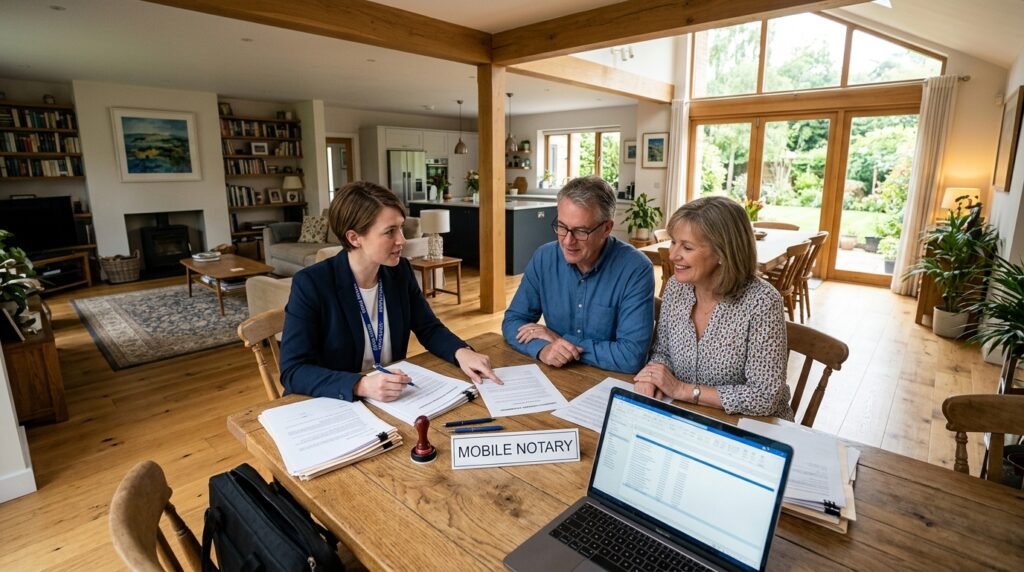
A mobile notary at your hotel solves this in about 30 minutes. The notary drives to your location, verifies your identity, watches you sign (or administers an oath), completes the notarial certificate, and leaves. Same legal standing as visiting a brick-and-mortar notary office. No rental car, no GPS roulette, no wasted afternoon.
But “simple” does not mean “nothing to prepare.” A few details handled beforehand make the difference between a clean signing and a wasted trip for everyone involved.
Why Hotel Guests Call a Mobile Notary
Orlando draws tens of millions of visitors every year. Convention attendees, theme-park families, international travelers, snowbirds passing through, real estate investors scouting properties. Documents don’t pause because you left your home state.
The calls we take from hotel guests tend to cluster around a few situations:
- A real estate closing that can’t wait: a purchase, refinance, or home equity line where the signing agent needs to witness the borrower’s signature in person.
- A power of attorney for a sick parent, an overseas relative, or a spouse who needs someone authorized to handle finances or medical decisions.
- Business acknowledgments, affidavits, or sworn statements tied to a deal with a hard deadline.
- Documents headed to another country that need notarization before apostille certification under the Hague Convention.
- Estate planning documents (living trusts, healthcare directives) finalized during a family trip when everyone happens to be in one place.
The National Notary Association estimated 4.4 million commissioned notaries in the U.S. as of its 2022 census. Not all of them travel. A mobile notary does. In every case, the job is the same: confirm your identity, confirm you’re signing willingly, and complete the correct notarial act (acknowledgment, jurat, oath, or copy certification). The hotel is just the address.
Where to Meet: Lobby, Business Center, or Room
Not every hotel room makes a good signing location. You need a flat surface, decent lighting, and enough quiet for a short conversation. You also need the hotel to let the notary in. Three options, ranked by practicality.
The hotel business center is often the best choice. It has a table, chairs, good lighting, usually a printer if you need to produce a document from email, and it’s a common area. The notary walks in without a room key or escort. Most Orlando convention hotels and International Drive properties have one. This setup is similar to arranging a mobile notary at your office, where a professional environment facilitates the process.
The lobby works when the business center is closed, full, or nonexistent. Pick a quieter corner away from check-in traffic. The notary needs enough surface space to lay out documents, apply a seal, and have you sign without elbows bumping. For a quick, single-page acknowledgment, a lobby table is fine. For a 40-page loan closing package, less so.
Your room offers the most privacy, which matters for sensitive documents like a power of attorney, trust agreement, or healthcare directive. This privacy advantage makes hotel rooms function much like mobile notary appointments at home, where discretion is paramount. But hotel visitor policies vary. Some properties require the guest to meet the visitor downstairs. Disney-area resorts, gated properties near Universal, and large convention hotels each run their own protocols. Call the front desk beforehand (more on that below). If room access gets complicated and privacy matters, ask the hotel whether a small meeting room is available for an hour. Many business-oriented hotels offer this at no charge or a modest fee.
What to Have Ready Before the Notary Arrives
A mobile notary can’t fix a missing ID or an incomplete document at the door. Twenty minutes of preparation on your end saves everyone’s time.
Bring a valid, government-issued photo ID. Florida law requires the notary to verify your identity through acceptable identification. A current driver’s license, state-issued ID card, U.S. passport, or military ID with a photograph all work. An expired license does not. A hotel key card does not. If you’re a foreign national, your current unexpired passport with a photograph will usually satisfy the requirement, but confirm with the notary in advance. Identity verification is not optional. A 2025 Virginia study found that digital forgeries accounted for over 57% of document fraud cases in its dataset. That’s why notaries can’t cut corners on identification, regardless of setting.
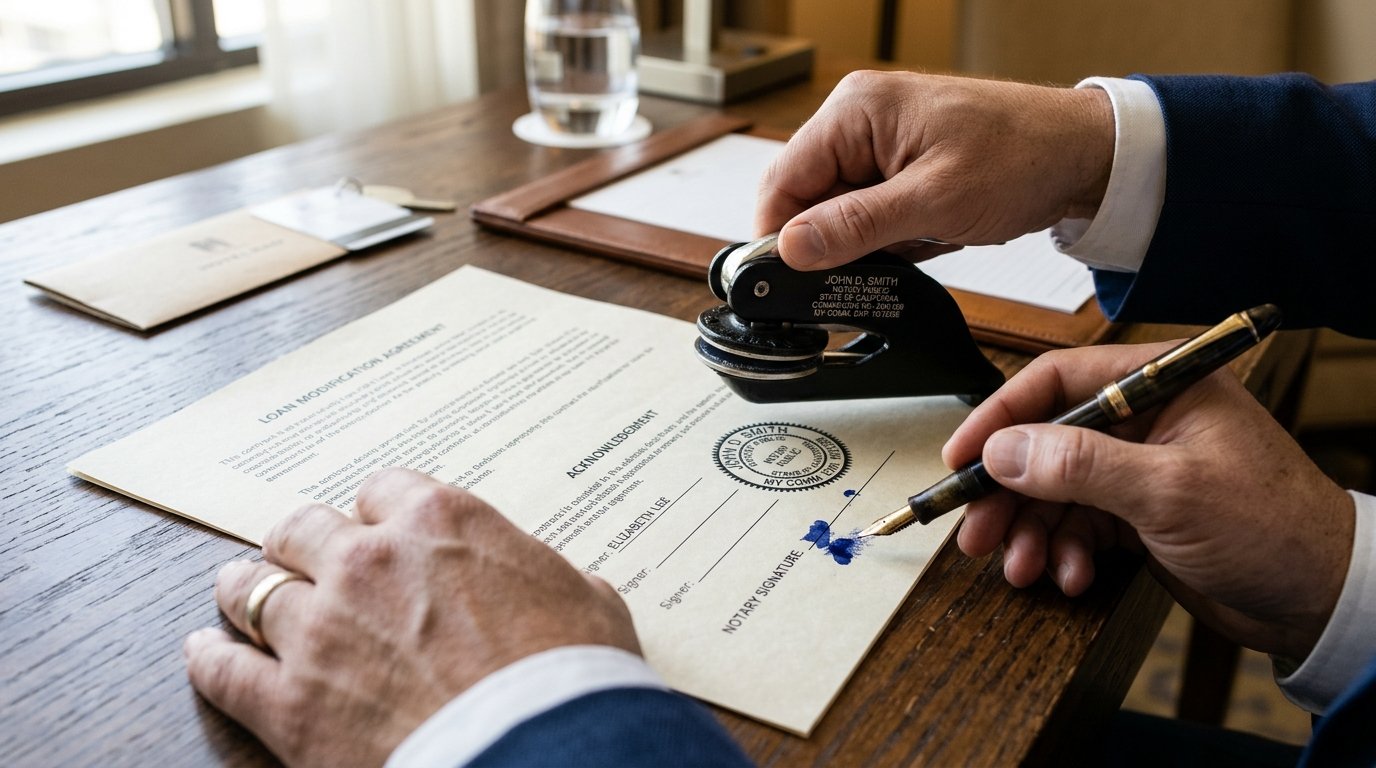
Have the document ready, but think before you sign it. If the notarial act is a jurat (the notary watches you sign and you take an oath), do not sign ahead of time. The notary needs to see you put pen to paper. If it’s an acknowledgment (you confirm to the notary that you already signed the document), you may have signed earlier. Not sure which one your document calls for? Look at the certificate language near the bottom of the last page. The words “subscribed and sworn” point to a jurat. “Acknowledged before me” points to an acknowledgment. When in doubt, leave the signature line blank until the notary is present.
If your document arrived as a PDF in your email, you need a paper copy. Most Orlando hotel business centers charge somewhere between $0.25 and $1.00 per page. Some charge more. Check the rate before the appointment. If the printer is broken or the price is steep, FedEx Office and UPS Store locations are within a few miles of most Orlando hotel corridors. We’ve also seen guests print a few pages at the front desk for a small fee. Whatever route you choose, have the physical, printed document in hand before the notary arrives. A notary cannot stamp a PDF on your phone screen.
Check whether your document requires witnesses. Most notarized documents in Florida do not require additional witnesses, but some do. A Florida last will and testament, for example, needs two. If you’re traveling alone and witnesses are required, ask the notary when you book. Many mobile notaries can bring a witness. Don’t assume the hotel bellhop will volunteer.
If more than one person is signing, every signer needs their own valid ID and must be physically present. The notary verifies each signer individually. One person cannot sign on another’s behalf unless a properly executed power of attorney authorizes it.
Getting Your Notary Past the Front Desk
Hotels exist to control who enters the building, especially above the lobby level. A notary showing up unannounced and asking for your room number will likely be stopped. Major chains direct guests to check each property’s individual visitor policies, which means there’s no universal rule to rely on.
What works: call the front desk before the appointment. Say something like, “I have a professional visitor arriving at 2 p.m. for a document signing. Their name is [name]. Please allow them access to my room, or I’ll meet them in the lobby.” Most hotels handle this the same way they’d handle a visiting colleague or a courier delivery. For resort properties with gated entrances (common around the Disney and Universal areas), give the notary the resort name, building number, and any gate code or parking instructions in advance. A 10-minute delay at a security checkpoint can derail a tight schedule.
If the hotel won’t allow an outside visitor upstairs, shift to the lobby or business center without worry. The notarization is equally valid in any of those locations. Where you sign doesn’t change the legal weight of the act.
What a Hotel Notary Visit Costs
Two separate charges usually make up the total: the notarial act fee and the travel (or convenience) fee.
In Florida, the statutory maximum for a traditional in-person notarial act is $10 per signature notarized. That’s the state-regulated cap for the notarial act itself. For a single-signature acknowledgment, the regulated portion is modest.
The travel fee is where the real cost sits. A mobile notary is driving to your location, often on short notice, sometimes at night or on a weekend. Travel fee rules differ by state: some states set limits, some require mileage-based calculations, and others (including Florida) leave the travel fee to agreement between the notary and the client. The practical takeaway: get a written, all-in quote before confirming the appointment. Ask for the total, including travel, the notarial act, and any after-hours or rush surcharge. If there’s a cancellation policy, know that too. No surprises at the door.
For context, a straightforward mobile notary visit in Central Florida for one or two signatures typically costs far less than the time and stress of hunting for an unfamiliar notary office across town. Multi-document signings, full loan closing packages, or urgent after-midnight calls will run higher. Always confirm the number before anyone gets in a car.
Special Situations: Apostille, Power of Attorney, Loan Closings
Some hotel notary calls go beyond a single signature on one page.
If your document is headed to a country that participates in the Hague Convention, it likely needs an apostille from the Florida Secretary of State after notarization. Notarization is step one. The apostille is step two, processed through the Secretary of State’s office in Tallahassee (the only such office in Florida). Filing directly with the state costs $10 per document, but you’ll need to mail it or drive to Tallahassee yourself. A mobile notary service that handles the full process (notarization, courier to Tallahassee, return delivery) typically charges $200 to $280 per document, with turnaround as fast as five days.
A power of attorney signing may require witnesses, specific statutory language, and (depending on the type) recording with the county clerk. A typical POA signing runs 20 to 45 minutes depending on the number of pages and whether it’s a general, limited, or durable POA. If the person granting authority is in a hospital near your hotel rather than in the hotel itself, the notary can meet you there instead. We handle POA signings at hospitals, hotels, and homes across Orange, Seminole, Osceola, and Brevard counties.
Mortgage closings require a notary signing agent, not just a notary public. A signing agent is trained to walk borrowers through the lender’s loan package, confirm every page is signed and initialed correctly, and return the documents to the title company or lender within tight deadlines. If you’re closing on a Central Florida property while staying at an Orlando hotel, make sure the notary you book has signing agent experience and understands lender instructions. This is different work from notarizing a single affidavit.
Foreign nationals visiting the U.S. should confirm with the notary that their passport meets the acceptable identification requirements under Florida law before scheduling the appointment. Most current, unexpired foreign passports with a photograph will satisfy the requirement. Do not assume. Ask.

Frequently Asked Questions
Can a notary legally notarize a document in a hotel room?
Yes. A Florida notary public can perform notarial acts anywhere within the state. The hotel room, lobby, or business center is simply the meeting address. The notarization carries the same legal weight as one performed in a traditional office. The only logistical issue is whether the hotel grants the notary access to your room.
What if I need to print a document at the hotel?
Check the hotel business center first. Page rates vary. If the price is high or the printer is out of service, FedEx Office and UPS Store locations are usually within a few miles. Have the printed, unsigned document ready before the notary arrives. Notarization requires a physical document, not a file on a screen.
Do I need a witness for notarization in Florida?
Not for most documents. Witnessing is required for certain instruments under Florida law, such as wills. If your document needs witnesses and you’re traveling alone, ask your mobile notary at the time of booking. Many can bring a witness along.
How fast can a mobile notary get to my Orlando hotel?
Same-day appointments are common in the Orlando area, and some providers can arrive within a couple of hours. For after-hours, weekend, or holiday requests, call or text as early as possible to check availability. The sooner you reach out, the more scheduling options you’ll have.
Can I use remote online notarization instead of an in-person visit?
Florida authorizes remote online notarization (RON), which connects you to a notary by audio-video call. 47 states and the District of Columbia now have laws permitting remote online notarization. RON works for many document types, but not all recipients accept electronically notarized documents. Check with the party receiving the document before choosing RON over a physical appointment.
What happens if I don’t have valid ID at the appointment?
The notary cannot complete the notarization. Florida law requires satisfactory evidence of identity, meaning a current, government-issued photo ID. Without it, the appointment must be rescheduled. There is no workaround at the door, so double-check your ID before the notary arrives.
If you’re staying at a hotel anywhere in Orange, Seminole, Osceola, or Brevard County and need a document notarized, we come to you. Call or text (689) 285-5579 to check available time slots. We work in English, Spanish, and Portuguese, and we’re reachable 24/7.