Your attorney just emailed a document that needs notarization before end of business. You have meetings stacked until four. You are not driving across town for a stamp. You need a mobile notary at your office, and you need to know what to have ready before they walk through the door.
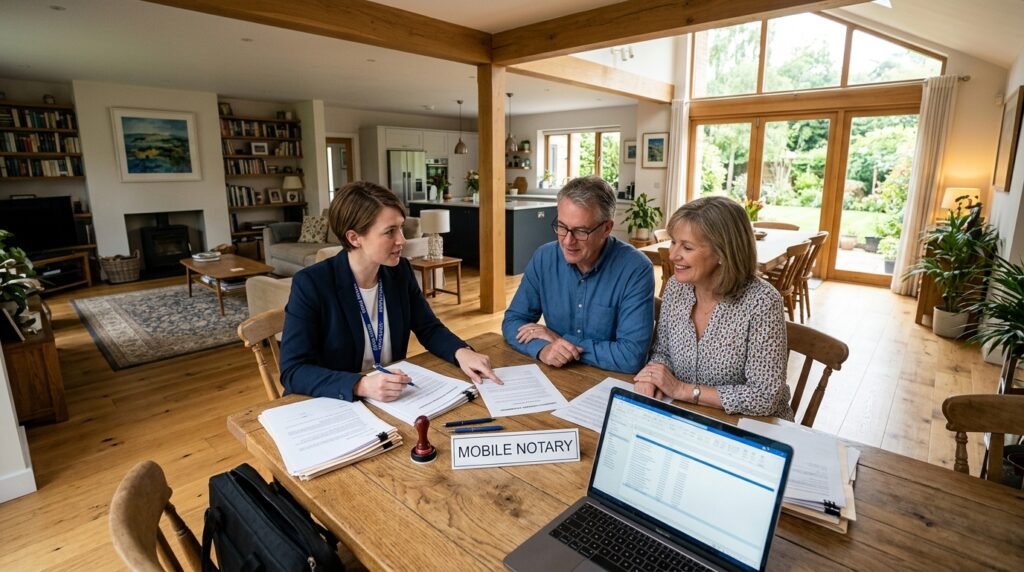
That is exactly what we do. We come to you (your desk, your conference room, even your lobby), notarize the document, and leave you to your day. Whether you need a mobile notary at home or at the office, the seal carries the same legal authority as one stamped at a bank branch. The only thing that changes is who does the driving.
A smooth visit depends on a little preparation. Here is what to expect, what to have ready, and what the whole thing costs.
How the Visit Works, Step by Step
The process is simpler than most people expect:
- You call or text us with the basics: what document needs notarization, how many signers, and your deadline. For a loan closing, mention the lender and loan type so we can confirm whether a notary signing agent is needed.
- We confirm details and schedule a time. We will ask about your office address, building access (badge, lobby check-in, parking), and whether the document requires witnesses.
- We arrive at the agreed time with our commission, seal, notary journal, and any supplies the appointment requires. For loan signings, we bring the document package from the title company or lender.
- Every signer presents valid, government-issued photo ID. We verify that the name on the ID matches the name on the document.
- The notarial act happens. If the document calls for an acknowledgment, you confirm the signature is yours and that you signed voluntarily. If it calls for a jurat, you sign in front of us and take an oath or affirmation that the contents are true. We complete the certificate, stamp the seal, and record the transaction in our journal.
- Done. Standard notarizations take 15 to 30 minutes. Loan closing packages with 100-plus pages run 45 minutes to an hour.
No waiting room. No leaving your building.

What to Have Ready Before the Notary Arrives
Most appointment delays happen because something was missing that could have been sorted out in five minutes the day before. Here is the checklist:
- Print the complete document with every field filled in. The NNA’s employer guide warns against notarizing documents with blank spaces, because those blanks can be filled in after the fact without the signer’s knowledge. If you are not sure what goes in a field, ask the attorney or document preparer, not the notary. We are not licensed to practice law or help complete legal forms.
- Have valid photo ID ready for every signer. A current driver’s license, passport, or state-issued ID card works. Expired IDs do not. If a signer’s legal name has changed since the ID was issued, that needs to be resolved before the appointment.
- Make sure every signer will be physically present. A notary cannot notarize a signature without the signer in the room. A coworker cannot sign on someone’s behalf unless they hold a properly executed power of attorney and the document allows it.
- Arrange witnesses if the document requires them. Certain instruments (some powers of attorney, healthcare directives, real estate documents) need one or two witnesses in addition to the notary. Check with your document preparer. If you need us to provide a witness, mention that when scheduling.
- Set aside a quiet, private space. A conference room or closed office with a table is ideal. Notarization involves sworn oaths and identity verification with sensitive personal information. An open-plan hallway is not the right setting for that.
If every signer has their ID, the document is complete, and you have a table and two chairs, you are ready.
Common Documents Notarized at the Office
Nearly anything that requires a notary’s seal can be handled at your workplace. Here is what we see most from office visits in Central Florida.
Loan closings and refinances are the most common reason a notary signing agent shows up at an office. The signing agent walks the borrower through the closing package page by page, notarizes the required signatures, and returns the completed documents to the title company. Whether it is a purchase, refinance, HELOC, VA loan, or FHA loan, the process follows the lender’s instructions.
Powers of attorney come up constantly, especially before international travel or when a relative needs someone to manage their affairs. A general, limited, or durable power of attorney almost always requires notarization. A typical POA signing takes 20 to 45 minutes depending on the document’s length.
Affidavits and sworn statements require a jurat: you take an oath or affirmation and sign in front of the notary. These are common in litigation, insurance claims, and immigration proceedings.
Real estate documents beyond closings (deeds, title transfers, lien releases, seller packages) often need an acknowledgment rather than a jurat. Real estate agents and property managers who schedule a mobile notary to their office save their clients a separate trip.
Business formation and governance documents round out the list: operating agreements, corporate resolutions, partnership agreements. If your company notarizes documents regularly, building a recurring schedule eliminates the scramble each time.
Documents bound for an apostille also start at the notary’s seal. If a document is going abroad to a country that participates in the Hague Convention, the Florida Secretary of State must issue an apostille to authenticate it. We handle the notarization and can also manage the apostille filing, courier to Tallahassee, and return delivery.
What It Costs
The total price has two components: the notarial fee and the travel fee.
Florida caps the notarial fee at $10 per notarial act. That is the statutory maximum whether the notary works from a bank counter or your conference room.
The travel fee is separate. It covers the notary’s drive to your location, the time reserved for your appointment, and any waiting. Travel fee rules vary by state; in Florida, the travel charge is a matter of agreement between you and the notary rather than a fixed statutory limit. Our recommendation: ask for the total price before confirming the appointment. You should know the full cost before we arrive.
For loan closings, the signing agent fee is typically set by the title company or lender. It covers the entire package: document walkthrough, notarization, printing, and return shipping. These fees range depending on loan type, page count, and complexity.
If you are scheduling multiple notarizations in one visit (say, four employees each signing a separate affidavit), bundling into one appointment usually costs less per person than booking four separate trips. One travel fee covers the lot.
Batching Multiple Signers in One Visit
Offices with recurring notary needs save real money by batching. An HR department processing employment documents, a law firm notarizing client affidavits, or a property management company handling lease signings can all stack several signers into a single appointment block.
The legal requirements stay the same whether there is one signer or ten. Each person still needs to personally appear, present their own valid ID, and complete their own notarial act. One person cannot take an oath on behalf of another. But from a logistics standpoint, grouping everyone into a two-hour window means one trip instead of five.
A few things to coordinate on your end: confirm that every signer can be available during the appointment window, and have a backup plan if someone gets pulled into an unexpected call. We can notarize in any order, so the schedule can flex as long as each signer shows up with ID.
If your office has a regular cadence of notarization (monthly closings, quarterly board resolutions, ongoing real estate transactions), let us know when you call. We can set a recurring schedule so you always have a notary on your calendar.
When Remote Online Notarization Works Instead
Florida permits remote online notarization (RON), where the signer and notary connect through a secure video platform instead of meeting face to face. Most states now have some form of remote notarization law, though implementation rules and timelines vary.
RON is a good fit when the signer is in another city, state, or country and cannot physically be at the office. It also works well when the receiving institution accepts remotely notarized documents and the document does not require a wet ink signature on original paper.
It is not always a replacement for an in-person visit. Some title companies still require physical original documents. Some government agencies reject electronically notarized forms. Before choosing remote over mobile, check with whoever will receive the finished document.
We offer both in-person and remote options. If you are not sure which fits your situation, call or text and we will help you decide based on the specific document and its destination.
Whether you need a single acknowledgment or a full loan closing package, the process starts the same way: call or text us at (689) 285-5579 with the document details and your preferred time. We are available 24/7 across Orange, Seminole, Osceola, and Brevard counties, and we work in English, Spanish, and Portuguese. We will confirm the total cost, the time slot, and everything you need to have ready so the visit goes right the first time.

Frequently Asked Questions
Can a mobile notary come to any type of office?
Yes. We notarize in corporate offices, home offices, co-working spaces, medical practices, and job sites. If your building requires a visitor badge or security screening, let us know when scheduling so we arrive with enough lead time to clear access.
What if a signer forgot their ID?
We cannot complete that signer’s notarization without valid government-issued photo ID. Florida law requires it. We can still notarize documents for other signers who have their identification and return for the remaining person at a later time.
Do I sign before or during the appointment?
It depends on the notarial act. A jurat requires you to sign in the notary’s presence after taking an oath or affirmation. An acknowledgment allows a previously executed signature, but you still must personally appear and confirm it is yours. Safest approach: wait to sign until the notary tells you when.
Can you notarize documents in Spanish or Portuguese?
Yes. We communicate directly with signers in English, Spanish, and Portuguese. The notary must be able to verify the signer’s willingness and understanding, so direct communication in the signer’s language matters.
How far in advance should I schedule?
Same-day appointments are often possible, especially in the Orlando metro area. For loan closings, we typically receive the document package from the title company one to two days before closing. If you need a mobile notary after hours, we offer 24/7 availability. The sooner you reach out, the more flexibility we have with time slots.
What areas do you cover for office visits?
We serve Orange, Seminole, Osceola, and Brevard counties in Central Florida. Orlando, Kissimmee, Sanford, Altamonte Springs, Melbourne, and everywhere in between. Call or text (689) 285-5579 to check availability for your location.