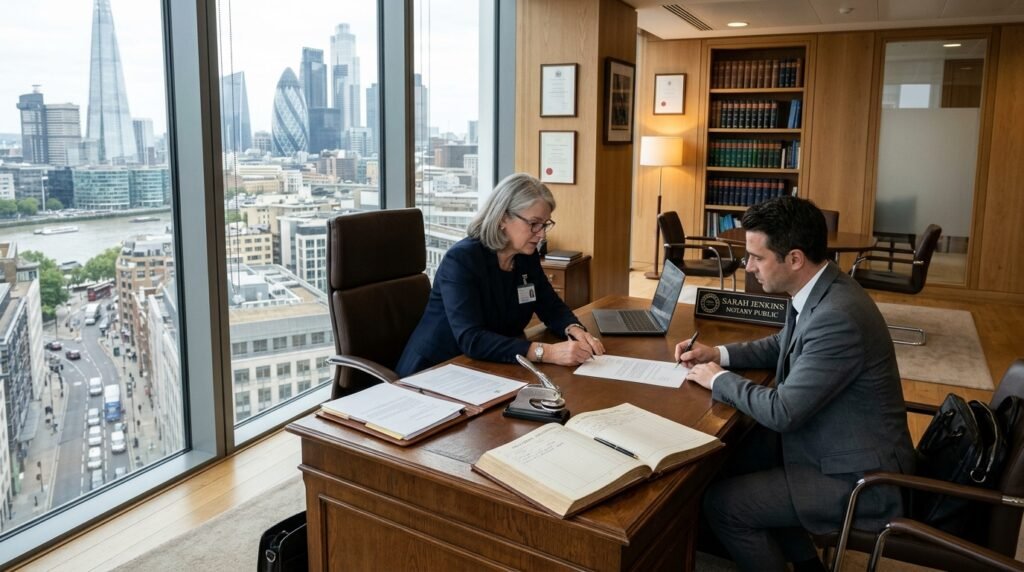
Someone told you your document needs to be “signed by a notary.” Maybe it was a title company, a lender, a consulate overseas, or the instructions printed on the form itself. You have the document. You’re ready to sign. But what does that phrase actually mean, what does the notary’s signature prove, and what happens if you get the process wrong?
Here’s the short version: when a document is signed by a notary, the notary isn’t endorsing what the document says. The notary is certifying that a specific person appeared, showed proper identification, and either acknowledged a signature or signed under oath. That distinction matters more than most people realize, and misunderstanding it is where problems start.
We notarize documents across Orange, Seminole, Osceola, and Brevard counties every day, and the questions below come up at nearly every appointment. This guide walks through what a notary’s signature actually does, how to prepare, and where things go wrong.
Two Signatures, Two Different Jobs
Every notarized document carries at least two signatures: yours and the notary’s. They do completely different things.
Your signature binds you to the document’s contents, whether that’s a deed transferring property, a power of attorney granting authority to someone else, or an affidavit stating facts under oath.
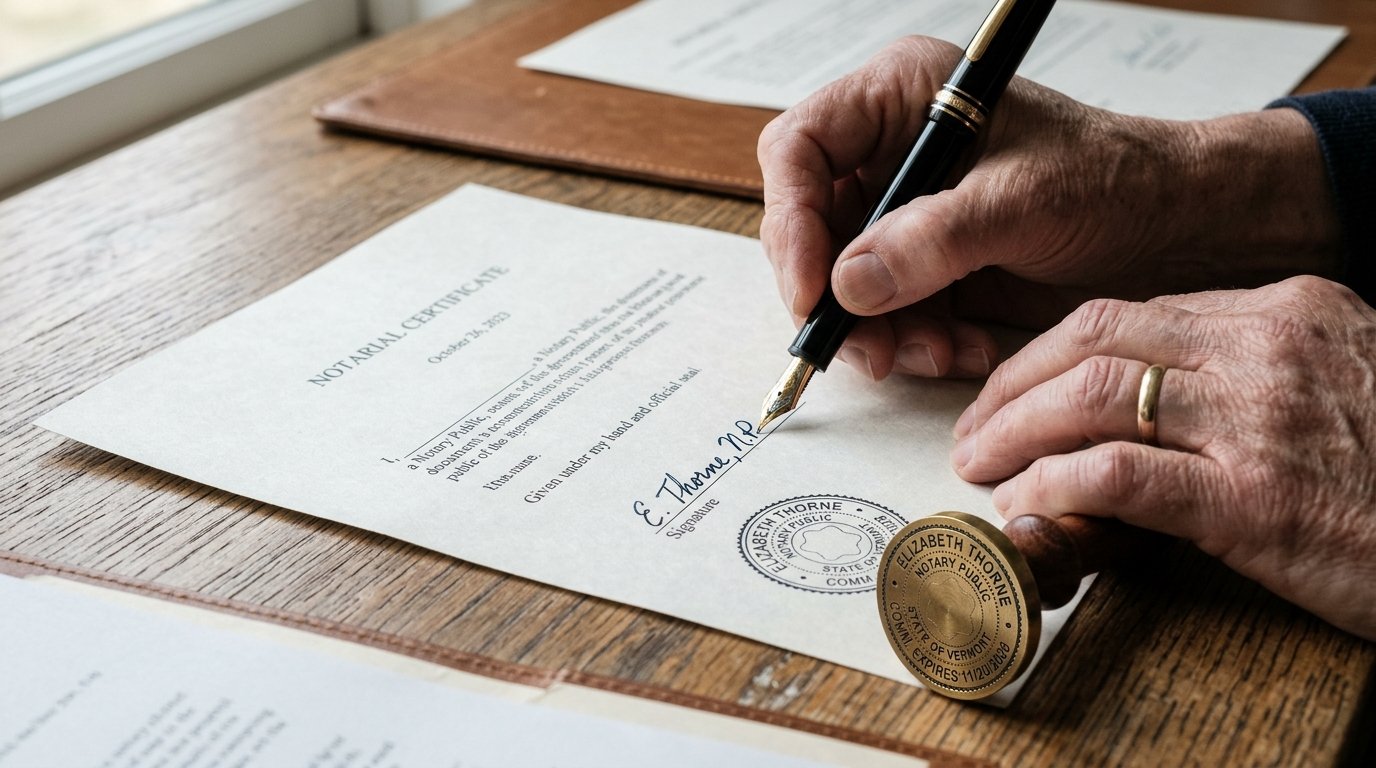
The notary’s signature goes on the notarial certificate, a block of official wording attached to or printed within the document. That certificate confirms the notary verified your identity, checked that you were signing voluntarily, and performed a specific official act. The California Secretary of State’s notary handbook states plainly that the notary’s certificate does not verify the truthfulness, accuracy, or validity of the document. Florida’s rules work the same way.
This means a notarized contract isn’t automatically enforceable. A notarized affidavit isn’t automatically true. The notary’s seal confirms identity and procedure, not substance. Courts, banks, and government agencies rely on that procedural confirmation, but the contents of your document remain your responsibility (and, when needed, your attorney’s).
So when someone says a document was “signed by a notary,” what actually happened is the notary signed the certificate. That certificate is proof of process. Nothing more, nothing less.
Acknowledgment vs. Jurat: The Rule That Catches People Off Guard
Not every notarization works the same way. The two most common notarial acts are acknowledgments and jurats, and they have different rules about when and how you sign.
Acknowledgment
With an acknowledgment, you appear before the notary, prove your identity, and confirm that you signed the document willingly for its intended purpose. The key detail: you can sign the document before the appointment. You still need to be physically present to acknowledge the signature, but the notary doesn’t need to watch you put pen to paper.
Real estate deeds, mortgage documents, and many powers of attorney typically use acknowledgments.
Jurat
A jurat is stricter. You must sign the document in the notary’s presence, and you must take an oath or affirmation that the contents are true. If you already signed before the appointment, the notary will ask you to sign again. Showing up with a pre-signed affidavit that requires a jurat means starting that signature over.
Affidavits, sworn statements, and certain court filings commonly require jurats.
How do you know which one you need?
Look at the document. Many forms include the notarial wording already printed at the bottom. If you see “subscribed and sworn before me,” that’s a jurat: don’t sign until you’re with the notary. If you see “acknowledged before me,” that’s an acknowledgment, and you can sign ahead of time (though you’ll still need to appear in person).
If there’s no notarial wording on the document, the notary can attach the correct certificate. But the notary can’t decide for you which act is appropriate, because that depends on the document’s purpose and the recipient’s requirements. When in doubt, call the entity requesting the notarization and ask before your appointment.
What to Bring to Your Notary Appointment
The appointment itself is straightforward when you arrive prepared. Knowing the requirements to notarize a document is what separates a five-minute visit from a wasted trip, so bring these three things.
First, a valid government-issued photo ID. In Florida, a current driver’s license, passport, or state ID card works. An expired ID still qualifies only if it was issued within the past five years. If your name has changed since the ID was issued (through marriage, divorce, or a court order), bring supporting documentation. The notary’s first job is confirming you are who the document says you are.
Second, the complete document. Every page, including exhibits and attachments. Don’t bring page 14 of a 20-page agreement. The notary needs to see what they’re certifying. If the document requires witnesses in addition to notarization, arrange for those witnesses to be present at the appointment.
Third, any instructions from the recipient. A title company, lender, consulate, or court may have specific requirements about the type of notarial act, the number of witnesses, or additional forms that must be included. The notary follows procedure. The recipient sets the rules for what they’ll accept.
If you’re completing a power of attorney, expect the signing to take anywhere from 20 to 45 minutes depending on the number of pages and complexity of the document.
Documents That Commonly Need a Notary’s Signature
Almost every significant life transaction eventually involves a notary public. Here are the ones we see most often in Central Florida:
- Real estate closings. Deeds, mortgage documents, closing disclosures, and title transfers. A notary signing agent handles these on behalf of a title company or lender, guiding signers through document packages that can run over a hundred pages. Purchases, refinances, VA loans, FHA loans: all follow the same basic notarization process.
- Powers of attorney. General, limited, and durable. These grant someone else the authority to act on your behalf for financial decisions, healthcare, or a specific transaction while you’re out of the country or unable to appear in person.
- Affidavits and sworn statements. Used in court proceedings, insurance claims, immigration cases, and business filings. These require a jurat because the signer is swearing to the truth of the contents under oath.
- Trust documents. Living trusts, trust amendments, and trust certifications commonly require notarized signatures.
- Travel consent forms. When a minor travels internationally with one parent, the other parent often needs to provide a notarized consent. The State Department’s Form DS-3053 for passport consent specifically instructs the consenting parent not to sign until the passport-authorizing officer or notary requests it. This is one form you never sign at home first.
- Vehicle title transfers. Florida sellers and buyers regularly need notarized signatures on vehicle titles to complete a sale or transfer ownership.
For any of these, the notary’s role is the same: confirm identity, confirm willingness, perform the correct notarial act, and complete the certificate. The document itself could be one page or one hundred. The notary’s process doesn’t change.
When Your Notarized Document Needs to Go Abroad
A domestic notarization alone isn’t enough when the document is headed to another country. Most foreign governments won’t accept a U.S. notary seal without an additional step verifying the notary’s authority. Whether it’s a commercial service agreement for international business or personal documents, the authentication process remains the same.
For countries that are members of the 1961 Hague Convention, the required step is an apostille. An apostille is a certificate issued by the Secretary of State that authenticates the notary’s commission. Without it, your perfectly notarized document may be rejected at its destination.
In Florida, apostille certificates are issued only by the Secretary of State’s office in Tallahassee. You can file directly for $10 per document if you go in person, but that means a trip across the state. We handle the full process: notarization, courier to Tallahassee, and return delivery, with turnaround as fast as five days. By regular mail, the Secretary of State’s office warns processing can take six weeks or more.
For countries outside the Hague Convention, a different authentication process applies. Check with the receiving country’s consulate or embassy before assuming an apostille will work.
The sequence matters. Notarize first, then apostille. And plan ahead: if your document is due at an overseas consulate next week and you haven’t started, you’re already tight on time.
What Can Invalidate a Notarization
A notarization isn’t just a stamp. It’s a chain of verified steps, and breaking any link in that chain can make the whole thing worthless when it reaches a court, recorder’s office, or bank.
The most common failure is the signer not being physically present. Mailing a signed document to a notary for stamping doesn’t work. Neither does having someone else show up with your ID. The signer must appear before the notary, period. Florida’s remote online notarization option requires a live audiovisual session with identity verification; it doesn’t eliminate the appearance requirement, it just changes the format.
Identification problems stop the process cold. If the notary can’t positively identify you through an acceptable, current ID, the notarization can’t proceed. This protects you. In a 2026 New Jersey investigation, an impersonator sold a $60,000 parcel of land by posing as the owner, insisting on an out-of-state notary and remote closing to avoid face-to-face verification. Proper identity checks are the first defense against this kind of fraud.
A notary’s personal interest in the document creates another problem. A notary public is a neutral third party. Florida law prohibits notaries from notarizing documents in which they have a direct financial or beneficial interest. If the notary is named in the document or stands to gain from the transaction, they shouldn’t be performing the act.
An incomplete or incorrect certificate can also sink a notarization. The certificate must include the correct wording for the act performed, the notary’s signature, seal, and commission information. A loose stamp pressed onto a blank page proves nothing.
Then there’s outright fraud. In February 2026, Memphis notary Shaneika Seymore was sentenced to 57 months in prison after notarizing fraudulent deeds that transferred more than 30 properties. In some cases, the listed signers were already dead. In a separate Queens case, investigators found a forged notary signature and stamp used to steal an elderly widow’s home. These are extreme examples, but they illustrate why reviewing the certificate and verifying the notary’s active commission matters, especially on documents you receive from someone else.
How a Mobile Notary Saves the Trip
Most notarization headaches come from logistics, not from the act itself. You need a notary, but the office is closed. You’re recovering at home after surgery. You’re working until 7 p.m. and the document is due tomorrow morning. The nearest available appointment is three days out, and your closing is in two.
A mobile notary eliminates the trip. We come to your home, your office, a hospital room, a nursing home, or a coffee shop. We work evenings, weekends, and holidays across Orange, Seminole, Osceola, and Brevard counties, in English, Spanish, and Portuguese.
Whether it’s a single-page affidavit or a full mortgage closing with a stack of loan documents, the process works the same way: you get in touch, we find a time that works, and we come to you. No waiting rooms. No rearranging your schedule. No dragging a sick relative across town to sit in an office.
If you need a document signed by a notary and would rather not spend half your day making it happen, call or text us at (689) 285-5579 to check available time slots. We can usually meet you the same day.
Frequently Asked Questions
Does a notary’s signature make my document legally valid?
No. The notary’s signature confirms your identity and that you signed voluntarily. It does not verify the document’s contents or make an otherwise invalid agreement enforceable. A notarized contract where one party lacked the authority to sign is still a flawed contract. Substantive legal questions belong with an attorney.
Can I sign my document before meeting the notary?
It depends on the notarial act. For an acknowledgment, yes: you can sign beforehand but must still appear in person to acknowledge the signature. For a jurat, you must sign in the notary’s presence and take an oath or affirmation. Check the notarial wording on your document before signing at home.
What if my document needs to be used in another country?
You’ll likely need an apostille from the Florida Secretary of State (for Hague Convention countries) or a separate authentication for non-Hague countries. Notarization comes first, then the apostille. Start early, because processing times range from same-day (in person in Tallahassee) to six weeks or more by regular mail.
How much does notarization cost?
Florida law caps standard notarial fees at $10 per act. A mobile notary may charge an additional travel fee to come to your location. For mortgage closings, the title company or lender typically pays the signing agent’s fee. Always ask for a complete quote before the appointment so there are no surprises.
Can a notary refuse to notarize my document?
Yes, and a good notary will refuse if something isn’t right. Common reasons include expired or unacceptable ID, a signer who appears confused or coerced, blank spaces in the document intended to be filled in after notarization, or a conflict of interest. A refusal protects you as much as it protects the notary.
Is notarization the same as witnessing?
No. A witness observes you sign. A notary public is a state-commissioned official who verifies identity, may administer an oath, and attaches a formal certificate with legal weight. Some documents require both a notary and separate witnesses, so check the instructions on your form before the appointment.