
Someone handed you a document and said “get this notarized.” Maybe it’s a closing package for your new house, a power of attorney for a parent, or an affidavit for court. You need it done quickly, and you’ve never thought much about how notarization works.
Here’s what matters: the requirements to notarize a document are specific, and missing even one of them means the notary has to turn you away. We see it happen. A person drives across town, sits down, and discovers their license expired two weeks ago. Appointment over.
The good news is that every requirement is easy to meet once you know what they are. Five things: a completed document, acceptable identification, personal appearance, willingness and awareness, and the correct notarial act. Below, we walk through each one so you arrive ready the first time.
What the Notary Is Checking (and What They’re Not)
Before we get into the checklist, a quick frame. A notary public verifies the signer’s identity, willingness, and awareness. That’s the job. Three things.
The notary does not verify that the contents of your document are true. Does not confirm that the contract is fair. Does not check that the property description is accurate. Those are questions for the attorney, lender, or agency that prepared the document.
People sometimes expect the stamp to “make the document legal.” It doesn’t. It means: this person appeared before me, proved who they are, and signed voluntarily. That distinction saves you frustration when the notary can’t answer questions about what a clause in your contract means. We’re not allowed to, and any notary who tries is overstepping.
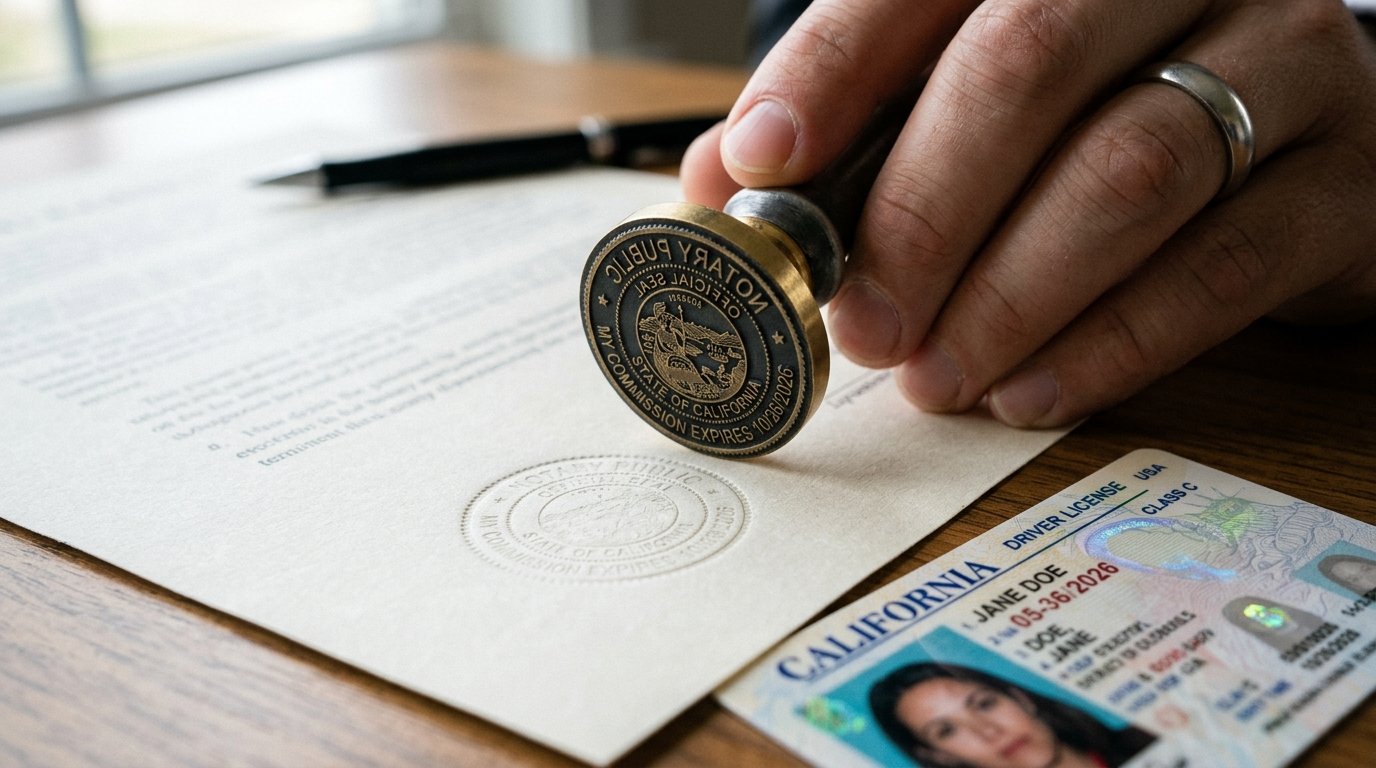
A Complete Document with No Blank Spaces
Bring the document filled out. Every field that should contain information needs to contain it before you sit down.
Under Florida law, and in most other states, a notary should not notarize a document that is clearly incomplete. Blank signature lines are expected (that’s why you’re there). But blank substantive fields: names, dates, dollar amounts, property descriptions: those stop the process.
If you’re unsure how to fill in a section, ask the person or institution that gave you the document. We can notarize it once it’s ready. We can’t tell you what should go in the blanks. That would be legal advice, and a notary is not authorized to provide it.
One more thing to check before you leave the house: does the document already have a notarial certificate printed on it? Some forms include one on the last page. Others don’t, and the notary will attach the appropriate certificate. Either way, knowing what the receiving party expects matters, because the type of certificate determines what happens at the appointment. If you’re unsure what a completed notarial certificate should look like, review example of a notarized document to see the standard format.
Acknowledgment vs. Jurat: Know Which One You Need
These are the two most common notarial acts. They are not interchangeable, and using the wrong one can get your document rejected by the recipient.
Acknowledgment: You appear before the notary, prove your identity, and state that you signed the document voluntarily. You may have already signed it beforehand. The notary confirms you are the person named on the document and that you acknowledge the signature as yours. Deeds, powers of attorney, and trusts commonly use acknowledgments.
Jurat: You sign the document in front of the notary and take an oath or affirmation that the contents are true. You cannot pre-sign a document that needs a jurat. If you already signed it, you may need to re-sign in the notary’s presence. Affidavits and sworn statements commonly use jurats. Learn more about what happens during the signed by a notary process.
The receiving institution decides which act is required, not the notary. Texas explicitly warns that a nonattorney notary may not choose the certificate for the customer, and the same principle applies here in Florida.
How to tell which one you need: look at the notarial certificate on (or attached to) your document. It will say “acknowledged before me” or “subscribed and sworn to before me.” No certificate? Ask whoever gave you the document.
Acceptable Photo Identification
This is where most appointments fail.
The notary must verify your identity through acceptable identification. In Florida, the following are generally accepted:
- Current U.S. passport or passport card
- Current driver’s license issued by any U.S. state
- Current state-issued identification card
- Current U.S. military identification
The key word is current. An expired driver’s license is not acceptable in Florida. This catches people off guard. California, by comparison, accepts specified identification issued within five years even if technically expired. Florida is stricter. Check your expiration date before you leave.
If you don’t have qualifying ID, Florida law permits identification through a credible witness: someone who personally knows you, presents their own acceptable ID, and swears an oath to the notary confirming your identity. This is an exception, not a shortcut. Arrange it beforehand.
One more detail people overlook: the name on your ID must match the name on the document. If your license says “Maria Gomez” and the deed says “Maria Gomez de Santos,” that mismatch can prevent notarization. Contact the document preparer to correct it before the appointment.
Personal Appearance Before the Notary
Every signer must personally appear before the notary at the time of notarization. “Personal appearance” means physically present, in the same room.
You cannot:
- Drop off a document and pick it up later with a stamp on it
- Have someone else bring your document to the notary on your behalf
- Use a regular FaceTime or Zoom call as a substitute
Remote online notarization (RON) is a legally distinct process. Florida authorizes it under specific conditions using approved audiovisual technology and identity-verification procedures. RON is not “any video call with any notary.” It’s a regulated session with specific safeguards. And not every document or recipient accepts remotely notarized documents. Confirm acceptance before choosing that route.
For most people, in-person notarization is simpler and more widely accepted. If getting to an office is the obstacle, that’s exactly what mobile notary service solves. We come to your home, your workplace, a hospital, a nursing home, wherever you need us across Orange, Seminole, Osceola, and Brevard counties.
Willingness and Awareness
The notary must be reasonably satisfied that you are signing voluntarily and that you understand what you’re signing. If you appear confused, pressured, or unable to communicate, the notary has a duty to stop.
This requirement protects you. Earlier this year, the Department of Justice reported that a Memphis notary was sentenced to 57 months in prison for notarizing fraudulent deeds on properties where the purported signers had already died. That’s an extreme case, but it shows why the screening matters. The notary stamp is supposed to mean a real person, present and willing, signed the document.
If you’re arranging notarization for an elderly or hospitalized family member, let us know the situation when you call. We can meet at a hospital or nursing home in Central Florida and take the time needed to confirm that the signer understands and consents. A signing typically takes 20 to 45 minutes depending on the number of pages.
When You Also Need Witnesses
Some documents require one or more witnesses in addition to the notary. Witnessing and notarization are separate functions.
In Florida, certain documents carry witness requirements. A last will and testament typically requires two witnesses. Some powers of attorney and real estate documents may also need witnesses depending on the transaction and the receiving party’s instructions.
Document witnesses watch you sign and then sign the document themselves. They are not the same as a credible witness used for identification (that’s a different role entirely).
Here’s the practical problem: if you walk into a bank or shipping store, the location may not supply witnesses. Many retail notary locations simply don’t staff for it. If your document needs witnesses, confirm the arrangement before the appointment, or bring your own.
When you schedule with us, tell us how many witnesses the document requires. We’ll make sure the right people are present.
What Notarization Costs in Florida
Florida law caps traditional notarial fees at $10 per notarial act and online notarization fees at $25 per act. A document with two signers who each need an acknowledgment involves two acts.
That’s the notarial fee. A mobile notary also charges a travel or convenience fee for coming to your location. This is standard and legal, and it varies by distance and time of day. Ask for the total upfront.
For context:
| Option | Typical cost per act | Trade-off |
|---|---|---|
| Bank (account holder) | Often free | Business hours only, limited document types, may lack witnesses |
| Shipping store | Varies by location | Walk-in, but staffing and services vary |
| Mobile notary | Statutory fee + travel fee | Comes to your location, flexible hours including nights and weekends |
| Online platform | $25+ per seal, plus possible add-ons | Requires tech setup; not all documents or recipients qualify |
Some banks and libraries offer complimentary notarization for customers, which works well for simple, single-signer documents during business hours. For anything more complex, or anything needed outside of 9-to-5, a mobile notary gives you more control over timing and location.
If Your Document Is Going Abroad
Notarization alone is not enough when a document will be used in another country. Most nations that are members of the Hague Convention require an apostille: a certificate issued by the Secretary of State that authenticates the notary’s signature and authority. The apostille does not verify the document’s contents. It tells the foreign government that the notary who stamped your document is a real, commissioned official.
In Florida, apostilles come from the Secretary of State’s office in Tallahassee. You can file directly for $10 per document, or use a service that handles notarization, filing, courier, and return delivery.
Turnaround is where people get caught. Walking into the Tallahassee office can mean same-day processing. Mailing your document with regular mail can take six weeks or more. If you’re facing a deadline for an immigration filing, a foreign property transaction, or an international business registration, that gap matters.
We handle apostille certification for clients across Central Florida, with courier turnaround as fast as five days. Call or text us to discuss your timeline.
Five Mistakes That Force a Return Trip
- Expired ID. Your license expired last month. The notary cannot accept it in Florida. Renew it or arrange a credible witness before the appointment.
- Blank fields on the document. Names, dates, and amounts must be filled in. The notary will not stamp an incomplete document.
- Name mismatch between ID and document. “Robert Smith” on the license, “Bob Smith” on the deed. Fix it with the document preparer first.
- Missing signers. Both parties on a real estate deed need to appear. One person cannot sign for the other without a valid, existing power of attorney.
- No witnesses when the document requires them. If your document needs witnesses and you didn’t arrange them, the appointment can’t proceed.
Every one of these can be prevented with a five-minute phone call before the appointment. Call or text us at (689) 285-5579, tell us what document you’re notarizing, and we’ll confirm exactly what to bring. We speak English, Spanish, and Portuguese.
Frequently Asked Questions
Can I notarize a document I already signed?
It depends on the notarial act. An acknowledgment allows a pre-signed document: you appear, prove your identity, and acknowledge the signature. A jurat does not: you must sign in the notary’s presence and take an oath. Check your document’s notarial certificate to see which act is required, or ask the institution that gave you the document.
What if I don’t have a valid photo ID?
Florida allows identification through a credible witness who personally knows you, presents their own acceptable ID, and swears an oath confirming your identity. This must be coordinated before the appointment. A credit card, utility bill, or social media profile is not acceptable identification for notarization.
Does notarization make my document legally binding?
Not by itself. Notarization verifies the signer’s identity and voluntary execution. Whether the document is enforceable depends on its contents, applicable law, and the requirements of the receiving institution. That’s a question for an attorney, not a notary.
Can I get a document notarized at night, on a weekend, or on a holiday?
Banks and retail locations keep business hours. A mobile notary can meet you on evenings, weekends, and holidays. We’re reachable 24/7 by call or text to check available time slots.
Is online notarization accepted everywhere?
Not universally. Acceptance varies by state, institution, and document type. Some county recorders, lenders, and foreign governments do not accept remotely notarized documents. Confirm with the recipient before choosing an online session over in-person notarization.
What is the difference between notarization and an apostille?
Notarization verifies the signer’s identity and willingness. An apostille, issued by the Secretary of State, authenticates the notary’s official signature and commission so the document will be recognized in countries that are members of the Hague Convention. They serve different purposes and are often both required for documents going abroad.