You have a document that isn’t fully filled out, and you need it notarized today. Can a notary notarize a blank document? In Florida, no. Florida Statute Section 117.107(10) prohibits a notary from notarizing a blank or incomplete document, and most other states have similar rules.
Not every empty space makes a document “blank” in the legal sense, though. A contract missing essential terms is a problem. A form where the other party hasn’t signed yet? Usually fine. Here’s how to tell the difference and get your document ready.
Florida Law Prohibits Notarizing Blank or Incomplete Documents
Section 117.107 of the Florida Statutes is direct: a notary public may not notarize a document that is blank or incomplete. The same section forbids delivering a signed blank affidavit or acknowledgment certificate for someone to use later.
One narrow exception exists. Endorsements or assignments in blank involving promissory notes and related security instruments are not treated as incomplete under this statute. That is a specific provision for certain financial transactions. It does not cover contracts, powers of attorney, deeds, affidavits, or the vast majority of documents people bring to a notary.
Florida isn’t unusual here. Ohio’s Revised Code Section 147.141 contains a nearly identical prohibition. California’s 2026 Notary Public Handbook requires notaries to refuse when a document’s incompleteness is apparent. Colorado’s Secretary of State directs signers to complete blank fields, strike unused ones, or write “N/A” before the appointment.
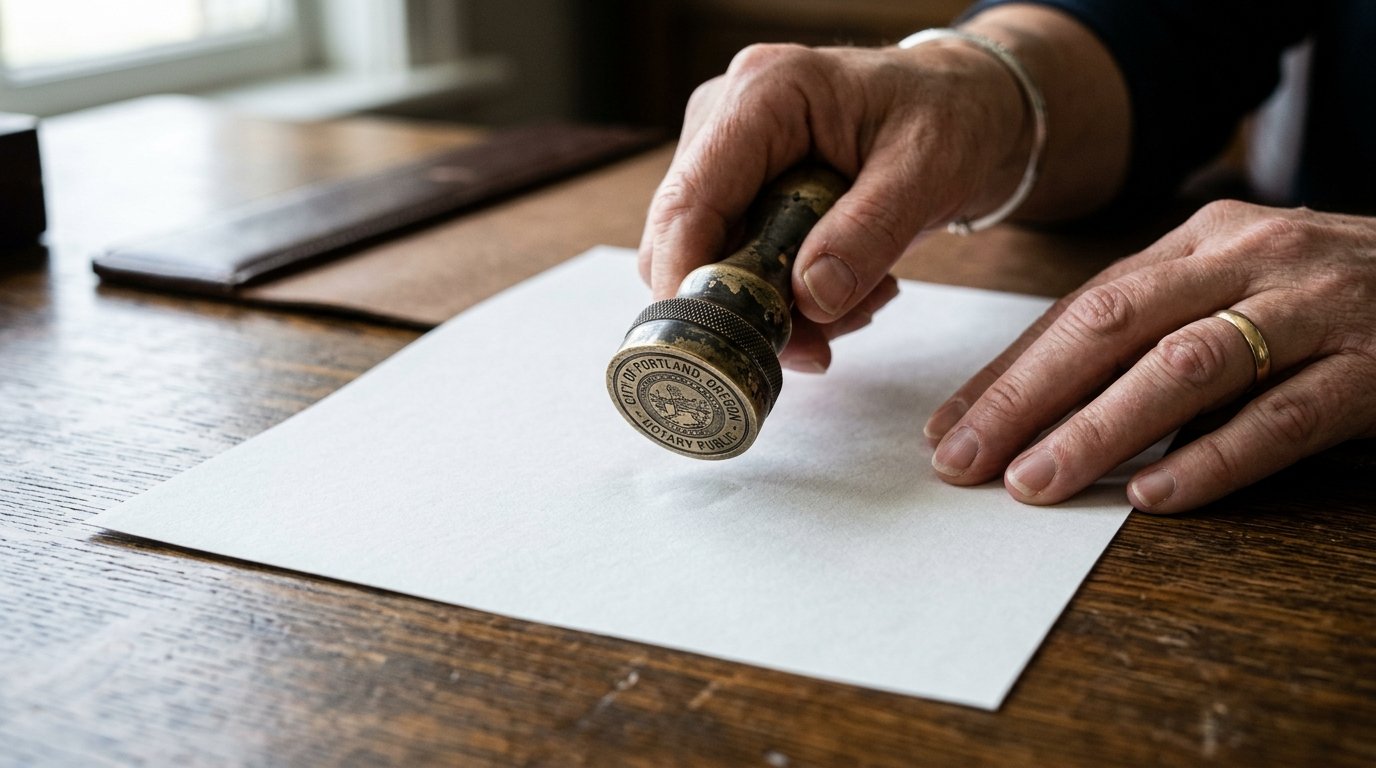
The reason is practical. A notary’s seal tells courts, title companies, banks, and government agencies that a specific person appeared, was identified, and executed a specific document. If the document is blank or missing key terms, someone could add content the signer never saw. The notarial seal would make those fabricated terms look legitimate.
Not Every Empty Space Makes a Document Incomplete
Most people who search this question aren’t trying to notarize a blank sheet of paper. They have a real document with a few empty lines and want to know if that’s a dealbreaker. It depends on what those lines are for.
| Situation | Notarizable? | What to do |
|---|---|---|
| Completely blank page | No | No identifiable document exists. |
| Missing essential terms (names, amounts, property descriptions) | No | Complete those fields first. |
| Your signature line is empty (jurat) | Yes | You sign in front of the notary. This is required. |
| Your signature line is empty (acknowledgment) | Depends | You may sign before or during the appointment. |
| Other party’s signature line is empty | Generally yes | Parties often sign at different times. |
| Official-use or recorder sections | Yes | Government offices fill these after filing. |
The National Notary Association confirms that a document can be notarized when other parties’ signature lines and designated official-use areas remain blank. The line is between substantive incompleteness (missing terms that define what the document does) and procedural blanks (fields filled by the right person at the right time).
The Type of Notarial Act Changes the Rules
Two common notarial acts handle signing differently. Mix them up, and you might think your document is “incomplete” when it’s in the right condition for the act you need.
Acknowledgment: You appear before the notary and confirm you signed the document voluntarily. You may have signed it days ago. The notary verifies your identity and records the acknowledgment. The certificate language typically says “acknowledged before me.”
Jurat: You sign in the notary’s presence and take an oath or affirmation that the contents are true. For a jurat, your signature line should be empty when you arrive. The certificate language says “subscribed and sworn before me.”
In both cases, the substance of the document (terms, descriptions, obligations) needs to be complete. An unsigned document waiting for your signature at a jurat is standard procedure. An unfinished document missing key terms is a different problem.
Not sure which act your document requires? Check the notarial certificate section near the bottom of the page. Or just tell us what the document is for when you call, and we’ll identify the right act.
What Happens When Incomplete Documents Get Notarized Anyway
Courts don’t treat notarization defects as paperwork errors.
In February 2026, a Memphis notary received 57 months in federal prison for notarizing fraudulent quitclaim deeds in a scheme involving more than 30 properties. In one case, both supposed signatories had died before the deed was even signed. The court ordered $280,914.25 in restitution.
In 2025, an Ohio appellate court invalidated a quitclaim deed and quieted title in the rightful owner, confirming that a forged deed cannot transfer property no matter what notarial stamp appears on it.
In a separate Ohio matter, the state Supreme Court publicly reprimanded a notary for improperly notarizing an affidavit. The affidavit was thrown out of the case, and additional proceedings were required.
These cases involved deliberate fraud and misconduct, not someone who accidentally left a field empty. But they show the weight a notarial seal carries in courtrooms and recording offices. When that seal appears on a document that wasn’t properly completed or executed, the consequences can include criminal prosecution, voided transactions, and six-figure liability.
How to Get Your Document Ready Before the Appointment
A few minutes of preparation prevents a rescheduled appointment. Before you meet with a notary:
- Fill in every substantive field. Names, dates, addresses, dollar amounts, property descriptions. If a term defines what the document does, it needs to be there.
- Mark fields that don’t apply. Write “N/A” or draw a line through any field that genuinely doesn’t apply to your situation. This prevents anyone from adding information later.
- Don’t guess on uncertain fields. Contact whoever gave you the document: your attorney, title company, lender, or the issuing agency. Texas’s Secretary of State warns that choosing document content for a customer constitutes practicing law, and the principle holds broadly. A notary cannot fill in your terms for you.
- Bring valid photo ID. Florida requires identity verification for every notarization.
- Know which notarial act you need. Check the certificate section of your document, or ask when you call.
If your document is mostly ready but you’re stuck on one or two fields, let us know when you reach out. We can schedule around the time you need to confirm missing details, or we can come to you and wait while you make a quick call to your attorney or title company. We serve Orange, Seminole, Osceola, and Brevard counties, speak English, Spanish, and Portuguese, and are reachable 24/7. Call or text (689) 285-5579 to check available time slots.
Frequently Asked Questions
Can a notary notarize a completely blank piece of paper?
No. A blank page is not a document. Florida and most other states prohibit notarizing blank or incomplete documents. Some states, like Nevada, allow a signature on an otherwise blank sheet if the signer adds a written explanation of the request, but in Florida the document must contain its substantive terms before notarization.
Can I sign now and fill in the details later?
That is exactly what the blank-document prohibition is designed to prevent. Completing terms after notarization means the notary certified a document the signer never reviewed in its final form. Get all substantive information in place first. If you’re waiting on a detail, schedule the notarization for after you have it.
The other party hasn’t signed yet. Is that a problem?
Usually not. Parties often sign at different times and locations. The National Notary Association’s guidance allows notarizing the appearing signer’s signature even when other signature lines are empty. That blank line belongs to someone else’s appointment, not yours.
Can the notary fill in blank fields on my document?
No. The notary performs the notarial act: identity verification, witnessing, oath administration. Completing or choosing document terms falls to you, your attorney, or the document preparer. If you don’t know what a field requires, ask whoever provided the form before the appointment.
Does remote online notarization change this rule?
No. Remote online notarization changes how the notary and signer connect (video call instead of in person). It does not waive the requirement that the document be substantively complete. The same state laws about blank or incomplete documents apply regardless of the medium.
What if my document was already notarized while incomplete?
Do not add information to a previously notarized document without understanding your state’s correction rules. California, for example, requires a new notarization with a new certificate, date, and journal entry. Contact the document’s recipient and, if needed, a qualified attorney to determine the proper correction.