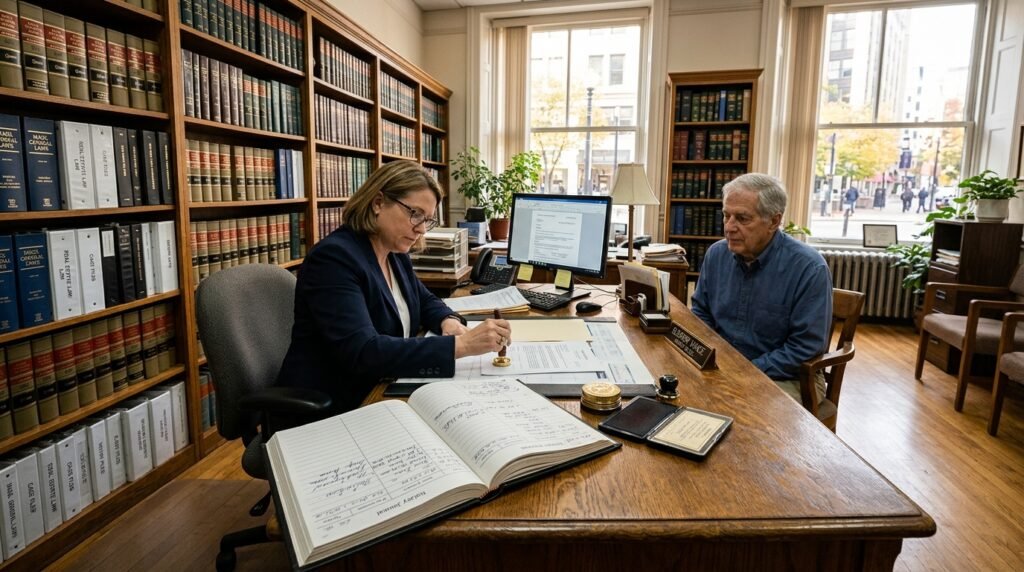
You signed a document in front of a notary. Now you need it again and can’t find it. Or maybe you’re about to sign something sensitive and want to know: does a notary keep a copy of documents with your personal details?
In most U.S. states, including Florida, the answer is no. A notary public typically does not keep a copy of the document you bring to be notarized. What the notary may keep is a journal entry: a brief record of the notarial act itself (the date, your name, how you were identified, a description of the document). That journal entry is not a photocopy of your contract, your power of attorney, or your loan package. It’s a record that the act happened.
This distinction determines where to look when a signed document goes missing, what a notary can produce if there’s a dispute, and how much of your private information sits in someone else’s file cabinet.
What a Notary Actually Keeps
A notary public is a witness, not an archivist. When you sign a document in front of a notary, the notary verifies your identity, confirms you understand what you’re signing and are doing it willingly, then applies their seal and signature. After that, the document goes back to you or to whoever is handling the transaction: a title company, an attorney, a lender.
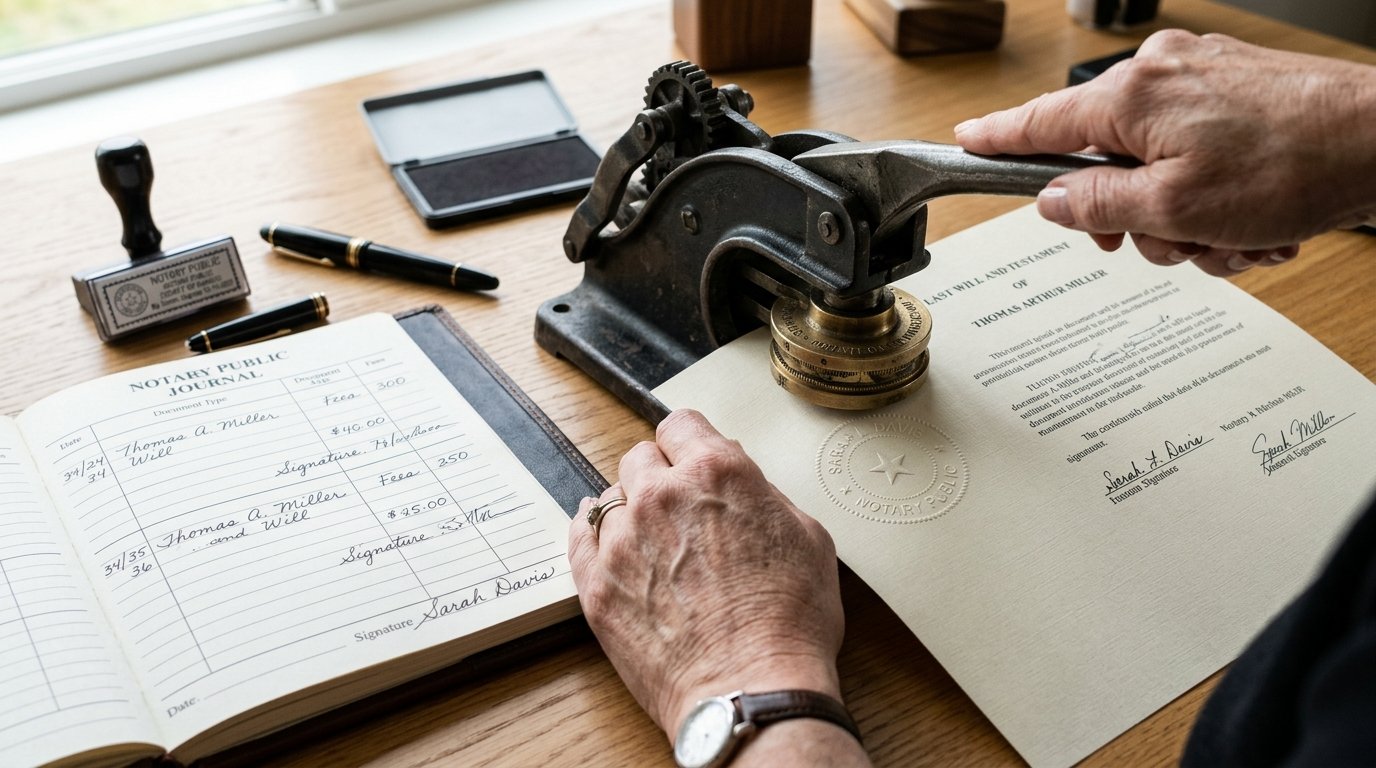
The notary’s own record, when one is required, is the journal. A typical journal entry includes:
- Date and time of the notarization
- Type of notarial act (acknowledgment, jurat, oath)
- Description of the document (title or type, number of pages)
- Name and address of the signer
- How the signer was identified (driver’s license, passport, personal knowledge)
- The notary’s fee
Notice what’s missing: the contents of your document. The journal doesn’t record the terms of your loan, the details of your medical directive, or the assets listed in your trust. This is also why notaries cannot provide guidance on document content—learn more about what notaries can and cannot advise.
Oregon’s official Notary Public Guide explicitly discourages notaries from retaining copies of notarized documents or client identification, and the National Notary Association echoes that guidance. The reason is straightforward. Your documents contain Social Security numbers, financial details, medical information, and signatures. A notary who stockpiles copies of all that creates a privacy and liability risk without a corresponding legal obligation to do so.
Florida’s Notary Record Rules
Florida has an unusual split that catches many people off guard.
For traditional in-person notarizations, Florida does not require the notary to keep a journal at all. If you had a document notarized at someone’s office or at your kitchen table in Orlando, the notary may have no formal record beyond what they remember. Some Florida notaries keep voluntary journals (many professional organizations recommend it), but the state doesn’t mandate it for in-person acts.
Remote online notarization is a completely different story. Under Florida Statute 117.245, a notary performing an online notarization must maintain a secure electronic journal and an audio-video recording of the entire session. Both must be retained for at least ten years. For electronic wills, the recording goes to a qualified custodian under separate estate statutes.
The practical takeaway for anyone in Orange, Seminole, Osceola, or Brevard County: if your document was notarized in person, don’t count on the notary having records. If it was done online, there’s a much better chance an electronic trail exists. Either way, keep your own copy.
How Retention Rules Vary by State
There is no federal standard for notary recordkeeping. Each state sets its own rules, and they differ more than you might expect.
| State | Journal Required? | Retention Period | Notable Detail |
|---|---|---|---|
| Florida | Online only | 10 years (online acts) | No journal mandate for traditional in-person notarizations |
| California | Yes | Varies by provision | Journal is the notary’s exclusive property; employer cannot take it |
| Texas | Yes (may be electronic) | 10 years from notarization | Journal entries are public information; certified copies available for a fee |
| New York | Yes (since Jan. 2023) | 10 years | Electronic acts also require audio-video recordings |
| Colorado | Yes | 10 years after last entry in the journal | Clock starts from the journal’s last recorded act, not each transaction |
| Virginia | Yes (since July 2026) | At least 5 years from the transaction | Brand-new requirement; all Virginia notaries must now comply |
| Oregon | Yes | 10 years after last entry | State officially discourages retaining document or ID copies |
Even when two states both say “ten years,” the object and trigger may differ. Texas counts ten years from each notarization. Colorado counts ten years from the journal’s last recorded act, meaning older entries in the same book stay longer. These differences matter if you ever need to request a journal entry as evidence.
And remember: a journal entry in any state is a record that the notarization happened. It is not a duplicate of the document itself.
Lost Your Notarized Document? Here’s What to Do
If you’re reading this because you lost a notarized document and hope the notary kept a copy, the odds aren’t great. But don’t panic. The document itself almost certainly exists somewhere. The question is where.
Start with your own records. Check email (many transactions involve scanned copies sent as attachments), cloud storage, filing cabinets, and safes. If anyone else was present at the signing, ask whether they received a copy.
Next, contact the other party to the transaction. This is usually the most productive step. A title company, lender, or closing attorney handling a real estate transaction keeps the complete loan package. An insurance company keeps your beneficiary forms. A law office keeps the estate planning documents they prepared. These organizations are the actual custodians of the signed instrument, not the notary who witnessed your signature.
For recorded documents (deeds, mortgages, certain affidavits), check with the county recorder’s office. In Orange County, for example, the Comptroller’s Office of Official Records maintains recorded documents.
For remote online notarizations, log into the platform where the session took place. Your account may still have the completed document available for download. Don’t assume it will be there indefinitely, though. Proof’s help center specifically recommends downloading and backing up documents promptly because future availability isn’t guaranteed.
When none of those routes work, re-notarization may be the answer. You’d prepare or obtain a new copy of the document, then sign it again before a notary. For documents like a power of attorney or an affidavit, this is usually straightforward. It becomes complicated when the other signer is deceased, incapacitated, or overseas.
Online Notarization Changes the Picture
Remote online notarization has grown rapidly. One provider alone reported over 238,000 notarizations in 2025 and more than two million cumulatively by early 2026. With that growth comes a reasonable question: if everything is digital, is the document saved somewhere you can reach it?
Often, yes. But “saved somewhere” is not the same as “available to you forever.”
Many RON platforms store the completed document, the journal entry, and the session recording. Florida requires at least ten years for the journal and recording from online sessions. However, the document file and the notarial record may live on different retention schedules. On some platforms, if the sender deletes the transaction, the notary’s journal entry survives but the document itself might not.
The practical advice has not changed since paper was the only option. Keep your own copy. Download completed documents the same day. Save them in more than one place: a local drive, a cloud backup, a printed copy in a safe. Treat any platform’s storage as a convenience, not your archive.
Protecting Your Documents Going Forward
Document fraud is not hypothetical. ALTA’s 2026 seller-impersonation study found that 59% of surveyed title firms encountered at least one impersonation attempt in the prior year, up sharply from 28% in 2024. Among firms reporting claims, half cited average costs above $100,000.
Knowing where your documents are, who has copies, and what records exist is more than good housekeeping. It’s protection.
Before you leave any signing table, whether it’s for a real estate closing, a trust, or an apostille heading overseas, answer three questions:
- Who keeps the signed original?
- Does the notary maintain a journal entry, and for how long?
- Is there a recording, and who holds it?
Those three answers can save you hours of confusion later. And if you need a document notarized (or re-notarized) in Central Florida, even on a Saturday or Sunday with our weekend mobile notary Orlando service, we’re available to meet you wherever works best: your home, your office, a hospital, a coffee shop. Call or text us at (689) 285-5579 to check available times.
Frequently Asked Questions

Can I ask a notary to make a copy of my document before notarizing it?
You can ask, but most notaries will decline or recommend you make your own copy beforehand. Notaries are generally advised against retaining copies of clients’ documents because of the sensitive personal information they contain. Bring your own copies or photograph the signed pages with your phone before leaving the appointment.
Does a notary signing agent for a mortgage closing keep my loan documents?
No. A notary signing agent facilitates the signing and returns the completed package to the title company or lender. The signed originals go to the transaction parties, not the notary’s personal files. You’ll typically receive a copy of the completed loan package from your lender or closing company after the transaction settles.
If a notary’s journal is a public record, can anyone look up my notarization?
It depends on the state. In Texas, journal entries are public information and certified copies are available for a fee. In California, a written request identifying the parties, document type, and approximate date can produce a journal line item at $0.30 per page. A journal entry shows a notarization occurred. It does not contain the full contents of your document.
What should I do if I suspect a document was fraudulently notarized?
Contact the notary’s commissioning authority. In Florida, complaints go through the Department of State. You may also report suspected crimes to law enforcement. A notary journal entry, if one exists, can help establish whether the notarial act actually took place and who appeared before the notary that day.
How long does a notary keep records in Florida?
For traditional in-person notarizations, Florida does not require a journal, so there may be no formal record at all. For remote online notarizations, the electronic journal and audio-video recording must be maintained for at least ten years under Florida Statute 117.245.
Can a notary re-notarize a document I lost?
A notary can notarize a new copy of a document, but they can’t recreate a past notarization. You’d need to obtain or draft a replacement document, then sign it again in front of a notary. For powers of attorney and affidavits, this is usually simple. For documents requiring multiple signers, all parties must be available to sign again.