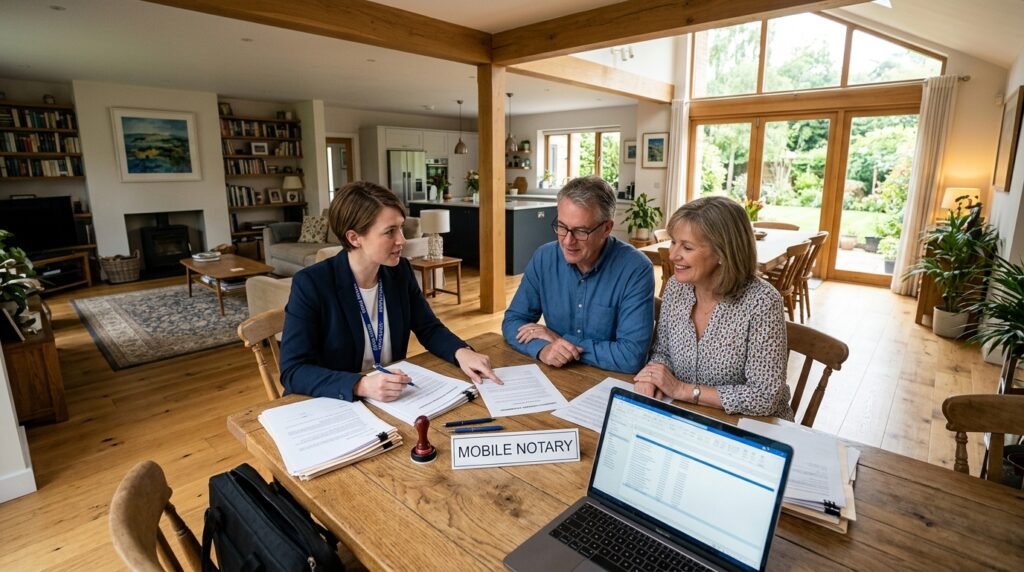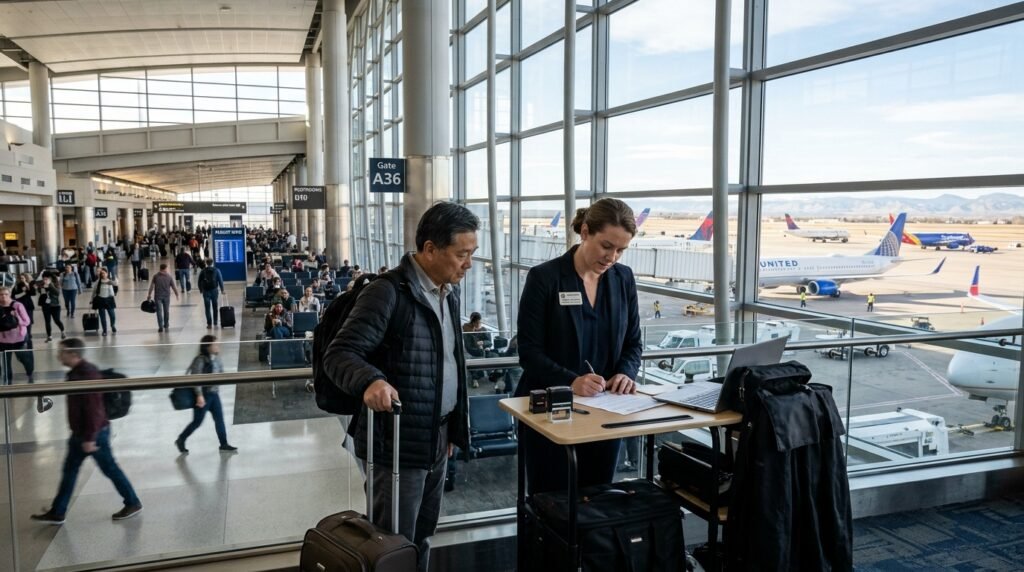
You just found out a document needs to be notarized before a deadline, and you cannot get to an office. Maybe a loan closing moved up. Maybe a relative is in the hospital and needs a power of attorney signed before surgery tomorrow morning. The first question in your head: how fast can a mobile notary come?
The honest answer is that most mobile notaries can reach you within one to four hours of your call, depending on where you are, what time it is, and whether the notary’s schedule is open. In Central Florida, where distances between Orlando, Kissimmee, Sanford, and the coast are manageable, we typically confirm an appointment quickly and get to your location the same day. But “fast” only counts if the signing actually gets done. That depends on you as much as it depends on the notary.
Here is what determines the real timeline, what can slow things down, and how to make sure the visit works on the first try.
What Controls How Fast a Mobile Notary Arrives
There is no national dispatch standard for mobile notaries. One San Francisco provider reports confirmation within 30 minutes and physical arrival in two to three hours, while a national signing network advertises four hours or less, including rural areas. These are local or company-specific claims, not an industry guarantee.
Five factors move the clock for any mobile notary appointment:
- Distance from the notary to you. A notary already in your part of town can be at your door in 30 minutes. One across the county may need over an hour of drive time alone.
- Time of day. A call at 10 a.m. on a Tuesday is easier to fill than one at 11 p.m. on a Saturday. After-hours and weekend requests are possible (we take calls 24/7), but the notary may be coming from farther away.
- The notary’s existing schedule. Mobile notaries often have appointments lined up. An open slot means faster service. A fully booked afternoon means the next available window might be evening.
- Facility access. If you need a signing at a hospital, nursing home, or assisted-living facility, visitor policies, check-in procedures, and floor restrictions add time that has nothing to do with the notary’s driving speed.
- Number of signers and witnesses. A single acknowledgment is simpler to schedule than a signing that requires two signers, two witnesses, and a stack of loan documents.
In Orange, Seminole, Osceola, and Brevard counties, the geography works in your favor. Most locations are within a 45-minute drive of each other outside of rush hour. That is why same-day service is realistic here, not a marketing slogan.
Two Clocks You Need to Know About
When people ask how fast a mobile notary can come, they usually mean “how fast can this whole thing be done?” That involves two separate timelines.
The first clock is arrival: the time between your call and the notary walking through your door. In a published case from a Massachusetts provider, a notary reached a hospital patient 94 minutes after the initial call. That is a real, documented example for an urgent situation.
The second clock is the appointment itself. A straightforward notarization (one signer, one or two documents) takes about 15 to 20 minutes, including identity verification and journal entry. Loan signing packages typically take 45 to 60 minutes, and a first-time borrower working through a thick stack may need up to 90 minutes.
So the total time for a simple document might be two hours from call to completion. A hospital power of attorney or a mortgage closing could take three hours or more. In that same Massachusetts hospital case, the entire process from phone call to finished documents took about two and a half hours.
Plan backward from your deadline. If the bank needs the document by 5 p.m., calling at 4 p.m. is too late.
Five Mistakes That Waste a Fast Arrival
A notary who arrives quickly but cannot complete the signing is a wasted trip for everyone. These are the errors we see most often, all preventable:
- No valid ID. Florida requires unexpired, government-issued photo identification. A driver’s license, passport, or state ID card works. An expired license does not. A work badge does not. If you realize your ID is expired after the notary arrives, the appointment cannot proceed.
- Signing before the notary gets there. This is the most common mistake. A notary must witness the signature. If you already signed the document, the notary cannot backdate or pretend to have watched you sign. You will need to start over with a new copy.
- Incomplete documents. Blank fields, missing pages, or a form you downloaded but did not fill out yet will stall the appointment. The notary cannot fill in your legal documents for you. That would be practicing law.
- Missing signers. If two people need to sign, both must be present with their own valid IDs. “My husband will be here in an hour” turns a quick visit into a long wait or a second trip.
- No witness when one is required. Some documents (certain wills, healthcare directives) need disinterested witnesses. The notary can often serve as a witness, but if two witnesses are needed, you may need to arrange for a second person to be present. Mention this when you call so we can plan.
Every one of these problems has the same fix: tell the notary exactly what you need when you first call. The more detail you give upfront, the faster the visit goes.
When Same-Hour or Same-Day Service Is Realistic
Same-day is the norm for most mobile notary appointments in our area. If you call in the morning, there is usually an opening that afternoon, or even sooner.
Same-hour is possible but depends on luck. If one of us happens to be nearby with an open schedule, we can sometimes be at your location within 30 to 45 minutes of your call. We do not promise that as a standard because it depends on what is already on the calendar.
Situations where speed is most realistic:
- You are in a central location (Orlando, Winter Park, Kissimmee, Altamonte Springs) during business hours, or need service at accessible facilities like airports.
- The signing involves one or two signers and a simple document like an affidavit, a jurat, or an acknowledgment.
- You have all documents printed, complete, and unsigned, with valid IDs ready.
Situations that typically need more lead time:
- Hospital or nursing facility signings, where visitor access and floor policies add steps.
- Mortgage loan closings with 100+ pages, which need coordination with the title company or lender.
- Late-night or holiday requests, where the available notary may need to travel farther.
- Multiple signers at different locations.
- Hotel signings, where front desk coordination and guest privacy protocols may require additional scheduling.
A good rule of thumb: call as soon as you know you need a notary. Even if your deadline is tomorrow, calling today lets us reserve a slot and gives you time to prepare your documents.
Mobile Notary vs. Online Notarization for Urgent Needs
Remote online notarization (RON) connects you to a notary over a video call. Some platforms advertise near-instant availability, and others report average signing times under 10 minutes. If you just need a quick acknowledgment on an electronic document, RON can be faster than waiting for someone to drive to you.
But RON does not work for every situation. Requirements vary by state, and more importantly, the receiving party (the bank, title company, court, or foreign government) may not accept a remotely notarized document. Mortgage lenders in particular sometimes require a physical signing agent to be present.
RON also does not help when:
- The signer has difficulty using a computer or smartphone (common with elderly or hospitalized signers).
- The document must be signed in wet ink on a physical page.
- The signer’s identification or capacity needs in-person verification.
- The document will be sent abroad and needs an apostille, which requires a physical notary seal recognized by the Florida Secretary of State.
For most of the urgent scenarios that bring people to us (hospital POAs, last-minute closings, documents for overseas), a mobile notary is the more reliable path because you know the result will be accepted.
How to Prepare So the Visit Takes 20 Minutes, Not 2 Hours
When you call or text us, here is what to have ready (or at least be thinking about):
- What type of document? Tell us if it is a power of attorney, a real estate closing package, an affidavit, a healthcare directive, or something else. This helps us estimate the time and bring any supplies we might need.
- How many signers? Each signer needs to be present with their own valid, unexpired government photo ID.
- Are witnesses needed? If you are not sure, ask whoever gave you the document. We can often provide a witness, but we need to know in advance.
- Where will we meet? Home, office, hospital room, coffee shop. If it is a restricted facility, let us know so we can plan for check-in time.
- What is the deadline? “My attorney needs this by 3 p.m.” or “surgery is scheduled for tomorrow morning” helps us prioritize and give you an honest arrival estimate.
- Do NOT sign anything yet. Leave signature lines blank until the notary is in front of you.
If you are dealing with a power of attorney, the signing typically takes 20 to 45 minutes depending on the number of pages. Having the document printed and reviewed ahead of time keeps you on the short end of that range.
What Happens After You Call Us
The process is straightforward:
- You call or text. Tell us what you need, where you are, and when you need it done.
- We confirm availability and give you a realistic arrival window. No vague “we’ll get back to you.” If we can come in an hour, we say so. If the earliest opening is this evening, we say that too.
- We travel to your location: your home, office, hospital room, wherever works.
- We verify identity, witness the signing, complete the notarization, and make the journal entry.
- You have your notarized document. Done.
We serve Orange, Seminole, Osceola, and Brevard counties and work in English, Spanish, and Portuguese. If you are not sure whether your situation requires a mobile notary or something else entirely, call or text and we will help you figure it out. No charge for the conversation.

Frequently Asked Questions
How fast can a mobile notary come in Central Florida?
In most cases, same-day service within a few hours. If a notary is nearby and the schedule allows, arrival can happen within 30 to 60 minutes. Call or text (689) 285-5579 with your location and deadline for an honest time estimate.
How much does a mobile notary charge for an urgent visit?
Fees vary by document type, number of signers, travel distance, and time of day. Florida sets a statutory limit on the notarial act itself, but the mobile service fee covers travel and convenience. Ask for a complete quote before the notary is dispatched so there are no surprises.
Can a mobile notary come to a hospital or nursing home?
Yes. Hospital and nursing home signings are one of the most common reasons people call a mobile notary. Let us know the facility name and any visitor restrictions so we can plan for check-in time. The notary must still verify the signer’s identity and confirm the signer understands and is willing to sign.
What ID do I need for a mobile notary appointment?
A current, unexpired government-issued photo ID. A Florida driver’s license, U.S. passport, or state identification card all work. Expired documents do not. If you have questions about alternative forms of ID, ask when you call.
What if I already signed the document before the notary arrives?
The notary cannot notarize it. A notary must witness the signature as it happens. You will need a fresh, unsigned copy of the document. This is the single most common reason a mobile notary visit has to be rescheduled.
Is online notarization faster than a mobile notary?
It can be, since there is no travel time. But not every document, jurisdiction, or receiving party accepts remote online notarization. For mortgage closings, apostille-bound documents, and hospital signings, an in-person mobile notary is usually the safer choice. When in doubt, check with whoever will receive the document.