
You can’t deny technology has fundamentally shifted how we handle our daily lives: we bank from our smartphones, shop for groceries online, and attend meetings from our living rooms.
Of course, it was only a matter of time before this wave of digital transformation reached the legal sector.
For decades, notarization was a strictly physical act, requiring you to stand face-to-face with a notary public, present your ID, and sign a paper document. But, as the demand for convenience and efficiency grows, a new solution has appeared.
Can you notarize a legal document without ever leaving your house? Yes, you can! This capability is known as “remote notary services,” or Remote Online Notarization (RON). This article will explore exactly what these services are, how the process works, and how they compare to other convenient options like mobile notarization!
What are remote notary services?
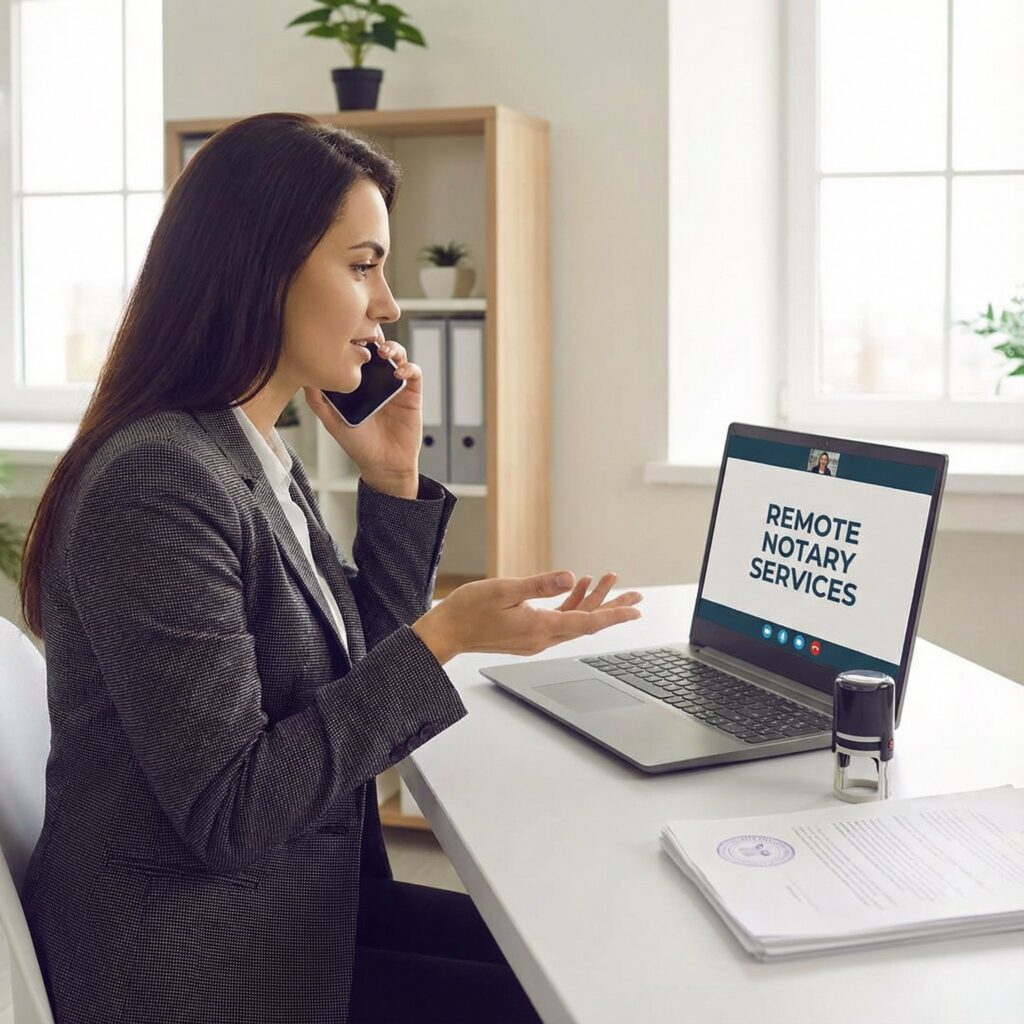
Remote notary services, also known as Remote Online Notarization (RON), allow documents to be notarized lawfully and securely using audio-visual technology.
Here, instead of driving to a bank or waiting for a notary to arrive at your office, the signer and the notary connect via a secure video call. The signer appears before the notary on a screen, and the documents are signed and notarized electronically.
It is important to distinguish this from “Electronic Notarization” (eNotarization). While the terms sound similar, they are not the same. It simply means the document is digital and signed with an electronic signature, but the signer must still be physically present in the same room as the notary.
Remote notary services take this a step further by removing the requirement for physical presence entirely.
Legally, this process has gained massive traction. Many states, including Florida, have passed legislation permanently authorizing RON. In other words, it is a fully recognized legal process.
However, this doesn’t mean you can simply hop on a FaceTime call or a Zoom meeting to get a deed signed. The law requires the use of specialized, state-approved platforms designed specifically for this purpose.
These platforms incorporate specific security protocols to record the session, verify identity, and attach digital seals, ensuring the process is just as secure (if not more so) than a traditional paper notarization.
How the remote notarization process works

If you decide to use remote notary services, the experience will look quite different from a traditional appointment. It relies heavily on technology, so having a reliable internet connection and a device with a camera is a must.
Here is what the typical workflow looks like:
1. Document upload
The process begins when you or the requesting agency uploads the document to a secure RON platform. This converts the physical paper into a digital format that can be tagged for electronic signatures.
2. Identity verification
Before you ever see the notary on screen, you must prove who you are. Because the notary cannot physically inspect your ID card to check for texture or holograms, the digital system uses a multi-step verification process:
- Credential analysis: You will be asked to take a picture of your government-issued ID using your smartphone or webcam. The software analyzes the image for security features to confirm it is a valid, unexpired document.
- Knowledge-Based Authentication (KBA): This is often the trickiest part for some users. The system will generate a quiz based on your credit history and public records. You will have a limited amount of time (usually two minutes) to answer specific questions, such as “Which of the following addresses did you live at in 2010?” or “What is the monthly payment on your auto loan?” You must answer these correctly to proceed.
3. The audio-visual session
Once identity is verified, you are connected with the notary via a live video feed. The notary will confirm your identity yet another time visually, ask if you understand the document, and ensure you are acting of your own free will.
4. Electronic signing and sealing
You will sign the document by clicking with your mouse or tapping the screen. The notary then applies their unique digital seal and electronic signature.
5. Digital certificate
Once the session ends, the document is finalized with a “tamper-evident” digital certificate. This ensures that if anyone tries to alter the document after the notarization is complete, the digital seal will break, rendering the document invalid.
Remote online notarization vs. mobile notarization

While remote notary services offer incredible convenience, they aren’t the only way to get documents notarized without traveling to a notary’s office. For this reason, let’s compare RON to mobile notarization.
Remote online notarization (RON) is a purely digital experience. You stay in your specific location, and the transaction happens over the computer. This is ideal for tech-savvy individuals, those with mobility problems, or ones with simple documents who have excellent internet access.
Mobile notarization, on the other hand, involves a notary public physically traveling to your location. They come to your home, hospital room, office, coffee shop, or any reasonable location of your choosing to conduct a traditional, in-person notarization.
With this in mind, when might a mobile notary be the better choice?
- Technology barriers: RON requires passing the strict Knowledge-Based Authentication (KBA) quiz and navigating new software. For seniors or those uncomfortable with technology, a mobile notary provides a stress-free human interaction.
- Complex loan packages: while some lenders accept RON, many still prefer or require “wet ink” (physical) signatures for mortgages, especially for the Note or Deed of Trust. For this reason, a mobile notary is the standard for these heavy document packages.
- The “human” element: sometimes, you need someone to guide you through the physical pages, point out where to sign, and ensure everything is physically collated and mailed correctly. A mobile notary provides that white-glove service that a computer screen cannot as of this article.
Are remote notary services safe? Security and record keeping
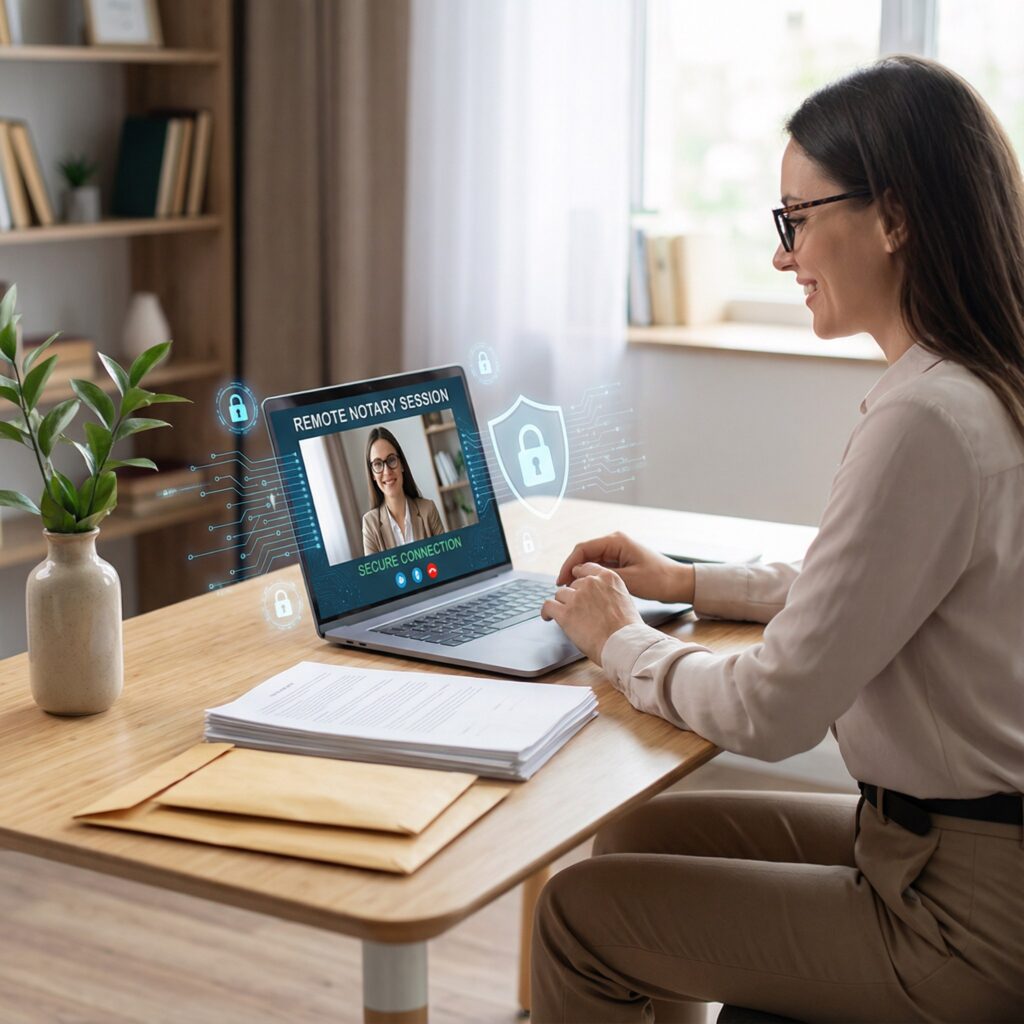
A common hesitation regarding remote notary services is security. Is a digital document as safe as a physical one? In many ways, it creates a more robust audit trail.
The digital platforms used for RON utilize tamper-evident technology. As mentioned, any change made to the PDF after the notary applies their seal immediately invalidates the file.
Furthermore, unlike a traditional notarization, where the only record is a line in a journal, RON sessions are recorded. For example, in Florida, the audio and video of the signing ceremony are stored securely, and the relevant files must be kept in an electronic journal for 10 years following the act.
This creates undeniable evidence of who signed, what they said, and that the notary witnessed the act, offering a powerful defense against fraud.
A mobile notary might be what you need
Remote notary services represent a fascinating evolution in how we handle legal documentation, offering a solution for a digital-first world. They provide speed and the ability to notarize from anywhere.
However, technology isn’t always the perfect fit for every situation or every person. Whether you need the digital speed of a remote session or the personalized, in-person service of a mobile notary, the goal remains the same: a securely authenticated document.
If you are unsure which method is right for you, or if you prefer the reliability of having a professional come directly to your door, Mobile Notary Orlando is ready to help. We specialize in providing professional mobile notary services throughout Orange, Seminole, Osceola, and Brevard counties.
We handle the travel and the details so you can have a hassle-free experience with your important documents. Contact us today to schedule your appointment!