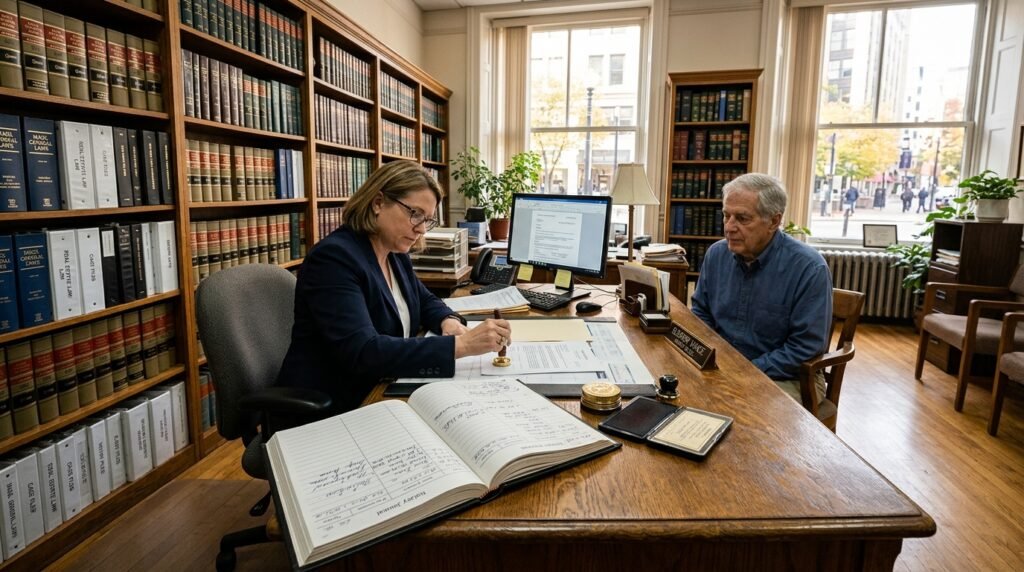
Signing a commercial lease agreement in Florida is one of the bigger commitments a business owner makes, and the landscape around it is different from what most people expect coming from residential renting.
Commercial tenants have far less built-in protection under state law than residential tenants do. Furthermore, the rules governing what makes a lease valid aren’t always intuitive, especially since some of the older requirements people remember no longer apply.
This article walks through what Florida law actually requires for a commercial lease agreement, what should be included beyond the legal minimum, and where notarization fits into the picture, since that part trips up more people than you might expect!
You may also like: How to write a consent letter for a passport application
What makes a commercial lease agreement in Florida legally valid?

Florida treats commercial leases primarily as contracts, governed by general contract law rather than the more protective landlord-tenant statutes that apply to residential rentals.
That gives both landlords and tenants more flexibility, but it also means there is less of a built-in safety net if something is drafted poorly or left out altogether.
The most important rule comes from Florida’s statute of frauds, codified in Florida Statute 725.01. Any lease with a term longer than one year must be in writing and signed by the party against whom it will be enforced.
A lease for one year or less can technically be agreed to verbally and still hold up in court, but in practice, almost no commercial lease is handled this way, given how much money and how many obligations are typically involved.
It is worth noting that the witness requirement that many people still associate with Florida leases no longer applies.
Until 2020, Florida Statute 689.01 required two subscribing witnesses for any lease running longer than a year. The Florida Legislature removed that requirement that year, and the law has not required witnesses for leases since the amendment took effect.
A valid commercial lease today simply needs to be in writing, properly signed, and clear about its essential terms – the names of the parties, a description of the property, the term, and the rent.
What should a commercial lease agreement actually include?
Meeting the legal minimum is not the same as having a lease that actually protects your interests. A well-drafted commercial lease agreement should go well beyond a basic written contract.
At a minimum, the lease should clearly identify both parties, describe the leased premises in detail, and state the lease term and rent amount.
Beyond that baseline, commercial leases typically address far more ground than residential ones, because Florida law leaves most of these terms to negotiation rather than dictating them by statute the way it does for residential tenancies.
If there’s anything you should pay extra attention to, it’s the rent structure. Commercial leases are often priced per square foot rather than as a flat monthly amount, and many include additional charges for property taxes, insurance, and common area maintenance on top of base rent.
This is sometimes called a triple net lease, and it is common enough in Florida commercial real estate that it is worth understanding before signing anything. The lease should spell out exactly what is included in base rent and what triggers an increase down the line.
Use restrictions, maintenance responsibilities, and improvement allowances are also worth addressing directly. Florida gives commercial landlords considerably more authority than residential landlords, including more flexibility around remedies and enforcement that would not be permitted in a residential context.
Because so much is left to the contract itself, vague language in any of these areas tends to surface as a dispute later, not at the time of signing, when everyone is still on good terms.
If a real estate broker is involved in negotiating the lease, Florida law also requires written disclosure of that broker’s relationship to either party, so both sides understand who the broker is actually representing in the transaction.
Does a commercial lease agreement in Florida need to be notarized?
No, as a commercial lease agreement in Florida does not need to be notarized to be valid or enforceable.
This surprises a lot of people, since notarization feels like a natural step for a document this significant, but Florida law simply does not impose that requirement on leases of any length.

There’s one important exception worth knowing about, though. If either party wants to record the lease in the county’s public records, the document must be notarized first, because Florida requires notarization for anything entered into the public record.
Recording a lease is optional, but tenants sometimes request it to protect their interest in the property in case of a future sale or dispute, and landlords occasionally prefer it for the same reason.
Even when notarization is not legally required, many landlords and tenants choose to have the lease notarized anyway. It does not strengthen or weaken the contract’s enforceability, but it does create a verified record of who signed the document and confirms that the signatures are authentic.
For a lease involving significant rent obligations or a long term, that extra layer of certainty is often worth the small additional step.
Why do some parties choose notarization even when not required?
A notarized signature is harder to dispute later. If a disagreement ever arises over whether a particular signature is genuine, having a notary’s seal and record removes most of the ambiguity.
This is very relevant for personal guarantee clauses, which are common in Florida commercial leases and require a business owner to personally back the company’s lease obligations.
As a personal guarantee carries real financial consequences for an individual, it’s common for landlords to request notarization of that clause in specific (even if the rest of the lease is not notarized).
Multi-party leases, leases involving corporate signers, or leases that will be referenced in future financing or sale transactions are also situations where notarization adds practical value, even without a legal mandate behind it.
FAQ: commercial lease agreements in Florida

Do both the landlord and tenant need to sign in front of the same notary? No. If the lease is being notarized, each party’s signature can typically be notarized separately, often at different times and locations, as long as each notarization is properly completed and documented.
Can a mobile notary notarize a commercial lease agreement? Yes. A mobile notary can come to a landlord’s office, a tenant’s place of business, or any other location to witness and notarize the signing, which is often more convenient than coordinating everyone around a single appointment.
Does notarizing a lease change anything about its enforceability? No. Notarization confirms the identity of the signer and the authenticity of the signature. It does not change the legal terms of the lease or make an otherwise invalid lease enforceable.
Mobile Notary Orlando: your notarization partner in Florida
As seen above, a commercial lease agreement in Florida carries fewer mandatory formalities than many business owners expect, but that flexibility cuts both ways. What the law does not require, the contract itself has to handle, which is exactly why careful drafting matters more than checking a notarization box.
This type of lease is too important a document to leave any part of it to chance, and notarization is a small step that adds real peace of mind, even when the law does not demand it.
At Mobile Notary Orlando, we can make that step effortless. Instead of coordinating schedules around an office visit, we come directly to your business, your attorney’s office, or wherever your signing is happening, fitting into your day rather than the other way around. Yes, we’re available 24/7!
We have built our reputation as the most dependable mobile notary partner across Orange, Seminole, Brevard, and Osceola counties, and we would be glad to be part of yours. Reach out whenever you are ready!