You are looking at a power of attorney, a deed, or a loan document, and you see an empty field. Maybe nobody typed in the other party’s name. Maybe the date line is blank. Your notary appointment is soon, and you need this finished.
The direct answer: in most cases, no. Florida Statutes § 117.107(10) prohibit a notary from notarizing a signature on a document that is blank or incomplete. Blank spaces can be filled in after you sign with terms you never agreed to. The law closes that door before it opens.
But not every empty space on a page is the same kind of problem. Understanding which blanks matter, which ones are expected, and how to fix the real issues before your appointment can save you a wasted day and a missed deadline.
What Florida Law Says About Blank and Incomplete Documents
Florida’s rule is short and unambiguous. A notary may not notarize a signature on a document that is incomplete or blank. Period. If you hand a notary a half-filled power of attorney and say “my attorney will add the agent’s name later,” the notary must decline. The blank creates room for someone to insert terms you never intended.
There is one narrow exception written into the statute. A blank endorsement or assignment on certain promissory notes or security instruments is not considered incomplete under this subsection. That matters in mortgage lending, where negotiable instruments sometimes change hands with a blank endorsement by design. For a personal document like a deed, affidavit, or medical directive, the exception almost certainly does not apply to your situation.
Florida is not unusual here. Ohio Revised Code § 147.141 uses nearly identical language, barring notarization of a blank or incomplete document and prohibiting any alteration after signing. California’s notary handbook instructs notaries to refuse a document “known from experience or plainly on its face to be incomplete.” Colorado’s Secretary of State goes further with specific instructions: the signer should fill in blanks, draw a line through unused spaces, or write “N/A” before the notary proceeds.
The exact wording differs from state to state, but the principle holds everywhere: sign a complete document, not a partially filled template.
Not Every Empty Space Is a Problem
“Incomplete” refers to fields that affect the substance of the agreement. A missing party name, dollar amount, property address, date, or beneficiary designation qualifies as a material blank. Those fields change what the document means, and they must be completed before signing.
Other empty spaces are normal:
- If you and a co-signer live in different cities, the notary can notarize your signature even though the other person has not signed yet. The document is not incomplete just because a second party executes it later at a separate appointment.
- Many government and lender forms have boxes marked “For Official Use Only” or “Recorder’s Use.” Those are meant to stay blank at signing. The receiving office fills them in.
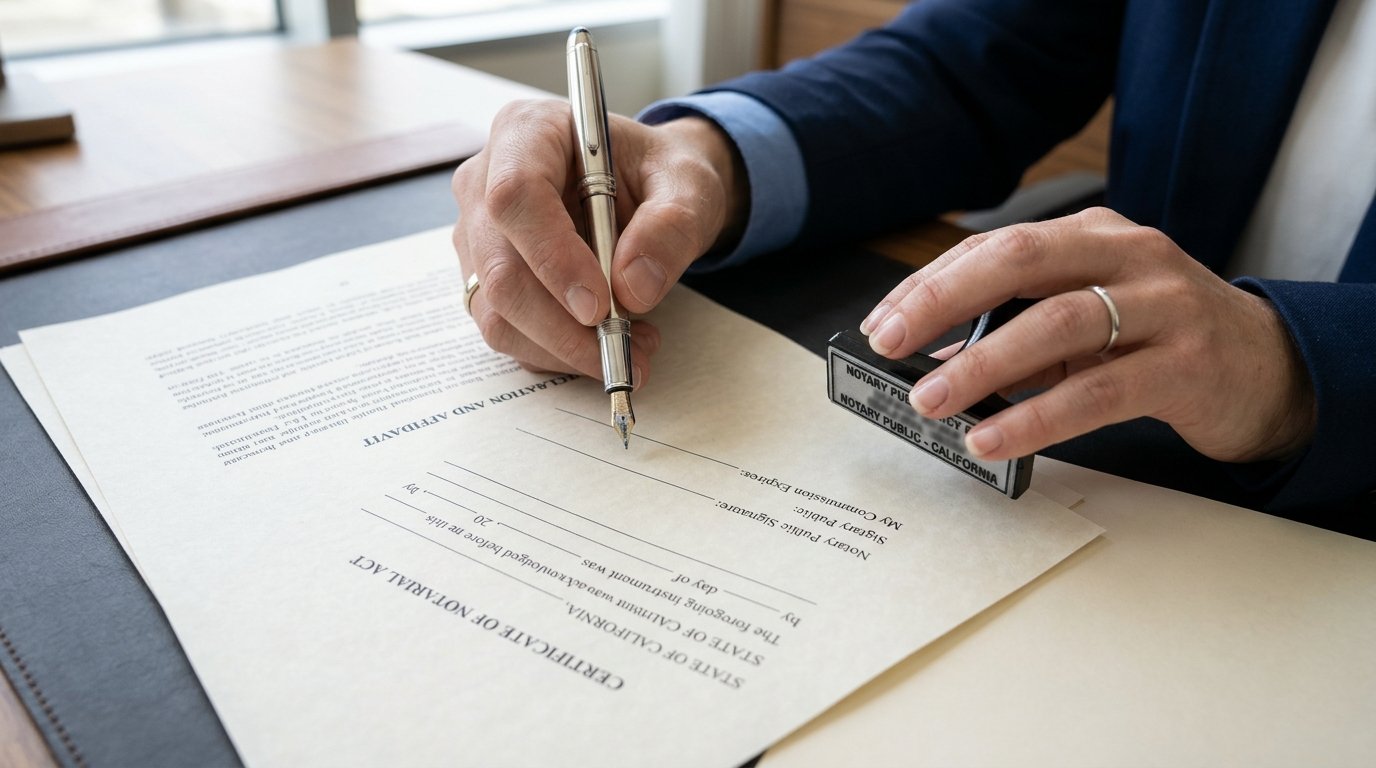
- The notarial certificate itself (the venue line, date of notarization, notary name, commission expiration, and seal) is the notary’s job. Those fields are completed during or immediately after the act, not by you beforehand.
The practical test is simple: does the empty field change the rights, obligations, or meaning of the document? If yes, fill it in before your appointment. If the field belongs to someone else (the county recorder, the lender’s back office, the notary), leave it alone.
How to Prepare Your Document Before the Notary Arrives
A little preparation prevents real headaches. We have seen signers lose days because a single blank field forced a reschedule. Here is what to check before your appointment:
- Read every page, not just the signature page. If the document is ten pages long, bring all ten. The National Notary Association advises that a notary should not proceed with a signature page presented without the rest of the instrument.
- Fill in every substantive field: names, addresses, dates, amounts, property descriptions. If you do not know what goes in a field, contact the person or company that gave you the document. Your attorney, title company, or lender can answer quickly.
- Draw a line through fields that do not apply to you, or write “N/A.” A form asks for a middle name and you do not have one? Write “N/A.” A section covers a situation that is not yours? Line through it. This tells everyone the space was intentionally left unused, not accidentally skipped.
- Do not leave a blank date field empty. If the document has a space for the date, enter the correct date. If you genuinely do not know what date belongs there, ask the document preparer.
- Bring valid, unexpired government-issued photo ID. A missing or expired ID is the second most common reason for a rescheduled notary appointment, right behind incomplete documents.
When you work with a mobile notary, preparation matters even more. We drive to your home, office, hospital, or wherever you need us across Orange, Seminole, Osceola, and Brevard counties. If a blank field forces us to pause, you are not just losing an appointment slot. You are waiting for a second visit.
What the Notary Cannot Do for You
A Florida notary public has six defined duties: administering oaths and affirmations, taking acknowledgments, attesting to photocopies of certain documents, solemnizing marriages, verifying vehicle identification numbers, and certifying safe deposit box contents. Filling in your document is not one of them.
A notary cannot type in names, dates, dollar amounts, or other substantive terms on your behalf. Texas guidance makes the point clearly: a nonattorney notary should not choose a notarial certificate when the document lacks one, and Florida notaries follow the same principle. Choosing between an acknowledgment and a jurat for you could cross into unauthorized practice of law.
A notary also cannot advise you on whether the document is legally sufficient, whether it suits your situation, or what terms should appear in the blanks.
This is not rigid bureaucracy. It is a boundary that keeps the notary neutral and keeps you in control. A notary who fills in blanks or selects your certificate type could leave you with a document that does not say what you intended. If you are unsure about any field, the right move is to call the person who prepared the document or consult an attorney before the signing appointment.
When Blank Fields Lead to Real Trouble
The prohibition is not theoretical. Courts and federal prosecutors deal with documents that were signed incomplete and later altered.
In 2025, an Ohio appellate court ruled that a quitclaim deed was forged, void, and ineffective to transfer title. The deed was missing the grantor’s marital status, and the first page had no date. The notary testified that identifying information on the second page was not in his handwriting and that the stamp appeared altered from another notarized document. The county recorder had accepted the deed and recorded it. That recording did not prove the signature was genuine. The property owner kept her home, but only after going through litigation.
In February 2026, a Tennessee federal court sentenced a notary to 57 months in prison and ordered $280,914.25 in restitution for notarizing fraudulent quitclaim deeds that transferred more than 30 Memphis-area properties. That case involved deliberate fraud, not a careless blank. But it shows the stakes: a notary’s stamp on a manipulated document can cost people their homes.
The broader picture reinforces the concern. ALTA’s September 2026 survey found that 59% of responding title firms reported at least one seller-impersonation attempt in 2025, up from 28% in the prior survey. Document integrity is not a footnote. It is the whole reason the rules exist.
What to Do If the Problem Shows Up After Notarization
Maybe a notarization already happened and you realize a field was left blank or filled in incorrectly. The fix is not to go back and “correct” the original certificate.
Florida law prohibits a notary from amending a notarial certificate after it has been completed. California’s handbook says the same. There is no post-hoc correction procedure for a finished notarial act. The solution is to have the underlying document corrected by the drafter or an attorney, then do a fresh notarization with a new certificate and a new journal entry.
If you are dealing with a power of attorney that was notarized with a problem, the practical step is to get a corrected version prepared and schedule a new notarization. A typical POA signing runs 20 to 45 minutes depending on the number of pages.
For documents that have already been filed or sent abroad, the correction process may add steps. If the document carried an apostille, for example, the apostille certificate was issued for the original notarization. A new notarization means a new apostille. Plan accordingly if you are working against a deadline for an overseas filing.
Quick Reference: Which Blanks Stop a Notarization
| Type of blank | Can the notary proceed? | What to do |
|---|---|---|
| Party name, amount, property description, or other material term | No | Signer fills it in, or contacts the document originator |
| Date field left empty | No (if the field exists on the form) | Signer enters the correct date or lines through the field |
| “For Official Use Only” or recorder’s section | Yes | Leave blank; the receiving office fills it |
| Signature line for another party who signs separately | Yes (for your signature) | The notary notarizes your signature; the other party signs at their own appointment |
| Notarial certificate fields (venue, date, notary info) | Yes | The notary completes these during the act |
| A field you do not understand | Stop | Contact the document preparer or an attorney before signing |

Frequently Asked Questions
Can a notary fill in a missing name or date on my document?
No. A notary cannot supply substantive information such as names, dates, amounts, or property descriptions. Those fields must be completed by the signer or the person who prepared the document. The notary fills in only the notarial certificate: venue, date of the act, the notary’s own name, and commission details.
What if the blank field does not apply to my situation?
Write “N/A” in the field or draw a line through it before signing. This shows the space was intentionally left unused, not missed by accident. An unmarked blank looks like an oversight, and a notary may reasonably refuse to proceed until it is addressed.
Can I have my signature notarized if the other signer has not signed yet?
Usually yes. If a document requires signatures from people in different locations, a notary can notarize your signature as long as you present valid ID and the document is otherwise complete. The other party has their own signature notarized at a separate appointment.
What should I do if my document has no notarial certificate attached?
Contact the person or company that prepared the document and ask which certificate type is needed (acknowledgment, jurat, or another form). A notary cannot choose for you because selecting the wrong type could affect the document’s legal validity, and making that choice could cross into unauthorized practice of law.
What if I discover a blank field after the document was already notarized?
Florida law does not allow a notary to amend a completed certificate. The document must be corrected by its preparer or an attorney, then notarized again with a new certificate and journal entry. If the document was already filed or apostilled, the receiving office may have its own correction requirements.
Does this rule apply to remote online notarization?
Yes. The requirement that a document be complete before notarization applies whether the act happens in person or through a remote online notarization (RON) platform. Digital platforms may flag missing signatures or initials, but they do not verify that every substantive field has been filled. The notary still applies state law to decide whether to proceed.
If you are in Orange, Seminole, Osceola, or Brevard County and need a document notarized, we can meet you at home, your office, or the hospital. Call or text us at (689) 285-5579 to check available time slots. If you are not sure whether your document is ready, describe the situation when you reach out. We will let you know what to expect so neither of us wastes a trip.