
Someone handed you a checklist. Maybe it came from an immigration attorney, a title company, a foreign consulate, or a university overseas. Somewhere on that list: “submit a notarially certified copy” or “documents must be notarially certified.” You know you need a notary. What you don’t know is which notarial act, which certificate, and whether the document will actually be accepted once it’s stamped.
That uncertainty is the real problem. A notary seal alone does not make a document “certified” for every purpose. The term “notarially certified” describes a result, not a single procedure, and getting the wrong one means rejection, delay, and paying to do it over.
Here is what the phrase means, what kinds of certification exist, why documents still get rejected after notarization, and how to match the right notarial act to your specific situation.
What “Notarially Certified” Actually Means
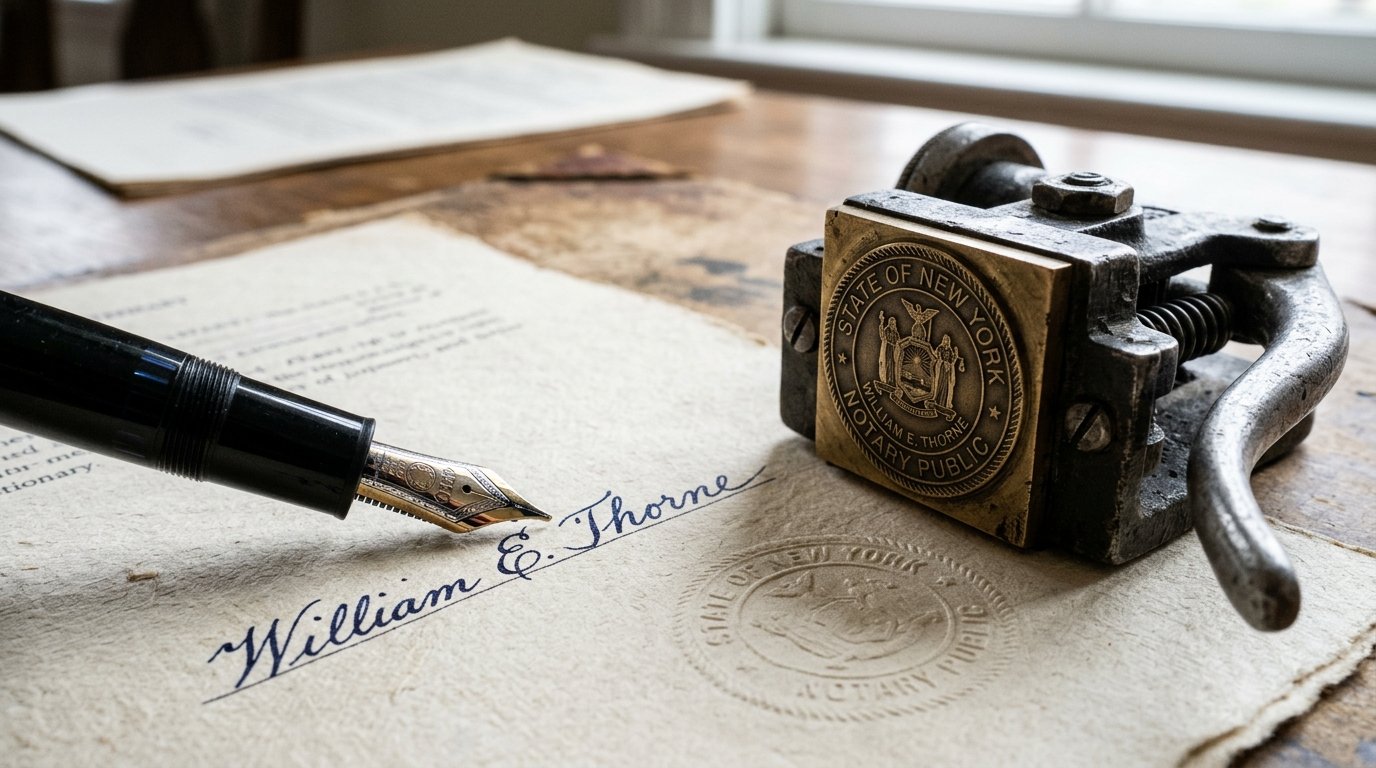
“Notarially certified” means a commissioned notary public performed a specific official act on or in connection with your document. That act is recorded through a notarial certificate: a written statement attached to or placed on the document, signed and sealed by the notary.
The key word is “specific.” A notary can perform several different acts, and each one certifies something different. California’s 2026 Notary Public Handbook makes this explicit: an acknowledgment verifies the signer’s identity and their acknowledgment of signing, but it does not verify the truthfulness, accuracy, or validity of the document itself.
That distinction trips people up constantly. When a bank, embassy, or government agency asks for a “notarially certified” document, they are asking for a particular assurance. Your job is to find out which one before you sit down with a notary.
Acknowledgment, Jurat, and Certified Copy Are Three Different Things
Most requests for notarially certified documents fall into three categories. They are not interchangeable, and choosing the wrong one is the single fastest way to have a document rejected.
Acknowledgment
The signer appears before the notary, proves their identity, and acknowledges that they signed the document voluntarily. The notary does not need to watch the signing happen (the document can be pre-signed) and does not verify that the statements inside the document are true. Deeds, mortgages, and powers of attorney typically call for an acknowledgment.
Jurat
The signer appears, proves their identity, signs the document in the notary’s presence, and takes an oath or affirmation that the contents are true. Because it includes that sworn statement, a jurat carries a stronger personal commitment. Affidavits and sworn statements usually require one. If the form says “subscribed and sworn to before me,” that is a jurat.
Certified copy
The notary certifies that a photocopy is a true, correct, and complete reproduction of the original. This one comes with a significant catch: the U.S. State Department notes that copy-certification authority varies by state, and public records like birth, death, and marriage certificates generally must come from the official records custodian, not from a notary’s photocopy.
Florida notaries can attest to photocopies of certain documents under state law. But that authority is not unlimited. The receiving institution’s rules control what they will accept.
Bottom line: if you bring a document to a notary and say “certify this,” the notary’s first question should be, “What type of act does the recipient require?” If the notary does not ask, ask it yourself.
Five Reasons Notarized Documents Get Rejected
Having a notary seal on your document does not guarantee acceptance. These are the problems we see most often.
The first, and most common, is getting the wrong certificate type. You needed a jurat but got an acknowledgment, or the other way around. The receiving party’s instructions almost always specify which act is required. Read those instructions before scheduling your appointment, not after.
The second is an illegible seal. A notary stamp must include the notary’s name, commission number, commission expiration date, and state of commission. Faded ink, a smudged impression, or a partial print on textured paper can all trigger rejection.
Third: name mismatches. The name on your identification must match the name on the document. If your passport says “Maria Elena Santos” but the document says “Maria E. Santos,” some agencies will refuse it. A 2025 NNA errors-and-omissions report described a warranty-deed notarization where the signer’s journal entry did not match the grantor name on the deed. That single inconsistency led to a $55,000 settlement plus $18,000 in attorneys’ fees.
Fourth: a missing step in the authentication chain. You got the document notarized but did not realize you also needed an apostille, a consular legalization, or a state-level certification. Notarization is often the first link, not the last one.
Fifth: the document was pre-signed when a jurat was required. If the receiving party asks for a jurat, you must sign in front of the notary and take an oath. Arriving with a document you already signed means starting over.
Every one of these problems is avoidable with the same preparation: read the receiving institution’s requirements, check that the name on your ID matches the document, and bring the right identification to the appointment.
When Notarization Alone Is Not Enough: Apostilles and International Documents
If your notarially certified document is headed to another country, notarization may be only the first step.
Countries that are part of the Hague Apostille Convention accept an apostille as proof that a public document’s signature, seal, and the signer’s official capacity are authentic. The apostille does not authenticate the document’s contents. It authenticates the notary’s authority to act.
The process works in sequence: your document gets notarized, then the notarized document gets an apostille from the Secretary of State in the state where the notary is commissioned. For documents notarized in Florida, that means the Florida Secretary of State in Tallahassee.
Countries that have not joined the Convention require a longer process called embassy legalization, which may involve the Secretary of State, the U.S. Department of State, and the destination country’s embassy or consulate.
As of January 2026, 59 countries and territories had implemented at least one component of the electronic Apostille Programme, which means some apostilles can now be issued and verified digitally. But the starting point is still the same: the document must be properly notarized first.
For an apostille in Central Florida, the Secretary of State’s filing fee is $10 per document. Walking into the Tallahassee office gets same-day results. Mailing it yourself takes 7 to 10 business days, and regular mail without tracking has been known to stretch to six weeks. We handle the full chain (notarization, courier to Tallahassee, and return delivery) through our apostille service.
Foreign-Language Documents and Certified Translations
This is where the layers stack up. If you are submitting a foreign-language document to a U.S. agency, you typically need three things:
- The original document or an acceptable copy
- A full English translation (not a summary)
- A translator’s certification stating the translation is complete, accurate, and that the translator is competent to translate
USCIS policy requires a full English translation and a translator’s certification of completeness, accuracy, and competence. It does not expressly require the translator’s certification to be notarized, but many attorneys and agencies request notarization as an added layer of credibility.
The distinction matters: the notary is notarizing the translator’s signature and oath. The notary is not certifying that the translation is correct. The notary probably cannot read the foreign-language original. That is fine. The notary’s role is to verify the translator’s identity and administer the oath or witness the acknowledgment.
One important warning for Spanish and Portuguese speakers: in many Latin American countries, a “notario público” is a licensed legal professional with authority similar to a lawyer. In the United States, a notary public has no such authority. California Attorney General Rob Bonta issued a consumer alert in June 2025 specifically warning that U.S. notaries and immigration consultants are not authorized to give immigration legal advice. If someone calling themselves a “notario” offers to prepare your immigration case, step back. That work belongs to a licensed attorney or accredited representative.
A Quick Decision Guide Before Your Appointment
Before you schedule a notary appointment, answer four questions. If you can answer all four, you will get the right service on the first try. For reference, you can review an example of a notarized document to see what a properly completed notarial certificate looks like.
1. What does the receiving institution require? Look for exact language: “notarized,” “acknowledged,” “sworn,” “certified copy,” “apostilled.” Each word points to a different act or chain of acts.
2. Is the document going abroad? If yes, check whether the destination country is a Hague Convention member. That determines whether you need an apostille or a full embassy legalization.
3. Is the document in a foreign language? If a U.S. agency will receive it, you likely need a full translation plus a translator’s certification. Confirm whether the certification must also be notarized.
4. Does the signer need to sign in front of the notary? For a jurat, yes. For an acknowledgment, the signer must appear before the notary but may have pre-signed. For some acts, witnesses may also need to be present. A power of attorney signing, for example, typically runs 20 to 45 minutes depending on the number of pages and whether witnesses are required.
How a Mobile Notary Fits In
Every notarial act described above can be performed by a mobile notary. The legal authority is identical. The difference is location: instead of you driving to an office and waiting, the notary comes to you.
That flexibility solves real coordination problems. A signer in a hospital bed cannot travel to a notary office. A real estate closing with a tight deadline and parties in different parts of town needs a notary signing agent who can meet people where they are. Someone working night shifts cannot visit a bank during business hours. A parent signing a power of attorney for a child studying overseas needs a notary who can come to the house at a convenient time.
The act itself does not change. The notary verifies your identity, determines which certificate the receiving party requires, completes the act (acknowledgment, jurat, witnessing, or another authorized act), applies the official seal and signature, and records the transaction. What changes is that it happens at your kitchen table, an office conference room, a coffee shop, or a hospital room.
We serve Orange, Seminole, Osceola, and Brevard counties and work in English, Spanish, and Portuguese. If you have a document that needs to be notarially certified and you are not sure which act applies, call or text us at (689) 285-5579. We can walk through the receiving party’s requirements with you and meet you wherever is most convenient.

Frequently Asked Questions
What is the difference between “notarized” and “notarially certified”?
In everyday use, the terms overlap. Both mean a notary public performed an official act. “Notarially certified” sometimes signals a certified-copy procedure specifically, but the receiving institution’s instructions control the meaning. When in doubt, ask them which notarial act they require.
Can a Florida notary certify a copy of my birth certificate?
Generally, no. Birth certificates, death certificates, and marriage certificates are public vital records. The issuing government agency (typically your county vital records office) is the only entity authorized to issue official certified copies. A notary can attest to photocopies of certain other documents under Florida law, but that does not extend to vital records.
Does notarization prove my document is legally valid or true?
No. An acknowledgment verifies the signer’s identity and voluntary execution. A jurat means the signer swore under oath that the contents are true. Neither act means the notary independently investigated or guaranteed the document’s accuracy or legal validity.
How much does notarial certification cost in Florida?
Florida law caps standard notarization fees at $10 per notarial act. Mobile notaries typically add a travel or convenience fee. An apostille filing at the Secretary of State is $10 per document, with additional costs for courier or handling services. Ask for an itemized breakdown before scheduling.
Can I get a document notarized if it is written in Spanish or Portuguese?
Yes. A Florida notary can notarize a document written in any language, provided the notary can communicate directly with the signer and the signer understands the act being performed. The notary does not need to read the entire document. If you also need a certified English translation for a U.S. agency, that is a separate step handled by a qualified translator.
What should I do if my notarized document was rejected?
Identify the rejection reason first. Common causes include the wrong certificate type, an illegible seal, a name mismatch between ID and document, or a missing apostille. In most cases, the document can be re-notarized with the correct certificate. If the problem is a name discrepancy, you may need to correct the underlying document or use identification that matches it exactly.