You need a document notarized, and you cannot get to an office. Maybe you are sitting with a family member at the hospital, locked into a workday you cannot leave, or recovering at home after surgery. The search makes sense: how far will a mobile notary travel to reach you?
The honest answer is that no national mileage limit exists. Most mobile notaries cover a routine radius of 10 to 50 miles. Some accept appointments beyond 100 miles for a higher fee. What determines the answer for your situation is a combination of your address, the notary’s schedule, state fee rules, and how much the full trip will cost you. Distance alone does not settle it.
This article walks through what shapes a mobile notary’s travel range, how distance changes the bill, and what to have ready so the appointment actually works on the first visit.
No Fixed Travel Limit Applies Nationwide
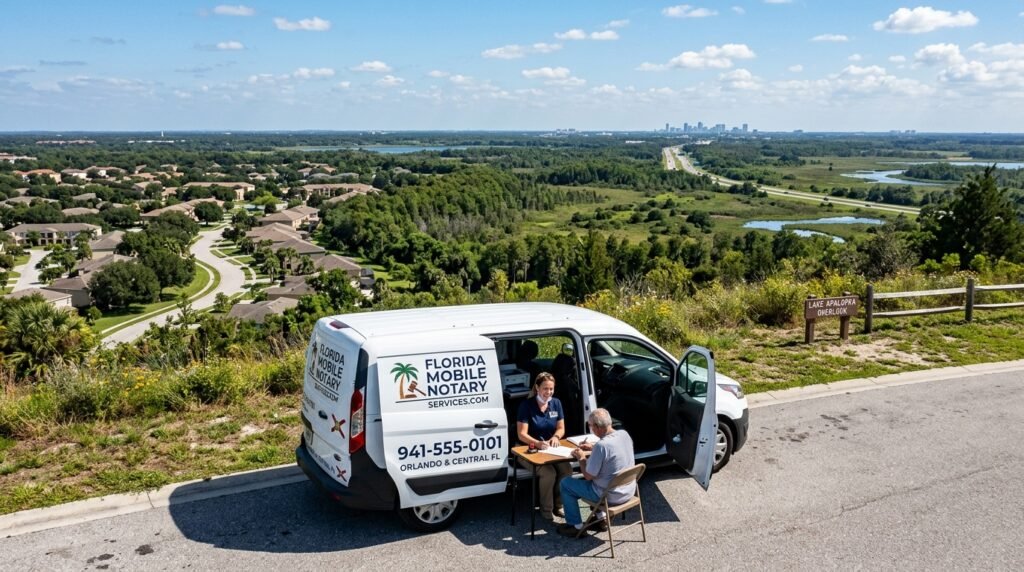
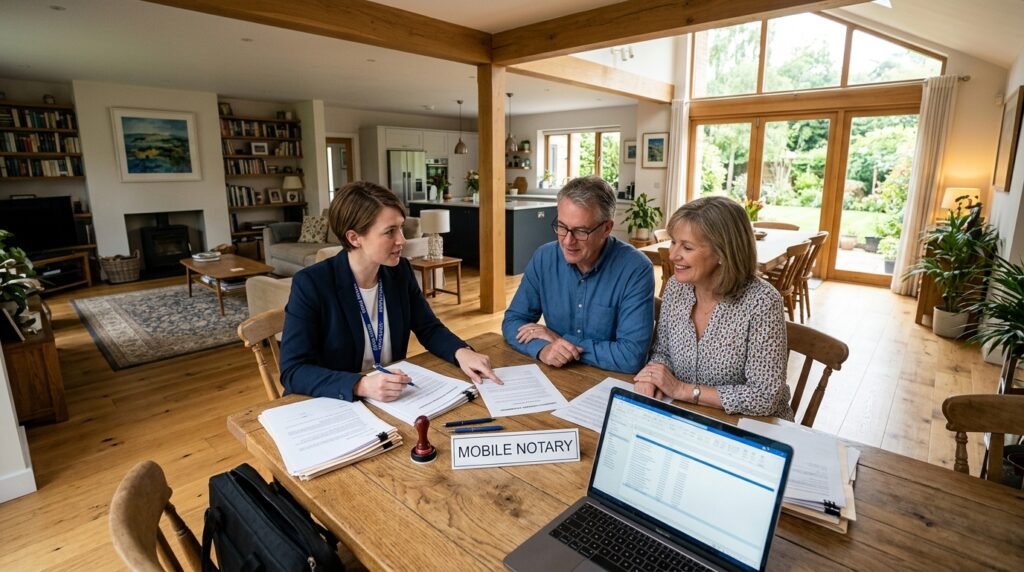
A mobile notary is a commissioned notary public who goes to the signer instead of working from a fixed office. Beyond that basic definition, every provider draws their own map. Published service areas across the country illustrate the spread:
- A provider in Round Rock, Texas, describes a typical 25-mile radius but invites inquiries from outside that zone.
- A Virginia-based service publishes a 50-mile primary radius with extended scheduling in surrounding areas.
- A Central Ohio notary prices travel in bands up to 20 miles, then adds a per-mile charge beyond that.
- One national provider publishes a pricing structure for trips exceeding 100 miles one way, including return-trip charges.
These are individual business decisions, not regulatory benchmarks. A notary with a 25-mile standard radius might still say yes to a 40-mile request on a slow afternoon. The only way to know is to provide your exact address and ask.

What Actually Determines a Mobile Notary’s Range
Five variables shape whether a notary will accept your appointment and what the trip will cost.
Base location and current schedule. Some notaries quote travel from a fixed office. Others run back-to-back appointments across a metro area and quote from wherever they are when you call. The same address can produce two different quotes from the same notary depending on the day.
Time of day. Evening, weekend, and holiday appointments often carry a surcharge of $25 to $75. Some providers simply do not work after hours. If your need is urgent at 9 p.m., expect fewer available notaries and a higher fee for the ones who are.
Number of signers and documents. A single acknowledgment on one page takes minutes. A full mortgage loan signing with 150 pages and two borrowers takes well over an hour. Notaries are more willing to drive farther when the appointment itself justifies the time and the signing-agent fee.
Your specific location. A suburban home visit is simple. A hospital means parking structures, check-in desks, elevators, and sometimes restricted visiting hours. A detention facility means security protocols and limited scheduling windows. Even locations like airports require special coordination, as detailed in our guide about mobile notary service at airports. These add time that providers factor into their quotes or their willingness to accept the job.
Commission territory. A notary public is commissioned by a specific state. California and Texas both grant statewide authority, meaning county lines are not a restriction within the state. But that authority stops at the state border. If you live near a state line, confirm that the notary holds a valid commission in the state where the signing will physically occur.
How Travel Distance Changes Your Total Bill
The cost of a mobile notary appointment has two distinct parts, and confusing them leads to sticker shock.
The first part is the notarial act fee, which state law sets or caps. In Florida, that fee is $10 per notarized signature. Straightforward.
The second part is the travel or convenience fee, and in many states (Florida included), no statute caps it. This is where costs vary dramatically.
| Pricing model | How it works | What to ask |
|---|---|---|
| Flat fee by radius band | $25 for up to 5 miles, $40 for 15 to 20 miles | What happens beyond the last band? |
| Base fee plus per-mile | $35 base, then $1.10 per mile beyond 10 miles | Are “miles” measured one way or round trip? |
| Tiered mileage rate | $2/mile for the first 100 miles, $5/mile after, plus 50% return | A 120-mile trip under this model costs $450 in travel alone |
| Hourly travel charge (state-regulated) | Up to $15/hour during business hours in Nevada | Does the state set the ceiling, or the notary? |
The practical formula is:
Total cost = notarial act fees + travel/convenience fee + extras (rush, waiting time, parking, witnesses, extra signers).
Extras add up faster than most people expect. Some providers start a waiting-time clock after 15 minutes. Others charge the full mobile fee if you cancel with less than two hours’ notice. Always get the complete, itemized quote before the notary leaves their location.
State Rules That Shape Notary Travel Fees
The National Notary Association identifies four broad approaches states take to travel fees:
Fixed caps. Nevada limits travel charges to $15 per hour during daytime (6 a.m. to 7 p.m.) and $30 per hour at night, with an allowed two-hour minimum. The notary must explain and agree on charges before traveling.
Federal mileage rate tie-ins. Maryland permits the IRS standard business mileage rate (currently 76 cents per mile for July through December 2026) plus a travel fee of no more than $5. North Carolina follows a similar approach but requires the signer’s written agreement before the notary starts driving.
General guidelines. These states require fees to be “reasonable” or “customary” without naming a dollar amount.
Provider-set fees. Florida falls here. The $10-per-signature notarial fee is fixed by statute, but no state law caps the travel charge. Your quote depends entirely on the provider, the distance, and the local market.
One current development worth noting: Pennsylvania’s regulations implementing the Revised Uniform Law on Notarial Acts took effect March 28, 2026, and they require itemized receipts that separate notarial fees from other charges. That kind of transparency is heading in a good direction. Wherever you are, asking for an itemized breakdown is the simplest way to avoid surprises.
When the Real Problem Is Not Distance
Sometimes people searching for travel range are facing an obstacle that more miles will not solve. Here are the ones we see most often.
Hospital and nursing home visits. The notary can reach the building. The question is whether the signer can participate. The person signing must be conscious, understand the document, and communicate consent. If they cannot hold a pen, a signature-by-mark procedure exists, but it requires witnesses. Coordinate the patient’s condition, facility visiting hours, required identification, and any witnesses before scheduling. Paying for a 30-mile trip accomplishes nothing if the signer cannot participate when the notary walks in.
Identification gaps. No valid ID, no notarization. In Florida, that means a current government-issued photo ID: driver’s license, passport, or state ID card. If the signer’s ID is expired or missing, that problem needs to be solved first.
Document preparation. A notary does not draft your documents. If you need a power of attorney prepared, that happens before the notarization appointment. Showing up with a blank template expecting the notary to fill it in will not work. We are not licensed to practice law in Florida and cannot advise you on what your document should say.
Witness requirements. Some documents require one or two witnesses in addition to the notary. If the appointment is at a private residence, you need those witnesses present. Mention this when you book so nobody wastes a trip.
The pattern here is consistent: resolve identification, documents, witnesses, and signer readiness before spending money on travel. Getting those right makes the appointment work on the first visit.
How to Get a Mobile Notary to Your Location
Whether you are five miles from a notary or fifty, the process runs smoother when you come prepared. If you’re wondering how fast a mobile notary can come, having the right information ready speeds up both scheduling and arrival time. Have the following ready when you call or text:
Your exact address and access details. “Orlando” is not enough. A specific street address, building name, floor, and notes about parking or security help the notary plan the trip and quote accurately.
The document type and number of signatures needed. “I need something notarized” is a start. “Two signatures on a power of attorney, plus one witness” is much better.
How many signers will be present. Each signer needs their own valid photo ID. If two people are signing, both must be there.
Your preferred date and time. Same-day service is often possible. But even a few hours’ notice improves availability, especially for hospital visits or after-hours requests.
Any special circumstances. Hospital room, homebound signer, language needs (we work in English, Spanish, and Portuguese), someone signing by mark. Mention these upfront so the notary brings the right tools and allocates enough time.
With that information, the call takes two minutes. A good mobile notary will confirm whether they can serve your address, give you the total cost (not just the per-signature fee), and tell you exactly what to have ready.
We cover Orange, Seminole, Osceola, and Brevard counties and are reachable 24/7 by call or text at (689) 285-5579. If you need a document notarized at your home, office, hospital, or anywhere else in Central Florida, reach out to check available time slots. We will give you a straight answer on whether we can get there and what it will cost.

Frequently Asked Questions
How far will a mobile notary travel?
There is no universal limit. Most providers cover 10 to 50 miles as a routine service area, though some accept appointments beyond 100 miles for higher travel fees. The only reliable way to find out is to provide your exact address and ask for a complete quote.
Can a mobile notary cross county lines?
In most states, yes. Florida notaries hold statewide commissions, so county boundaries are not a restriction within the state. The limit is the state line: a Florida-commissioned notary cannot perform notarial acts in another state.
How much does a mobile notary charge for travel?
It depends on the state and the provider. Florida does not cap travel fees, so quotes vary by distance, time of day, and appointment complexity. Expect anywhere from $25 for a short local trip to several hundred dollars for long-distance or after-hours service. Always ask for the total cost, not just the notarial fee.
Will a mobile notary come to a hospital or nursing home?
Many will. The key requirement is that the signer must be conscious, understand the document, and able to communicate consent. Coordinate identification, witnesses, visiting hours, and the patient’s condition before scheduling the appointment.
Is online notarization an alternative to a mobile visit?
For some documents, yes. 47 states and Washington, DC, have enacted remote online notarization laws, with published prices starting around $25 per session. However, not all documents qualify, and not all recipients (courts, foreign governments, certain lenders) accept remotely notarized documents. Confirm acceptance with the receiving party before choosing this option.
What should I have ready when the mobile notary arrives?
A valid, current government-issued photo ID for every signer. The completed documents to be notarized (not blank forms). Any required witnesses physically present. A surface for signing, even if it is a hospital tray table. Having everything prepared keeps the appointment short and helps avoid waiting-time charges.