
You have a guardianship form on the table, a school enrollment deadline or a medical appointment that will not wait, and one question: does this need a notary stamp before anyone will accept it?
The honest answer is that it depends on two things: which state you are in and which guardianship document you are holding. Some require notarization. Some require witnesses instead. Some need both. And a few allow a sworn declaration as a substitute. Getting it wrong can mean a rejected filing, a wasted trip to the courthouse, or worse, a document that looks official but carries no legal weight at all.
We notarize guardianship-related documents regularly for families across Orange, Seminole, Osceola, and Brevard counties. Here is how the rules actually work, what notarization does (and does not do) for your document, and what to check before you sign.
The Answer Changes Based on the Document and the State
There is no single federal rule that says “all guardianship documents must be notarized.” Guardianship law is state law. Each state decides which documents need a notary, which need witnesses, and which need a court filing on top of everything else.
Making this harder: the word “guardianship” covers at least five different types of paperwork, each with different execution requirements:
- A pre-need guardian designation (naming who should be your guardian if you become incapacitated in the future)
- A minor-guardian nomination (a parent naming a preferred guardian for their child)
- A short-term or temporary guardianship (delegating care for a limited period, often six months or less)
- A caregiver authorization agreement (giving a non-parent adult limited authority for school and medical decisions)
- A court petition for guardianship (asking a judge to formally appoint a guardian)
A document that works perfectly in one category may be the wrong form entirely for another. And a notary requirement that applies in Nevada may not exist in New York for the same type of document.
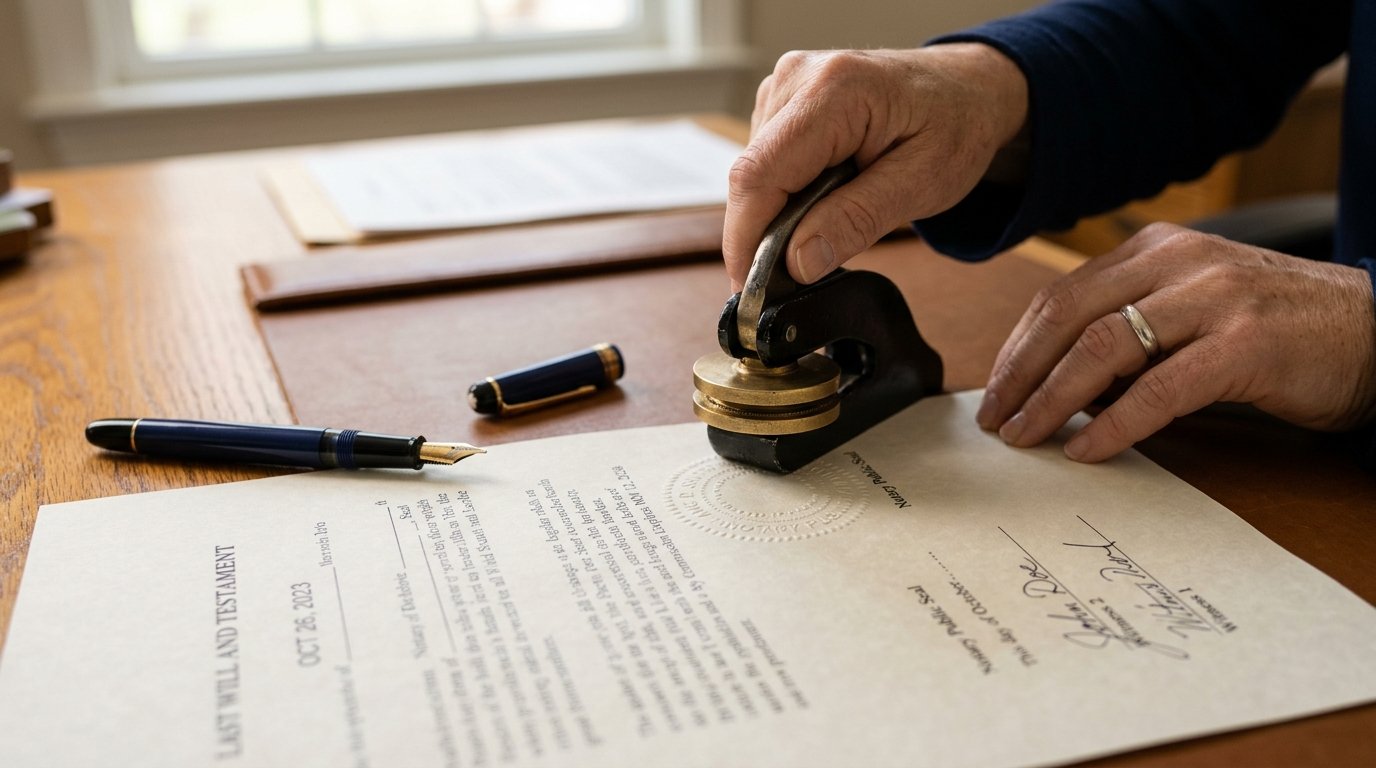
Which Guardianship Papers Typically Require a Notary
Here is what we see across states, based on current statutes and court form instructions. This is not an exhaustive 50-state survey, but it covers the patterns that matter most.
Minor-guardian nominations (varies by state)
Nevada’s statute is specific: a parent’s nomination of a guardian for a minor must be signed by the parent, attested by two impartial adult witnesses, and notarized. Even after all that, the nominee still has to petition a court and receive a formal appointment before exercising guardian powers.
California’s approach is different. Under Probate Code Section 1502 (amended effective January 1, 2026), a nomination may be made in a petition, at a hearing, or in a signed writing. The statute does not state a notarization requirement in those provisions.
Short-term and temporary guardianship
Nevada’s short-term guardianship form requires both the parent and the appointed short-term guardian to sign and acknowledge the instrument before a notary. It becomes effective on execution and generally lasts no more than six months.
Other states set different rules. Some require only witnesses. Some require a court appearance even for temporary arrangements. The form itself will tell you, but only if you are using the right state’s current form.
Caregiver authorization agreements
Texas law requires that both the parent and the adult caregiver sign and swear to the authorization agreement before a notary. But the statute is explicit about something important: this agreement does not give the caregiver legal custody or the rights of a legal guardian. It is a limited tool for a limited purpose.
Standby-guardian designations
New York’s standby-guardian provisions call for a written designation signed in front of two witnesses who are at least 18 years old. The cited statute does not state a notarization requirement, though the standby guardian must later file specified documentation with the court.
Adult guardianship petitions
Alaska’s adult guardianship instructions require the petitioner to sign a notarized verification. If no notary is available, the court allows a separate self-certification under penalty of perjury. That alternative exists because Alaska recognizes that someone filing from a remote area may not have immediate notary access, but it is a specific exception, not a general rule.
Court orders and letters of guardianship
These come from the court itself after a judge acts. Colorado’s instructions describe Letters of Guardianship as a formal notice completed and signed by the court after appointment. You do not notarize a court order. You may, however, need a certified copy from the clerk’s office, which is a different process.
Florida’s Guardianship Notarization Rules
Since we serve Central Florida families, this is the section most of our clients need.
Florida’s guardianship framework lives in Chapter 744 of the Florida Statutes. The state recognizes several guardianship instruments, and notarization requirements differ across them.
The pre-need guardian designation (Section 744.3045) is one of the clearest examples. If you want to name the person who should serve as your guardian in the event you become incapacitated, Florida law requires the declaration to be signed in the presence of two attesting witnesses and a notary public. Miss the notary, and the designation may not hold up when it matters most.
For formal guardianship petitions filed with the court, Florida’s probate courts have their own verification and filing requirements. The petition itself may require a sworn statement. The court, not the notary, makes the actual appointment after evaluating evidence, hearing from interested parties, and (for adults) reviewing an examining committee’s report.
Florida also allows limited guardianships and guardian advocacy for adults with developmental disabilities. These are court processes with their own paperwork, hearings, and legal standards. Notarization may be part of the filing requirements, but it is never the whole process.
The takeaway for Florida: if you are preparing any guardianship-related document, check whether the specific form calls for a notary, witnesses, or both. Florida’s rules are strict about execution requirements, and courts have rejected documents that skipped a step.
What Notarization Actually Does for a Guardianship Document
This is where confusion causes real problems. Many people believe that notarizing a guardianship document “makes it legal” or “makes it official.” That belief can lead to serious mistakes.
Here is what a notary actually does:
- Verifies the signer’s identity (through government-issued ID)
- Confirms the signer is acting voluntarily (not under visible duress or coercion)
- Administers an oath or affirmation when the document requires a sworn statement (called a jurat)
- Witnesses and certifies the signature with an official seal
What a notary does not do: appoint a guardian, verify that you are using the correct form, review the document for legal sufficiency, or give you legal custody of anyone.
Nevada makes this distinction crystal clear in its statute. Even after a parent files a notarized, witnessed minor-guardian nomination, the nominee must petition the court and obtain a formal appointment before exercising any guardian powers. Texas is equally direct: its notarized caregiver authorization agreement explicitly states it does not create legal custody or guardian status.
Think of notarization as one layer of authentication. It proves who signed, when, and that they did so willingly. The legal authority to act as a guardian comes from somewhere else: a court order, a statutory designation that meets every required element, or a limited authorization that only covers specific decisions.
When Schools, Hospitals, and Banks Reject the Document
This is the scenario nobody prepares for. You have a notarized guardianship form. You bring it to the school to enroll the child. The front office says they cannot accept it.
It happens more often than you would expect, and it happens for predictable reasons:
The document does not match what the institution requires. A school may need a court order or a specific state caregiver authorization form. A hospital may require documentation that meets their legal department’s standards. A bank almost certainly will not honor a temporary guardianship form for financial transactions. Insurance companies frequently reject documents that fall short of a court appointment.
The document is from the wrong state or uses a generic template. A form downloaded from a legal website may not comply with Florida’s specific execution requirements. If it lacks the right witness count, the right notarization, or the right statutory language, the institution is within its rights to reject it.
The document has expired. Short-term guardianship authorizations typically have built-in time limits. Nevada’s lasts up to six months. Other states set different windows. If yours has lapsed, it carries no authority.
What to do if your document is rejected:
- Ask the institution exactly what document they will accept. Get the specific form name, statute reference, or court order type.
- Check whether the state’s court self-help center has a form that matches.
- If you need a court order, understand that this involves a petition, a hearing, and judicial review. It is not something a notary can provide.
- If you need a properly notarized caregiver authorization or temporary guardianship form under your state’s statute, get the correct form and have it executed with the right combination of signatures, witnesses, and notarization.
The worst approach is to assume a notary stamp on any piece of paper will solve the problem. The right form, properly executed, is what creates acceptance.
Alternatives That Might Solve Your Problem Faster
Not every situation requires a full guardianship. In fact, courts increasingly prefer less restrictive alternatives when they are available. The U.S. Department of Justice’s Elder Justice Initiative identifies several decision-making options that preserve more individual autonomy than guardianship, and many states have adopted similar frameworks.
Washington State’s adoption of the Uniform Guardianship, Conservatorship, and Other Protective Arrangements Act in 2022 is a good example. It expressly requires courts to consider whether a less restrictive alternative, such as a supported decision-making agreement, could meet the person’s needs before appointing a guardian.
For families in Florida, the most common alternatives we see include:
Power of attorney. If the person can still make decisions and wants to delegate specific authority (financial, medical, or both), a durable power of attorney may accomplish what you need without court involvement. It requires proper notarization under Florida law, and it can be tailored to cover exactly the decisions that need to be made. We handle power of attorney signings throughout Central Florida, typically in 20 to 45 minutes depending on the document.
Health care surrogate designation. Florida allows adults to name a health care surrogate to make medical decisions if they become unable to do so. This requires a signed, witnessed document, and it avoids the guardianship process entirely for medical decisions.
Caregiver affidavits and authorization forms. For parents who need to give a grandparent or other relative temporary authority over a child’s school enrollment or medical care, these limited authorizations may be enough. Medical authorization documents have their own execution requirements that vary by state and purpose. Check Florida’s specific requirements for the form, witnesses, and notarization.
The right alternative depends on the situation. A power of attorney works when the person granting authority can still understand and agree to the arrangement. Guardianship exists for situations where that capacity is gone or where court oversight is needed to protect someone.
The Guardianship Data Problem Nobody Talks About
If you have been searching for clear, state-by-state rules on guardianship notarization, you have probably noticed how hard reliable information is to find. There is a reason for that.
A federal-funded environmental scan estimated roughly 1.3 million adult guardianship cases under court review nationally, but that number comes from varying reports from selected states, not a comprehensive census. Many states cannot readily produce even basic caseload totals because they rely on local systems, paper records, or inconsistent data fields.
This is changing. In July 2026, the National Center for State Courts received a three-year, $450,000 grant to develop a national estimate of adult guardianship cases using multiple data sources and statistical modeling. The initiative is also working on state-level action plans to improve court data infrastructure.
Why does this matter to you? Because poor data means inconsistent practices. When courts, schools, hospitals, and banks each follow different rules about which guardianship documents they accept, families pay the price in rejected paperwork, repeated trips, and unnecessary delays. Knowing what your specific situation requires, down to the exact form and execution method, is the best way to avoid becoming another lost data point in a system that is still catching up.
How to Get Your Guardianship Document Notarized Correctly
Whether you are in Orlando, Kissimmee, Sanford, or anywhere in Central Florida, the process is straightforward once you have the right document in hand.
- Identify the exact document type and your state’s requirements. Is it a pre-need guardian designation? A caregiver authorization? A court petition verification? Each has its own rules for signatures, witnesses, and notarization.
- Use the current official form. Download it from your state’s court website or self-help center. Generic templates from legal websites frequently miss state-specific requirements.
- Do not sign until the notary is present. This is a common mistake. If the form requires notarization, the notary needs to witness your signature, verify your identity, and (for jurats) administer an oath. A pre-signed document cannot be notarized after the fact.
- Bring valid government-issued photo ID. A current driver’s license or passport is standard. Expired IDs will not work.
- Bring your witnesses if the form requires them. Florida’s pre-need guardian designation, for example, requires two attesting witnesses in addition to the notary. The witnesses cannot be the same person as the notary in most situations, and they should be disinterested parties.
- Complete any required court filing. Notarization is one step. If the document also needs to be filed with a court, registered with a state agency, or served on other parties, those are separate steps that must happen on their own timelines.
We come to you for the notarization step. Home, office, hospital, nursing home, wherever works. If you have a guardianship form that needs notarization in Orange, Seminole, Osceola, or Brevard County, call or text us at (689) 285-5579 to check available time slots. We work in English, Spanish, and Portuguese, and we are reachable 24/7. You can also learn more about our mobile notary services and how the process works.

Frequently Asked Questions
Does a guardianship document need to be notarized in Florida?
It depends on the document. Florida’s pre-need guardian designation (Section 744.3045) requires both two attesting witnesses and a notary public. Court petitions for guardianship may require sworn verification. Caregiver authorizations and other forms have their own execution requirements. Always check the specific form’s instructions before signing.
Does notarizing a guardianship form make me a legal guardian?
No. Notarization verifies identity and authenticates a signature. It does not create legal authority. In most states, becoming a legal guardian requires a court petition, a hearing, and a judge’s formal appointment. Even Nevada’s notarized minor-guardian nomination requires a separate court appointment before the nominee can act.
Can I use a guardianship document from another state in Florida?
Florida courts generally require compliance with Florida law. A document executed under another state’s rules may not meet Florida’s execution requirements. If you relocated or need to use an out-of-state document, consult with an attorney about whether it needs to be re-executed or supplemented with a Florida filing.
What is the difference between a guardianship and a power of attorney?
A power of attorney is a voluntary delegation: the person granting it must have the capacity to understand and agree. Guardianship is a court-imposed arrangement for someone who cannot make decisions for themselves. Both may require notarization, but they serve different purposes and carry different legal weight. A power of attorney can often be completed in a single signing appointment.
Can a guardianship document be notarized online?
Remote online notarization is legal in many states, including Florida. However, the receiving court or institution must accept the format. Some courts require original ink signatures or in-person appearances for certain guardianship filings. Confirm with the court clerk before completing a remote session to avoid having your document rejected.
What should I bring to a guardianship document notarization?
Bring the unsigned document, a current government-issued photo ID (driver’s license or passport), and any required witnesses. For Florida’s pre-need guardian designation, you need two disinterested adult witnesses. Do not sign any part of the document before the notary arrives and verifies your identity.