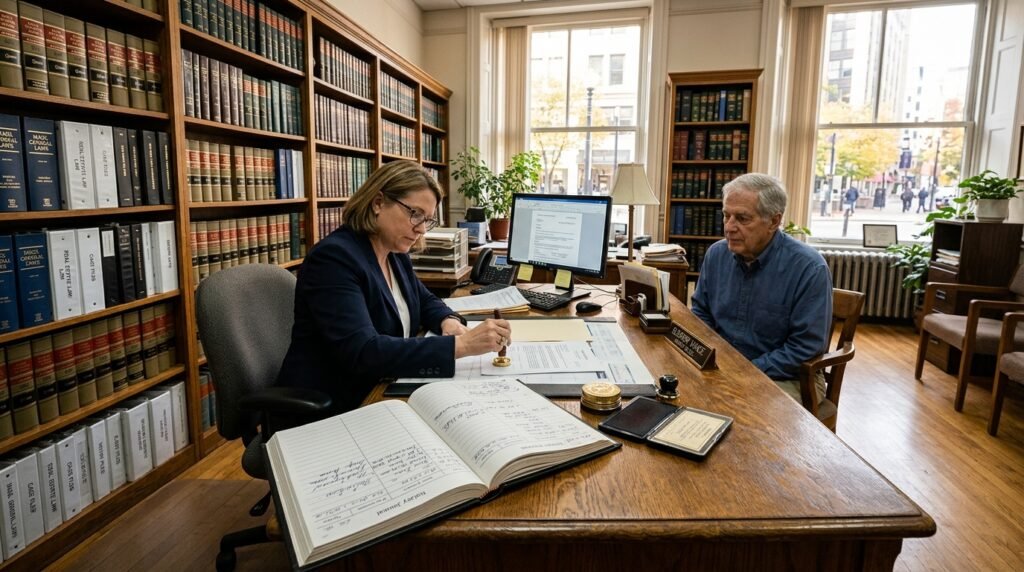
You have a document drafted in one state and you need it notarized in another. Maybe you relocated to Florida but still own property up north. Maybe a relative sent you a power of attorney form from across the country. Or maybe you just signed a lease on a place in Orlando while the paperwork came from a lender in Georgia.
The question “can I notarize in another state” sounds simple. The answer is mostly yes, but it depends on which part of the equation is crossing state lines: the document, the signer, or the notary.
The Direct Answer: Yes, With One Key Distinction
A notary public can notarize a document that originated in another state. This is the most common version of the question, and it trips people up because they assume the document must be notarized in the state where it was created or where it will be filed.
That is not how it works. Minnesota’s Secretary of State puts it plainly: a document created in another state may be notarized in Minnesota. The notary performs the act, fills in the certificate with the actual state and county where the signing happened, and the document moves on.
What a notary generally cannot do is pack a bag, drive to another state, and use a commission that only authorizes acts in the home state. The commission is tied to the state that issued it.
So: the document can travel. The notary’s authority usually cannot.
Why the “Venue” on the Certificate Matters More Than You Think
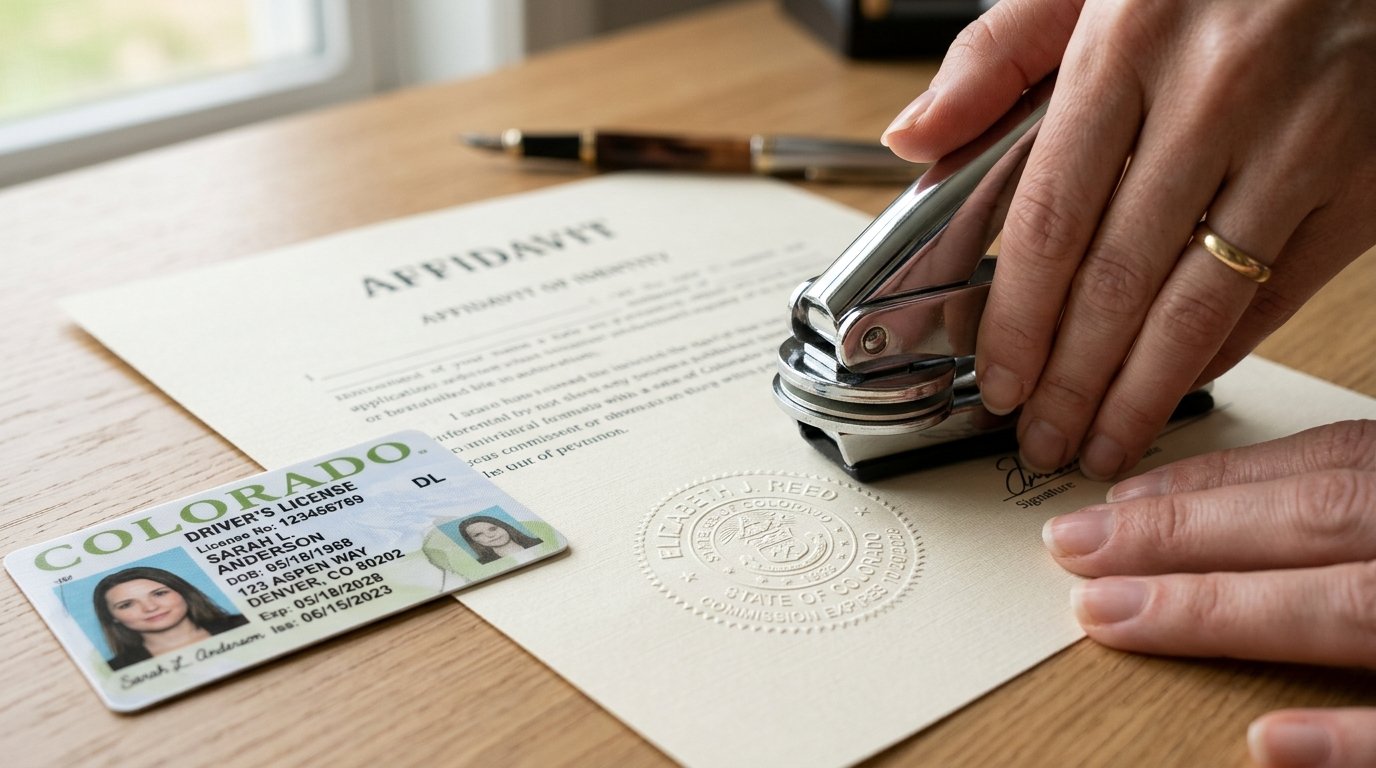
Every notarial certificate has a venue line, typically reading “State of _____, County of _____.” That line identifies where the notarization actually took place, not where the document was created or where it will be used.
Here is where mistakes happen. You receive a power of attorney form pre-printed with “State of New York.” You are signing it in Orange County, Florida. If the notary leaves “New York” on the certificate, the document now claims something false: that it was notarized in New York by a Florida notary who has no authority there.
The fix is straightforward. The notary crosses out the incorrect venue and writes in the correct one (State of Florida, County of Orange), or attaches a separate certificate with the proper wording. The National Notary Association recommends correcting the venue to reflect where the act actually occurred and, when necessary, using a compliant replacement certificate form.
The notary corrects the venue. The notary does not rewrite the document itself or choose what type of notarial act to perform. That is the signer’s responsibility, often guided by whoever prepared the document or will receive it. While notaries handle venue corrections and certificate compliance, they cannot notarize documents they personally have an interest in—learn more about whether you can notarize your own documents.
When a Notary Can Actually Cross State Lines
A handful of states carve out narrow exceptions to the “stay in your own state” rule. These are worth knowing, though they apply to specific situations, not to a general right of interstate practice.
- Virginia expressly permits its commissioned notaries to perform acts outside the Commonwealth, as long as they follow Virginia’s own notary chapter. Section 47.1-13(B) of the Code of Virginia spells this out.
- Montana allows its notaries to act in a bordering state, but only if that bordering state recognizes the Montana notary’s authority. Conditional permission, not a blank check.
- Military notaries and certain federal officials operate under separate rules that can extend across jurisdictions.
Outside these exceptions, a notary who acts in a state where they hold no commission is performing an unauthorized act. The document may be challenged, the notary may face penalties, and the person who needed that document now has a bigger problem than the one they started with.
If you need someone notarized in Florida, use a notary commissioned in Florida. If you need it done in Georgia, find a Georgia notary.
Will the Other State Accept My Notarized Document?
This is the flip side of the question. You got a document properly notarized in Florida. Will New York, Texas, or any other state accept it?
Generally, yes. States recognize notarial acts performed by authorized officers in other states. Rhode Island’s Uniform Law on Notarial Acts, for example, gives a qualifying notarization performed in another state the same effect as one performed locally.
Recognition of the notarial act, however, does not resolve every question about the document. A county recorder might require a specific format for a deed. A court might need witnesses in addition to the notarization. A lender might demand a particular closing procedure. The notary’s job is the notarial act itself (verifying identity, administering an oath or taking an acknowledgment, completing the certificate). Whether the full document package satisfies the receiving institution is a separate question.
Before you schedule anything, ask the recipient: “What format, wording, and method do you require?” That single question prevents most rejections. Remember that notaries verify identity and witness signatures but cannot give legal advice about which documents you need or how to fill them out—consult an attorney for legal guidance.
Remote Online Notarization: A Different Path Across State Lines
Remote online notarization (RON) connects a signer and a notary over live video. The signer can be anywhere. The notary stays in a state where they hold a commission and where RON is authorized.
The National Association of Secretaries of State reports that 47 states and Washington, D.C. now have laws allowing some form of remote electronic notarization. That is broad coverage, but the details vary by state.
Two rules matter here:
- The notary must remain physically in the state that authorized the remote act. Texas, for instance, prohibits its online notary from performing the act while outside Texas. Pennsylvania defines RON as a Pennsylvania-commissioned notary located in Pennsylvania.
- The receiving institution must accept the remotely notarized document. A county recorder, a lender, or a foreign consulate may have its own requirements.
RON is not yet universal. California’s 2026 notary handbook says the state’s notaries still lack authorization for audiovisual RON, with implementation staged for approved notaries on or before January 1, 2030. A California resident who needs a remotely notarized document today would need a notary commissioned in a state that does authorize remote acts, and would need confirmation from the document’s recipient that the result is acceptable.
Florida authorizes RON. Florida statute caps the fee for the online notarial act itself at $25, though platform fees and related services are separate.
Real Estate Closings Across State Lines
Real estate is where cross-state notarization gets the most complex. You may be selling a home in one state while living in another, refinancing a property remotely, or closing on a purchase from across the country.
Fannie Mae, which sets guidelines for a large share of U.S. mortgage transactions, distinguishes between two remote methods:
- Remote Online Notarization (RON): Fannie Mae requires the notary to be licensed and physically located in the state of the notarial act, and the relevant county recorder must accept the electronically notarized document for recording.
- Remote Ink-Signed Notarization (RIN): Fannie Mae’s RIN rules require both the borrower and the notary to be physically in the state where the act takes place. Paper signatures and seals are used, with a video connection for the meeting.
Fannie Mae also requires lenders to offer a borrower the option of a non-remote notary if requested. The borrower cannot be forced into a remote process.
For a signing agent handling a mortgage closing, the question is never just “can this be notarized?” It is “will the title company, lender, county recorder, and title insurer all accept this method and format?” A notary signing agent working a Florida closing follows Florida law, uses a Florida commission, and ensures the completed package meets the title company’s instructions.
When the Document Goes International: Apostille and the Hague Convention
Sometimes the question is not “another state” but “another country.” If a notarized document needs to be used abroad in a country that is party to the 1961 Hague Apostille Convention, it typically requires an apostille, a certification issued by the Secretary of State confirming that the notary’s signature and seal are legitimate.
The apostille does not verify the content of the document. It verifies the notary’s authority. This is why getting the notarization right comes first. If the notary’s commission is invalid or the venue is wrong, the apostille either will not be issued or will certify an act that may be challenged later.
In Florida, apostilles are issued by the Secretary of State in Tallahassee. The document must first be properly notarized by a Florida-commissioned notary. Then it goes to Tallahassee for the apostille certificate. We handle both steps: notarization plus apostille processing, with turnaround as fast as same-day if using our courier option to the Secretary of State’s office, or 5 to 10 business days by mail.
Practical Steps Before You Schedule
Whether you are the signer, the person preparing the document, or the one receiving it, this sequence prevents most problems:
- Ask the recipient first. Before anything else, confirm with the court, lender, title company, recorder, or foreign authority exactly what they need. Type of notarial act (acknowledgment vs. jurat), format (paper vs. electronic), specific certificate wording, witnesses, apostille, whatever they require.
- Identify where the signing will happen. If you are in Orlando, the notarization happens in Florida under Florida law, regardless of where the document originated or where it is going.
- Check the venue on any pre-printed certificate. If the form says “State of Ohio” and you are in Seminole County, Florida, the venue must be corrected. A competent notary does this routinely.
- Bring valid identification. Florida law requires satisfactory identification. A current passport or driver’s license is the standard.
- Confirm the notary’s authority. Make sure the person notarizing your document holds a valid commission in the state where the act takes place. For a power of attorney signing, a loan closing, or any other transaction, this is non-negotiable.
If remote notarization is the right fit, confirm that the RON provider’s notary is commissioned and physically located in an authorized state, and that your document’s recipient will accept the result.

Perguntas frequentes
Can a notary from another state notarize my document in Florida?
No. A notary must hold a valid Florida commission to perform notarial acts in Florida. Out-of-state commissions do not transfer. If you need a document notarized in Orlando, Kissimmee, Sanford, or anywhere in Central Florida, you need a Florida notary public.
Can I notarize a Florida document in another state?
Yes. Any notary authorized in the state where the signing takes place can notarize a Florida-originated document. The certificate venue must reflect the actual location of the act, not Florida. Confirm with the Florida recipient that they will accept an out-of-state notarization for their specific purpose.
Does remote online notarization work for all documents?
Not always. While Florida and most other states authorize RON, the receiving party (a lender, county recorder, court, or foreign government) may not accept a remotely notarized document. Always confirm acceptance before scheduling a remote session.
What if my pre-printed form has the wrong state in the venue?
The notary corrects the venue to reflect the actual state and county of the notarization. If the certificate wording itself is specific to another state’s requirements and cannot be properly adapted, a separate compliant certificate form may be attached. The notary does not alter the body of the document.
Do I need an apostille if my notarized document is going to another U.S. state?
No. Apostilles are for documents going to countries that are part of the Hague Apostille Convention. U.S. states recognize each other’s notarial acts without an apostille. If your document is heading to another country, an apostille from the Florida Secretary of State may be required.
Can I hold notary commissions in more than one state?
Yes. Some notaries obtain commissions in multiple states, which means they can perform acts in each state where they are commissioned. Each commission is separate, with its own application, bond, seal, and rules. Holding a Florida commission and a Georgia commission does not create a single combined authority; it means two independent authorizations.
If you are in Central Florida and need a document notarized, whether it came from out of state, needs to go out of state, or requires an apostille for international use, we can meet you at home, your office, or the hospital. Call or text us at (689) 285-5579 to check available time slots. We work in English, Spanish, and Portuguese, and we are reachable 24/7 across Orange, Seminole, Osceola, and Brevard counties.