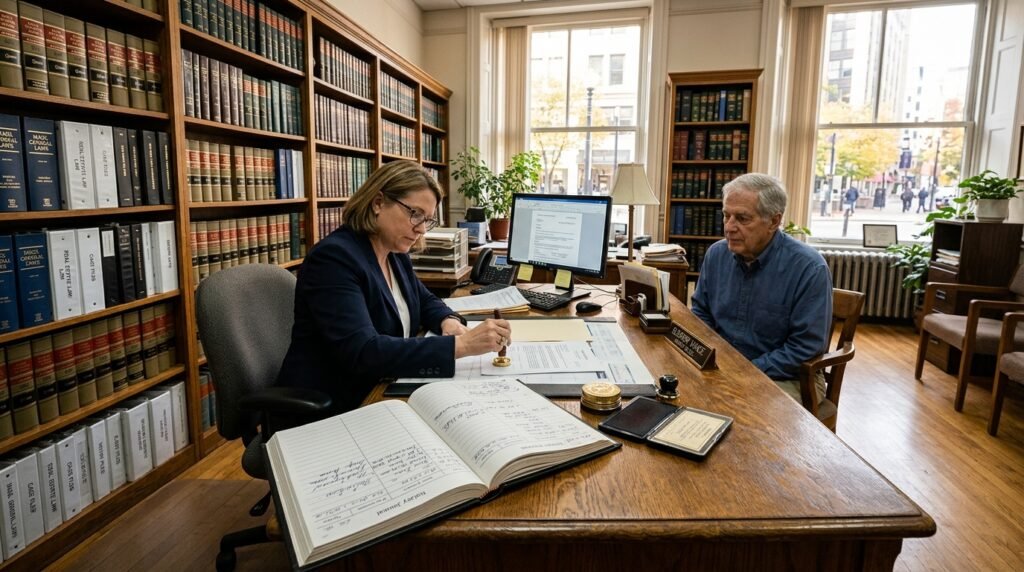
Every vendor relationship, every partnership, every lease, and every employment arrangement starts with some form of a commercial agreement. And how that agreement is drafted, signed, and authenticated can make the difference if something goes wrong down the line.
For business owners here in Florida, for instance, understanding what makes a commercial agreement enforceable and when notarization adds value is practical knowledge.
Today, we’ll cover the most common types of commercial agreements, what Florida law actually requires of them, and where notaries like us fit into the picture.
You may also like: What is a statutory declaration? Do I need one?
What is a commercial agreement?
A commercial agreement is any legally binding contract between parties operating in a business context. That covers a wide range of documents, from a two-page services contract between a freelancer and a client to a multi-year lease between a landlord and a corporate tenant.
What distinguishes a commercial agreement from a personal one is the context: the parties involved are acting in a commercial or business capacity, and the terms reflect that.
In Florida, commercial agreements are primarily governed by contract law and the Florida Uniform Commercial Code, not the more protective consumer or residential statutes that many people are more familiar with.
That means fewer default protections and more reliance on whatever the contract itself actually says, which is exactly why getting the language right matters more than most business owners realize until they are already in a dispute.
Common types of commercial agreements and what they require

Commercial agreements are not all the same document. Their type determines what it must contain, whether it needs to be in writing, and whether any additional formalities apply.
Among the most common types, you’ll find service agreements and vendor contracts, which document the terms under which one party provides a service or supplies goods to another.
Florida law does not require these to be notarized, and for most routine business transactions, a signed written agreement between the parties is sufficient to be enforceable.
That said, whether a contract is valid without notarization depends on the document type, not just the business context, so it is always worth checking before assuming.
Commercial lease agreements are also very common. Florida requires leases with terms longer than one year to be in writing under the state’s statute of frauds. Notarization is not required for the lease to be valid, but it is required if the parties want to record the lease in public records.
By the way, we have covered this in detail in our guide to commercial lease agreements in Florida.
Partnership and operating agreements govern how a business is structured and how decisions are made internally. An LLC operating agreement, for example, outlines each member’s rights and responsibilities and how profits are distributed.
These documents do not typically require notarization to be effective, though some businesses choose to notarize them to create a verified record of who signed and when.
Loan agreements and promissory notes are a category where notarization is more commonly expected. When one business lends money to another, or when a personal guarantee is involved, lenders frequently require notarized signatures to protect against later disputes about whether a party actually signed.
The notarial act in this context does the same thing it always does: it confirms identity and authenticates the signature rather than altering the legal substance of the agreement.
Non-disclosure agreements and confidentiality agreements are widely used in business settings, but almost never require notarization. They are enforceable when properly signed by both parties.

Does a commercial agreement need to be notarized?
Not in all cases. Generally speaking, though, it’s a smart move – even when the law does not require it.
Florida does not impose a blanket notarization requirement on commercial agreements. For most business contracts, a properly signed written agreement is sufficient.
The exceptions tend to cluster around a few specific situations: documents that will be recorded in public records, real estate-related instruments such as deeds and mortgages, and certain financial documents where lenders or counterparties specifically require it as a condition of the transaction.
Why is notarizing a commercial agreement a smart move?
Beyond legal requirements, there’s a practical reason businesses choose to notarize commercial agreements even when not obligated to: contesting a notarized signature is much harder.
If a dispute ever arises and a party claims they did not sign a document, the notary’s record, which includes identity verification and the date of signing, creates a layer of evidence that a plain signature does not.
For high-value agreements or those with a long duration, that added certainty often justifies the small additional step.
Understanding what a notary statement in Florida actually certifies is useful here. The notary is not attesting to the content of the agreement or its fairness, just to the identity of the signer and the act of signing.
Nonetheless, parties should still review the terms carefully with legal counsel before putting pen to paper.
Where mobile notarization fits into the commercial world
The practical challenge with commercial agreements is that the parties involved are often busy, spread across different locations, or working against tight deadlines.
A lease that needs to be signed before a move-in date, a partnership agreement that has to be executed before funding is released, a personal guarantee that a lender needs before closing a loan – none of these wait for convenient scheduling whatsoever.
A mobile notary solves this directly. Rather than requiring all parties to appear at the same office at the same time, a mobile notary travels to wherever the signing is happening, whether that is a business location, a title company, an attorney’s office, or wherever makes sense for the transaction.
For businesses executing multiple documents or coordinating signings between several parties, a mobile notary can often handle everything in a single visit.
It is also worth noting the range of commercial documents a notary can provide services for. Beyond the obvious categories, notaries regularly work with corporate resolutions, affidavits of authority, power of attorney instruments used in business settings, and international trade documents that require authentication before being accepted by foreign parties.
Frequently asked questions

Do both parties to a commercial agreement need to sign in front of the same notary? No. Each party’s signature can be notarized separately, at different times and locations, as long as each notarization is properly completed. This is common in commercial transactions where the parties are not in the same city.
Is a digital or electronic signature on a commercial agreement valid in Florida? Generally, yes. Florida has adopted the Uniform Electronic Transactions Act, which gives electronic signatures the same legal standing as wet signatures in most commercial contexts. However, some document types still require original signatures, so it is worth confirming for each specific agreement.
If a commercial agreement is notarized, does that mean it is legally binding? Notarization confirms the identity of the signer and the authenticity of the signature. It does not independently make a contract enforceable. A contract still needs to meet the basic requirements of contract law to be binding, regardless of whether it has been notarized.
Mobile Notary Orlando: your answer to all document matters in Florida
Commercial agreements are the backbone of every business relationship, and the details matter more than most people appreciate until something goes wrong. Whether a document needs notarization or simply benefits from it, getting that part right from the start removes a potential point of failure from an already complex process.
The team at Mobile Notary Orlando works with businesses across Orange, Seminole, Brevard, and Osceola counties on exactly this kind of work. If you have a commercial agreement that needs to be notarized and you would rather not interrupt your day to make it happen, we come to you. Tell us where and when, and we will handle the rest!