
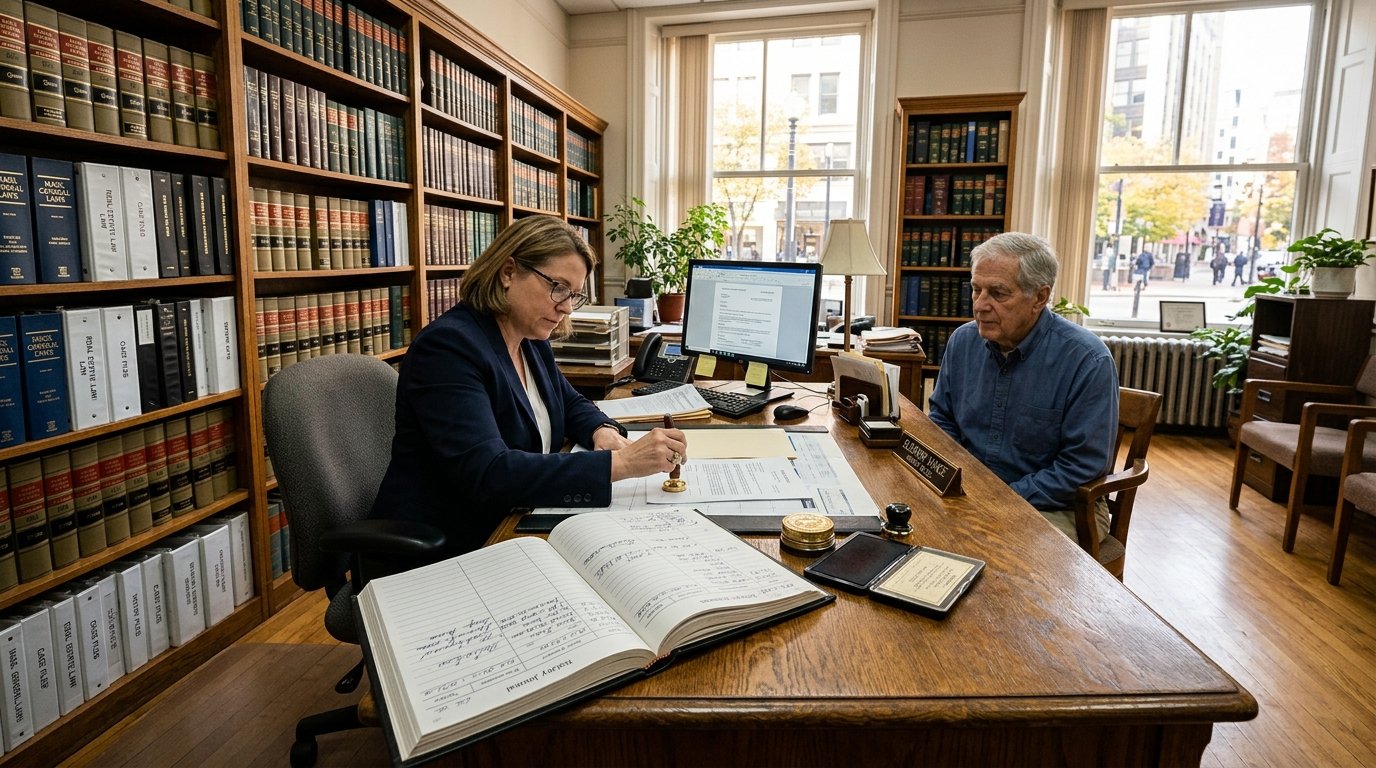
You sit down with a notary public to sign a power of attorney, close on a mortgage, or swear an affidavit. Before the stamp hits the paper (or right after), the notary opens a book or taps details into an app. Your name, the date, the document title, how you proved your identity. That record is a notary journal, and it exists to protect you, the notary, and anyone who might need to verify what happened at that table years from now.
If you’re wondering why it matters, or what ends up in it, this is the practical guide.
A Notary Journal in Plain Terms
A notary journal is the chronological log of every official notarial act a notary performs. It lives apart from the document you signed and apart from the notary’s seal or stamp. It is its own independent record.
The National Notary Association describes notarization as three components: screening the signer, recording the act in a journal, and completing the notarial certificate. The journal is the middle piece. It doesn’t replace the certificate on your document. It doesn’t prove every claim inside your document is true. What it does prove is that a specific notarial act occurred, on a specific date, involving a specific person, with specific identification presented.
If a question arises later about whether that notarization actually happened, the journal is the evidence.

What Goes Into Each Entry
The exact fields depend on the state, but the NNA recommends recording these details at minimum when state law doesn’t prescribe specific fields:
- Date and time of the notarization
- Type of notarial act (acknowledgment, jurat, oath, copy certification)
- Description of the document or transaction
- Name and signature of the signer
- How the signer’s identity was verified (driver’s license, passport, personal knowledge, credible witness)
- The notary’s fee
Some states add requirements. California Government Code §8206 requires a thumbprint for specified real-property deeds and powers of attorney. Texas takes the opposite approach: it prohibits notaries from putting biometric identifiers in their journals.
This isn’t a minor footnote. The same notary working across state lines could be required to collect a fingerprint in one jurisdiction and forbidden from collecting it in the next. The state’s law controls, not the notary’s personal habit.
Not Every State Requires One (But the List Is Growing)
There is no single federal law requiring all U.S. notaries to maintain a journal. Requirements come from individual states, and they differ significantly.
New York requires all notaries to maintain a journal and keep it for 10 years. California mandates one active sequential journal under the notary’s exclusive control. Colorado allows either a tangible or electronic journal, retained for 10 years after the last act recorded.
Two significant changes took effect in 2026:
Utah’s S.B. 139 became effective May 6, phasing the journal requirement in for newly commissioned and renewing notaries rather than applying it overnight to every existing commission. The law also introduced inspection procedures and criminal penalties for unauthorized possession or use of a notary seal or journal.
Virginia’s July 1 changes now require both traditional and electronic notaries to maintain records, with at least five years of retention for covered transactions.
Even in states where journals aren’t strictly required for every act, keeping one is broadly recommended by professional organizations. The reasoning is simple: memory fades, paper trails don’t.
Paper or Digital
Traditional notary journals are bound books with sequentially numbered pages. The NNA’s standard book holds 488 entries with Smyth-sewn binding designed to make page removal obvious. It runs roughly $32 to $44.
Electronic journal apps offer timestamped entries, ID scanning, cloud backups, and searchability. Subscription pricing varies: one popular app starts at $4.99 per month for a limited number of entries, with higher tiers running $9.99 and $14.99.
The choice isn’t purely about convenience.
Colorado specifically permits either format. Florida mandates an electronic journal for remote online notarizations. California’s statute and its 2026 handbook describe a sequential journal under the notary’s exclusive, locked control. That doesn’t automatically mean any commercial app qualifies as a substitute for the statutory requirement.
A vendor claiming its software works in 45-plus states is making a product claim, not a legal determination. The commissioning state’s rules decide whether an electronic format is acceptable for a particular type of notarization.
Paper avoids recurring fees and subscription dependencies. At full capacity, the NNA book works out to roughly seven to nine cents per entry before storage and labor. An app makes retrieval faster, especially for signing agents handling dozens of closings per month. Both approaches require a plan for long-term storage and eventual disposition of records when the notary’s commission ends.
Why the Journal Matters: Two Real Cases
Rules and field names are abstract. Two documented cases show what happens when the journal does its job and when it doesn’t.
In a case recounted by the NNA, a man allegedly signed a notary journal while impersonating a property owner in a real estate transaction connected to that owner’s murder. The impersonator later tried to steal the journal. He failed. The recorded thumbprint helped investigators connect him and a co-conspirator to the scheme. Both received life sentences. The journal didn’t prevent the crime. It preserved an independently verifiable clue that investigators could use years later.
In a separate case published by the NNA in 2025, a notary was accused of fraudulently notarizing a warranty deed. She had no journal record of the purported signing. Investigators eventually determined the seal on the deed didn’t match her actual seal, and she was cleared. But her defense costs hit $14,000 against a $25,000 errors-and-omissions policy limit. A journal entry showing no such signing occurred could have shortened that process considerably.
In yet another NNA case, an investigation of an allegedly fraudulent grant deed found repeated statutory violations, including missing required journal information. The notary’s commission was revoked.
The pattern repeats: an accurate journal protects an honest notary. A missing or incomplete one leaves everyone exposed.
What This Means for You as a Signer
If you’re getting a document notarized (not performing notarizations yourself), you might wonder why the notary is writing down your name, ID type, and other details. This is standard procedure, and it works in your favor.
If someone later disputes your signature, claims the document was forged, or questions whether you appeared in person, the journal entry is independent evidence that the notarization happened as described. For power of attorney documents, real estate closings, and estate-planning instruments, that evidence trail can be critical years down the road. It’s also important to remember that while notaries document and witness signatures, they cannot provide legal advice about the documents being signed.
On the privacy side: journal access isn’t open to the public. California, for example, requires a written request identifying the specific parties and document type before a copy of an entry can be provided. The notary is expected to shield unrelated entries. Different states handle access differently, but your personal details aren’t available for casual browsing.
You may also be asked for a thumbprint in states that require one for certain document types. If the notary asks, it’s because the law in that jurisdiction requires it for your particular transaction, not because they’re collecting biometric data on a whim.
How Florida Handles Notary Journals
Since we serve Orange, Seminole, Osceola, and Brevard counties, Florida’s rules deserve a closer look.
For remote online notarizations, Florida Statutes §117.245 requires the online notary to maintain one or more secure electronic journals. Each entry must identify the principal, the type of notarial act, the document or proceeding, identity evidence, and any fee charged. The platform must also retain an unedited audiovisual recording of the session. Both the journal and the recording must be kept for at least 10 years.
For traditional in-person notarizations, Florida law does not impose the same electronic journal mandate. The NNA notes this distinction. Keeping a journal for in-person acts remains a strong professional practice, though, particularly for notary signing agents handling mortgage closings, powers of attorney, and other documents where the stakes are high and the timeline for potential disputes is long.
When we travel to your home, office, hospital, or wherever you need us for a signing, the journal entry is part of our standard process. It takes moments, adds a layer of protection for both sides, and stays securely in our records.
Corrections, Mistakes, and What Not to Do
Mistakes happen. A notary enters the wrong date, misspells a name, or records the incorrect act type. The fix matters as much as the error.
The NNA’s guidance on corrections is direct: never use correction fluid. Never use erasable ink. Never tear out a page and start over. Never recreate an entry out of chronological order at a later date. All of those undermine the journal’s value as an audit record.
The proper approach is to draw a single line through the error (so it’s still legible), write the correction nearby, initial and date the change, and follow any state-specific procedures. The goal is transparency. If the journal ever goes before a court or an investigating authority, the correction itself becomes part of the evidence. A White-Out smear suggests something was hidden. A visible, initialed correction suggests an honest mistake, honestly fixed.
Frequently Asked Questions
What is a notary journal used for?
It documents each official notarial act: who appeared, what type of act was performed (acknowledgment, jurat, oath), what document was involved, how the signer proved identity, and the date and time. It serves as independent evidence that exists apart from the signed document.
Is a notary journal required in Florida?
For online (remote) notarizations, yes. Florida Statutes §117.245 requires a secure electronic journal with at least 10-year retention. For traditional in-person notarizations, Florida law does not impose the same mandate, though keeping one is widely recommended professional practice.
Can anyone look at a notary’s journal?
No. Access is controlled. Rules vary by state. In California, a person must submit a written request identifying the specific parties, document type, and approximate date. The notary should shield unrelated entries. Your information is not available for casual public browsing.
How long does a notary keep journal records?
It depends on the jurisdiction. New York requires 10 years. Colorado requires 10 years after the last act recorded in the journal. Florida requires at least 10 years for online notarization journals and recordings. Virginia’s 2026 law specifies at least five years for covered transactions.
Paper journal or electronic: which is better?
Neither is universally superior. Paper avoids subscription costs and vendor dependencies. Electronic journals offer faster search, timestamping, and cloud backup. The real question is whether your state’s law permits the format you choose for the type of notarization you perform.
Why did the notary ask for my thumbprint?
Some states require a fingerprint for specific document types. California requires thumbprints for certain real-property deeds and powers of attorney. Other states (like Texas) prohibit collecting biometric data in the journal. If a notary asks, it’s because the law in that jurisdiction requires it for your particular transaction.
If you need a document notarized in Central Florida and want to skip the trip to an office, call or text us at (689) 285-5579. We come to your home, your office, or the hospital, and we work in English, Spanish, and Portuguese. You can also learn more about our mobile notary services or check details on apostille certification if your document needs to go abroad.