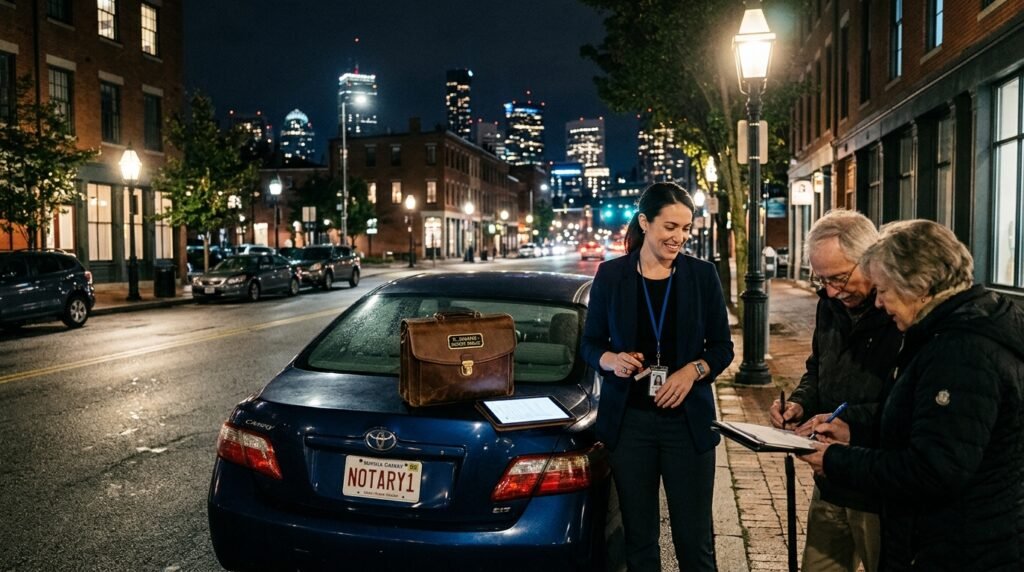
Your flight leaves in a few hours and you just realized a document needs to be notarized before you board. Maybe it’s a power of attorney for a relative back home, a child travel consent form, or a real estate closing that simply cannot wait until you land. You’re at the airport (or headed there), and the question is straightforward: can a notary come to you?
Yes. A mobile notary at an airport meets you in person, verifies your identity, performs the notarial act, and applies their seal. The process itself is identical to any other mobile notary appointment—whether at your office, home, or airport terminal. The complication is the airport: security zones, parking costs, terminal logistics, and a hard departure time nobody can push back.
Here’s what you need to know to make it work.
What a Mobile Notary at an Airport Actually Does
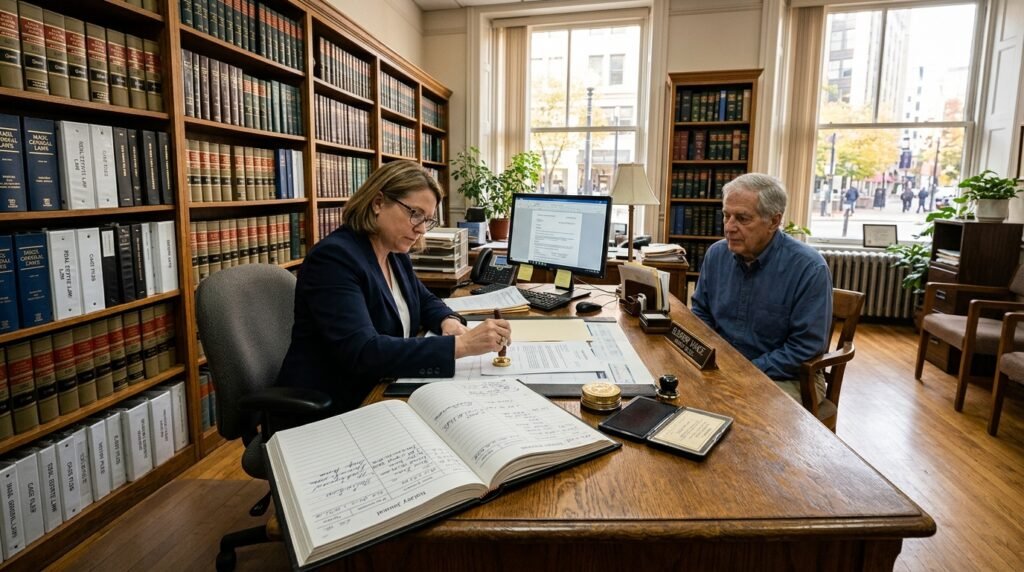
A mobile notary is a commissioned notary public who travels to the signer instead of waiting in an office. At an airport, the notary drives to the terminal, meets you at the agreed spot, and performs the same duties they would anywhere else: taking acknowledgments, administering oaths for jurats, witnessing signatures, or certifying copies where state law allows.
The notarial act doesn’t change because you’re standing in a terminal. What changes is everything surrounding it: how the meeting is arranged, where it happens, how much it costs, and how tightly your schedule constrains the process.
A few airports have permanent notary services on site. San Francisco International (SFO) officially lists Airport Travel Agency as a notary provider, operating pre-security in the International Terminal, with notary hours Monday through Friday. That’s rare. Most airports, including Orlando International (MCO), have no in-terminal notary desk. If you need notarization at one of those airports, a mobile notary is the way to get it done.
Where You’ll Actually Meet the Notary
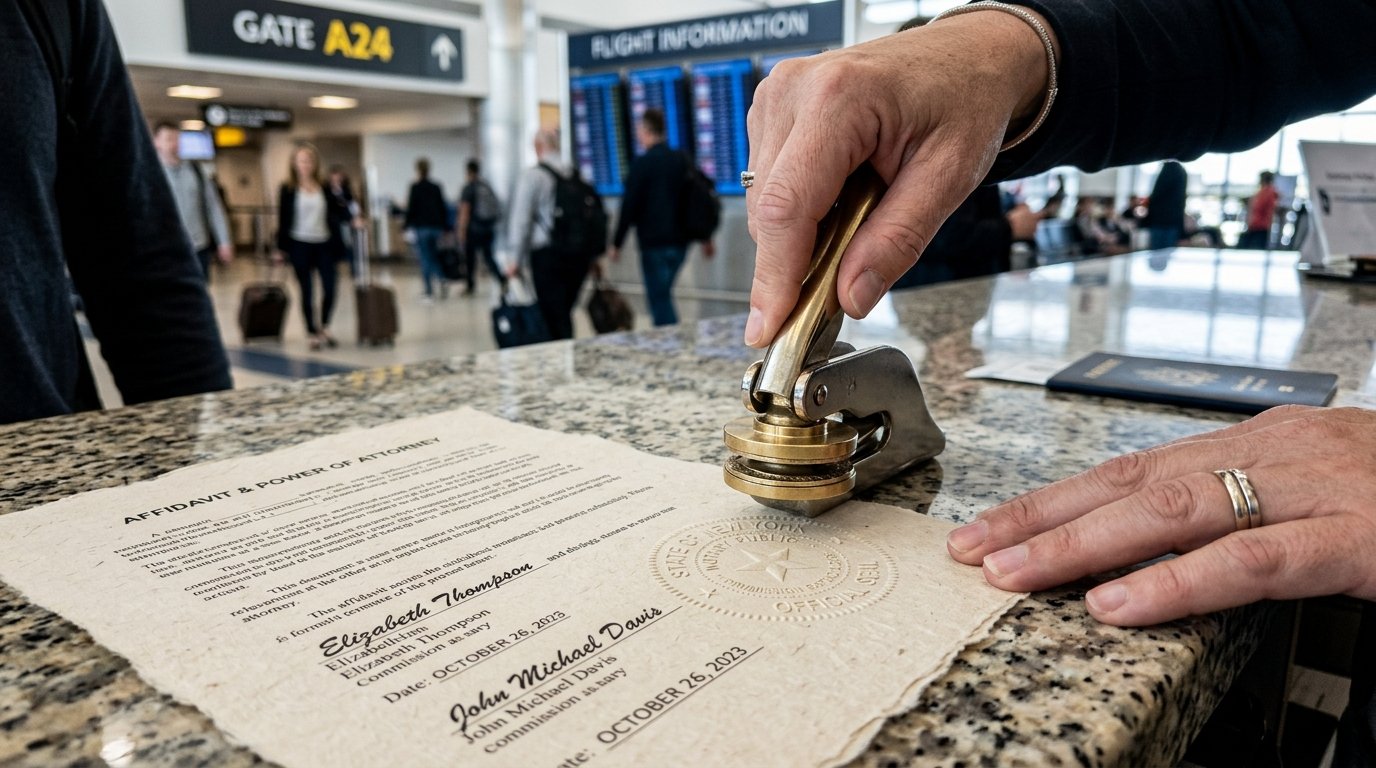
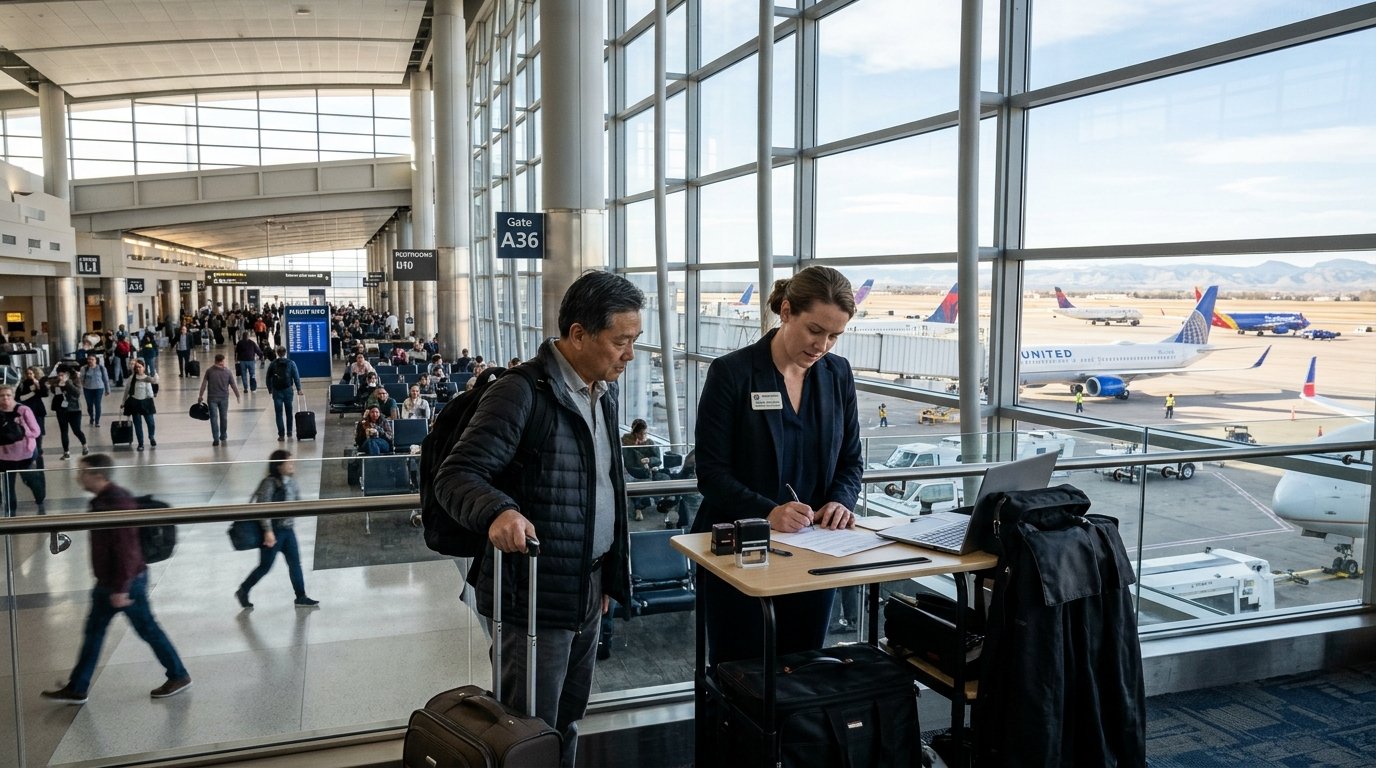
This is the part most airport notary services gloss over. The meeting almost always happens before the security checkpoint, in the public area of the terminal. Think arrivals level, ticketing hall, a nearby hotel lobby, or even the cell phone lot.
A notary without a boarding pass cannot get past TSA. Getting through without one is not simple, and in many cases, not allowed.
TSA’s Gateside by TSA PreCheck program lets eligible nontravelers apply for access at participating airports. But applications must be submitted at least one day in advance (and no more than three). That’s not a last-minute option. And some airports restrict visitor passes further. Seattle’s visitor pass program, for example, explicitly prohibits commercial or professional use.
The practical plan: meet your mobile notary before you go through security. Allow enough time for the signing, then head to your gate. If the document takes 15 to 20 minutes and the security line might run 30 to 45 minutes, start the whole process at least 90 minutes before boarding. More if the airport is busy.
At MCO, both the main terminal and the newer Terminal C have comfortable public areas where a mobile notary can meet you without any access issues. We do this regularly, just as we provide mobile notary services at hotels throughout the Orlando area for travelers who need notarization before or after their flights.
Documents Travelers Need Notarized Most Often
Four categories cover the vast majority of airport notary requests.
Child travel consent. If one parent is traveling internationally with a child and the other parent isn’t present, many destinations recommend or require a notarized consent letter. USAGov recommends checking the destination’s entry and exit requirements and suggests a notarized, English-language letter listing the absent parent’s contact information, the child’s travel dates, and the names of authorized companions.
For U.S. passport issuance specifically, the State Department’s Form DS-3053 is the formal consent document. The absent parent or guardian must sign it before a notary or authorized officer, and it’s valid for 90 days from the date of notarization. Note: this is a passport form, not a boarding permission slip. They solve different problems.
Powers of attorney. A traveler leaving the country for weeks or months may need to grant someone authority to handle financial, medical, or legal matters while they’re gone. A power of attorney signing typically takes 20 to 45 minutes depending on the number of pages. The principal (the person granting authority) must appear in person and sign in front of the notary.
Real estate and business documents. Mortgage closings, purchase agreements, corporate resolutions, and affidavits don’t pause because someone has a flight. A notary signing agent can meet a borrower or seller at the airport to complete time-sensitive loan documents before departure.
Documents headed abroad. If your notarized document will be used in another country that participates in the Hague Convention, notarization is often just step one. You may also need an apostille from the Secretary of State to authenticate the notary’s commission. That’s a separate process with its own timeline. In Florida, filing directly with the Secretary of State in Tallahassee costs $10 per document. Turnaround ranges from same-day (in person at the Tallahassee office) to five business days by courier, or seven to ten business days by mail.
The “Right Signer” Problem Most People Miss
This is where airport notarizations go wrong more often than you’d expect. The person who needs to sign is not always the person standing in the terminal.
A notary can only notarize the signature of someone who is physically present and shows acceptable identification. If a document requires your spouse’s signature and your spouse is in another city, a mobile notary at your gate area cannot fix that. The signer has to be there.
DS-3053 catches people off guard on this point. The form requires the absent parent’s notarized consent. That means the parent who is not traveling with the child is the one who needs to sign it in front of a notary, wherever that parent happens to be. The traveling parent at the airport is not the required signer.
A 2022 case in Toronto shows how these gaps can cascade. CityNews reported that a man traveling with his eight-year-old niece was denied boarding by Air Canada over a dispute about whether the child’s parental consent letter needed to be certified. The child remained in Toronto and flew back a week later as an unaccompanied minor, costing the family an additional C$175. An immigration lawyer quoted in the report disagreed that the certification was even required. Air Canada declined to discuss the case.
The lesson: confirm who must sign, and where, before anyone heads to the airport. A notary seal on the wrong person’s signature doesn’t solve the underlying problem.
What It Costs (and Why It’s More Than an Office Visit)
Every state caps the per-signature notary fee. In Florida, it’s $10 for most notarial acts. But the state fee is the smallest part of a mobile airport appointment.
Three components make up the typical bill:
- Travel fee covers the notary’s drive to the airport, parking, and transit time. Published rates from providers around the country range from $50 to $100 depending on distance, time of day, and urgency.
- Per-signature notary fee is the state-regulated amount for each notarial act performed.
- Waiting or scheduling charges apply with some providers if the signer is delayed, the appointment falls on a weekend or holiday, or printing and document handling are involved.
For a concrete benchmark: published rates from regional mobile notary providers show travel charges of $50 to $100 (depending on timing) plus $10 per notarization and $20 per 15 minutes of waiting. A straightforward daytime appointment with one signature might land around $60 total. A weekend late-night appointment could exceed $120 before additional signatures.
Airport appointments tend to cost more than a standard home or office visit. Airport short-term parking runs $3 to $6 per half hour at many terminals. The drive into an airport zone is often congested. And the time pressure means the notary may need to block out a larger window than usual. None of this is unreasonable. It just means you should ask for an itemized quote before the notary leaves their office.
What to Bring to Your Airport Notary Appointment
Showing up without the right materials is the fastest way to waste time and still miss your flight.
Valid, government-issued photo ID. A current driver’s license or passport. Your ID must be acceptable under your state’s notary law, not just acceptable to TSA. These are separate systems with separate rules. TSA began enforcing REAL ID requirements on May 7, 2025, but a REAL ID-compliant license and a notary-acceptable ID are not always the same thing. Ask the notary what they accept when you schedule.
The complete document. Every page, every blank filled in. A notary cannot notarize an incomplete document. If you’re waiting for someone to email the final version, hold off on scheduling until you have it ready.
All required signers. If two people need to sign, both must be present with their own valid ID. No exceptions. A spouse cannot sign for a spouse. A parent cannot sign a consent form on the other parent’s behalf.
Witnesses, if required. Some documents need one or two disinterested witnesses in addition to the notarization. Your notary may be able to bring a witness or arrange one, but confirm this when booking. Do not assume a stranger in the terminal will qualify or agree.
Recipient’s instructions. If a title company, lender, attorney, or government agency sent you the document, they may have specific requirements about the type of notarial act (acknowledgment vs. jurat), the number of certified copies, or how the completed document should be returned. Bring those instructions. The notary performs the act; the receiving institution decides whether they’ll accept it.
When Remote Online Notarization Works Instead
If you have a laptop or tablet with a camera and microphone, plus a stable internet connection, you may not need a notary to drive to the airport at all.
Remote online notarization (RON) connects you to a commissioned notary through a live video session. You verify your identity through knowledge-based authentication questions, sign electronically, and the notary applies a digital seal. Rhode Island’s Secretary of State explains the key distinction clearly: in-person electronic notarization still requires the notary and signer to be in the same room, while RON uses an audiovisual connection to bridge the distance entirely.
The advantages for airport situations are obvious. No travel fee, no parking complications, no meeting-point coordination. Some RON platforms advertise starting prices as low as $25 per notarization and fast connection times, though actual costs and availability vary by provider and state.
But RON doesn’t work for everything. Some receiving institutions won’t accept electronically notarized documents. Some states haven’t fully implemented RON. And some documents, particularly those requiring witnesses or multiple signers, may be simpler to handle face to face.
For child passport consent, the State Department does accept electronically notarized DS-3053 forms when permitted under state law, but requires a printed copy for the actual passport application. That can be a useful option for the absent parent signing from another location.
Three questions decide whether RON fits your situation: Does the recipient accept electronic notarization? Does your state authorize RON for this document type? Is your connection reliable enough for a live video session in a busy terminal? If all three answers are yes, RON may save you time and money. If any answer is no, schedule the in-person appointment.
How to Handle Foreign-Language Documents
International travelers frequently arrive at U.S. airports carrying documents in Spanish, Portuguese, French, or another language. A common question: does the notary need to read or translate the document?
A notary’s core job is verifying the signer’s identity and performing the notarial act (witnessing the signature for a jurat, or confirming the signer’s acknowledgment that they signed voluntarily). The notary does not certify the contents of the document as true or accurate. That said, the notary needs to communicate directly with the signer, and many states require the notary to understand the document’s general nature before proceeding.
If your document is in a language the notary doesn’t speak, or if the receiving institution requires a certified translation, arrange that before the airport appointment. A translator and a notary serve different roles, and assuming one can substitute for the other creates delays at the worst possible moment.
We work in English, Spanish, and Portuguese. For international travelers passing through Orlando, that covers a large share of language needs and removes one variable from an already tight timeline.
Frequently Asked Questions
Can a mobile notary meet me at my gate after security?
In most cases, no. A notary without a boarding pass cannot pass through TSA screening unless the airport offers an approved nontraveler access route, and most restrict or prohibit commercial use of those passes. TSA’s Gateside program requires at least one day’s advance application and operates at limited airports. Plan to meet your notary in the public area before the security checkpoint and allow time to go through screening afterward.
How far in advance should I schedule an airport notary?
As early as possible. Same-day appointments happen all the time, but the notary needs travel time and you need a buffer for the signing, security, and boarding. Even a few hours’ notice gives you more scheduling flexibility and may reduce urgency-related charges. If you know the appointment is coming, don’t wait until you’re at the curb.
What if I realize I need a notary while I’m already past security?
Two options. If the document and recipient allow it, remote online notarization can be completed from your phone or laptop at the gate. Otherwise, you would need to exit the secure area, meet the mobile notary in the public terminal, then go back through security. Budget extra time if you take the second route.
Does a notarized consent letter guarantee my child can board?
No. A notarized letter helps prove that you have the absent parent’s permission to travel with the child, but airlines and border agents make their own boarding and entry decisions. Requirements vary by destination and carrier. Check your specific airline’s documentation policies and the destination country’s entry rules before assuming a notarized letter alone resolves everything.
Can I get an apostille at the airport?
Not directly. An apostille is issued by the Secretary of State, not by a notary. A mobile notary can notarize your document at the airport, but the apostille requires a separate filing with the state. In Florida, that means filing with the Secretary of State in Tallahassee. Turnaround ranges from same-day (if filed in person) to seven to ten business days by mail. If your document is heading abroad and time is short, plan the apostille step before your travel date.
Is there a notary inside Orlando International Airport (MCO)?
MCO does not have a permanent in-terminal notary service. A mobile notary is how you get documents notarized at or near the airport. We regularly meet clients at MCO’s public terminal areas and can typically arrive within about an hour of your call. Call or text us at (689) 285-5579 to check available time slots.