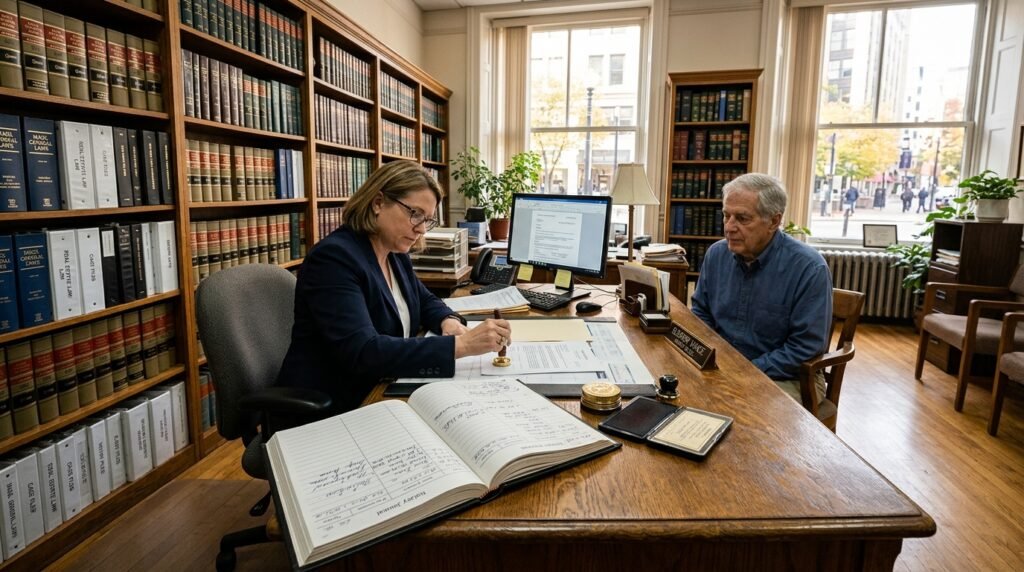
You have a document on your kitchen table. Maybe it’s a power of attorney for a parent who just had surgery. Maybe it’s a deed, a loan package, or an affidavit that needs to reach a court by Friday. Somewhere on that document, there’s a blank space waiting for a notary public’s stamp and signature.
If you’ve never dealt with a notary before, the whole thing can feel mysterious. It shouldn’t. A notary public performs a small number of specific, well-defined acts, and once you understand those acts, the process takes minutes. This guide covers what a notary does, the types of notarial acts, when you need one, what to bring, how much it costs, and what a notary is not allowed to do for you.
What a Notary Public Actually Is
A notary public is a state-appointed official who serves as an impartial witness during the signing of important documents. The state, not the federal government, grants a notary their commission. That commission comes with a specific set of duties defined by state law and a strict obligation: remain neutral.
The notary does not represent you. The notary does not represent the other party. The duties of a notary public are to verify three things:
- Identity. You are who you claim to be.
- Willingness. You are signing voluntarily, not under threat or coercion.
- Awareness. You appear to understand what you are signing.
That’s the core of the job. Everything else (the stamp, the signature of a notary public, the notarial record, the certificate wording) exists to document those three verifications so the transaction can be trusted later.
The United States has roughly 4.4 million commissioned notaries, and the workforce is getting younger: more than a quarter of surveyed notaries were 35 or under in the NNA’s most recent census. Many work as mobile notaries or notary signing agents, traveling to a client’s home, office, hospital, or wherever the signing needs to happen.

The Notarial Acts You’ll Encounter
Not every notarization is the same. State law defines which acts a notary may perform, and the document you’re signing usually specifies which type of notarial certificate it requires. Understanding the different services of a notary public helps you request the right one. Here are the ones you’re most likely to need.
Acknowledgment
This is the most common notarial act. You appear before the notary, prove your identity, and acknowledge that you signed the document. In some states, you can sign the document before the appointment and then acknowledge your signature at the notary’s desk (or kitchen table, or hospital bedside). The notary confirms your identity and that you’re acting freely, then fills out the acknowledgment certificate and applies their seal.
Real estate deeds, mortgage documents, and powers of attorney almost always require acknowledgments.
Jurat
A jurat is a step up in formality. You must sign the document in the notary’s presence (not before), and you must take an oath or affirmation that the statements in the document are true. The notary watches you sign, administers the oath, and completes the jurat certificate.
Affidavits and sworn statements typically call for jurats. If a document says “subscribed and sworn to before me,” that’s a jurat.
Oath or Affirmation
A notary can administer an oath (a solemn pledge invoking a higher power) or an affirmation (the same pledge without religious language). Both carry the same legal weight. Oaths and affirmations are sometimes standalone acts, but they also appear as part of a jurat.
Other Notarial Duties
Depending on the state, a notary may also certify copies of certain documents, witness signatures, solemnize marriages, verify vehicle identification numbers, or certify the contents of a safe deposit box. Florida law, for example, gives notaries six specific duties: administering oaths and affirmations, taking acknowledgments, attesting to photocopies of certain documents, solemnizing marriage, verifying VINs, and certifying safe deposit box contents.
The key distinction between an acknowledgment and a jurat matters because using the wrong certificate can get a document rejected. The document or the law governing it (not the notary) determines which certificate is required.
| Feature | Acknowledgment | Jurat |
|---|---|---|
| When you sign | Before or during the appointment (varies by state) | Must sign in the notary’s presence |
| Oath required? | No | Yes, oath or affirmation |
| What the notary certifies | You appeared, proved identity, and acknowledged your signature | You appeared, proved identity, swore or affirmed, and signed before the notary |
| Common documents | Deeds, mortgage closings, powers of attorney | Affidavits, sworn statements, depositions |
When You Need a Notary Public
Most people encounter a notary for one of four reasons: a real estate transaction, a legal document like a power of attorney, a business filing, or a document going abroad. Here’s what each situation looks like.
Real Estate and Mortgage Closings
Buying or refinancing a home means signing a stack of documents, and many of them require notarization. Deeds, deeds of trust, mortgage notes, affidavits of identity, and closing disclosures may all need a notary’s seal. This is where a notary signing agent comes in: a notary who specializes in guiding borrowers through a loan package, making sure every signature, initial, and date lands in the right place.
The mortgage industry is going digital. A 2025 survey of 100 mortgage lenders found that 90% offered digital closings, up from 74% in 2023. But availability and actual usage are different things. Only 14% of those lenders reported that most of their loan volume was fully digital. For now, expect some combination of electronic documents and an in-person (or remote) notary.
Power of Attorney
A power of attorney lets you authorize someone to act on your behalf, whether that’s managing finances, signing real estate documents, or making healthcare decisions. Because a POA grants serious authority, most states require notarization to make it valid or at least to make it enforceable without challenge.
These signings often happen under pressure. A parent is in the hospital. A family member lives overseas. Someone needs to sell a property but can’t be there. The notary’s job is to confirm the signer’s identity and willingness, especially when the signer is elderly, ill, or in a care facility. A typical power of attorney signing takes 20 to 45 minutes depending on the number of pages.
Business and Legal Documents
Corporate authorizations, partnership agreements, vendor contracts, loan applications, immigration forms, court filings, and affidavits for litigation: the list is long. If a document has a notary block printed on it, it needs a notary. If it doesn’t but the receiving party requests notarization, you’ll still need one.
International Documents and Apostilles
If a notarized document needs to be used in another country, you may also need an apostille. An apostille is not a stronger form of notarization. It’s a separate certificate issued by a competent authority (usually the Secretary of State) that authenticates the notary’s signature, capacity, and seal for use between countries that participate in the Hague Convention. It does not certify the content of the document itself.
The sequence matters: first, get the document notarized properly. Then get it authenticated and apostilled. Skip a step or do them out of order, and the receiving country may reject the whole thing. If you need an apostille in Florida, the filing goes through the Secretary of State’s office in Tallahassee. You can file directly for $10 per document, or use a service that handles the notarization, courier, and return delivery, which typically runs $200 to $280 per document with a turnaround of up to five days.
What a Notary Public Cannot Do
This is where confusion causes real problems.
A notary public is not a lawyer (unless they happen to also hold a law license, which is a separate credential). A notary cannot draft your document, choose the right form for your situation, explain what a contract means, or advise you on your legal rights. A notary also cannot notarize their own signature, so if you’re wondering can you notarize your own documents, the answer is no. In states like California, the notary handbook explicitly prohibits notaries from practicing law, selecting legal documents, or advising signers about legal rights and obligations.
The “notary vs. notario” confusion is especially dangerous. In many Latin American countries, a “notario” is a highly trained legal professional, similar to an attorney. In the United States, a notary public has no such authority. California’s attorney general has warned that only lawyers, accredited representatives, or recognized organizations may provide immigration legal advice, and that consumers should not rely on someone using the title “notario” for legal help. If you need legal advice, talk to an attorney. If you need a document notarized, call a notary.
A notary’s stamp also does not make a fraudulent document legitimate. In a 2025 Philadelphia case, prosecutors charged a notary in an alleged scheme involving nearly two dozen property transfers with forged signatures, backdated dates, and fraudulent stamps. The notary seal is one layer of protection, not a guarantee. For real estate, title searches, lien checks, and independent legal review provide the other layers.
What to Bring to Your Notary Appointment
The most common reason a notarization falls apart is identification. The notary is legally required to verify your identity, and “I left my wallet at home” means the appointment cannot proceed. Here’s what to have ready:
- Government-issued photo ID. A valid driver’s license, state ID card, or passport. Expired IDs are generally not accepted. The name on your ID must match the name on the document.
- The document itself. Bring it unsigned if it requires a jurat (the notary needs to watch you sign). If it’s an acknowledgment, check whether your state allows you to pre-sign.
- All signers present. If the document requires multiple signatures, everyone who is signing needs to be there with their own valid ID. The notary cannot notarize a signature that happened elsewhere unless the state specifically allows it through a remote process.
- Any required witnesses. Some documents (like certain wills or healthcare directives) require witnesses in addition to notarization. A notary can sometimes serve as a witness, but not always. Check the document’s instructions.
If you’re not sure whether your ID will work, or if a signer’s name has changed, call the notary before the appointment. A two-minute phone call prevents a wasted trip.
Mobile Notary, Office Notary, or Online Notary
You have three basic options for getting a document notarized. Each trades off convenience, availability, and cost differently.
Office Notary
Banks, shipping stores, law offices, and government buildings often have a notary on staff. You go to them during business hours, wait your turn, show your ID, and get the document notarized. If you work nearby and the document is straightforward, this can be the simplest path. The limitation: their schedule, not yours.
Mobile Notary
A mobile notary comes to you. Home, office, hospital, nursing home, coffee shop, wherever you need to be. This matters when the signer is bedridden, when the closing is at 7 p.m., when you’re juggling three kids and can’t leave the house, or when you need a notary on a Saturday. Mobile notaries typically charge the statutory notary fee plus a travel fee.
For anything time-sensitive or location-dependent, mobile is the practical choice. We see this constantly with hospital signings, power of attorney appointments for homebound parents, and loan closings scheduled around a buyer’s work day.
Remote Online Notarization (RON)
RON uses live audio and video so the signer and notary connect from different locations. The signer’s identity is verified through credential analysis (uploading a photo ID) and knowledge-based authentication (answering questions about personal history). The session is recorded and stored.
RON availability varies by state. As of 2026, 45 states plus the District of Columbia had enacted RON statutes, but enacted doesn’t always mean operational. Some states require approved platforms, some don’t, and some have laws on the books that can’t yet be used. The NNA’s state-by-state platform map is a useful starting point for checking current status. Florida allows RON and charges a $25 fee for remote notarization on top of the standard notary fee.
RON works well for straightforward documents when the signer is tech-comfortable and has a qualifying ID. It’s less ideal for elderly signers unfamiliar with video calls, signers whose identity documents don’t pass automated checks, or situations where an in-person presence is simply more reassuring.
How Much Notarization Costs
Every state sets maximum fees for notarial acts, and the range is wider than you’d expect. The NNA’s 2026 fee table lists these examples:
| State | Acknowledgment | Jurat | RON Fee |
|---|---|---|---|
| Florida | $10 | $10 | $25 |
| California | $15 | $15 | Varies |
| Texas | $10 (first signature), $1 each additional | $10 | $25 + regular fee |
| Colorado | $15 | $15 | $25 |
| Illinois | $5 | $5 | $25 |
These are the fees for the notarial act itself. A mobile notary may also charge for travel, and a signing agent handling a full mortgage closing typically charges a separate signing fee set by the title company or lender. When you call to schedule, ask for the total cost upfront so there are no surprises at the table.
How to Spot a Notarization Problem Before It Becomes One
Most notarizations go smoothly. The ones that don’t usually fail for preventable reasons:
- Name mismatch. The name on your ID says “Robert” but the document says “Bob.” Some notaries can work with this; others can’t. If there’s any discrepancy, mention it when you schedule.
- Expired ID. An expired driver’s license or passport is not valid identification for notarization in most states. Renew it first, or bring an alternate form of qualifying ID.
- Missing signers. Every person whose signature needs notarizing must appear before the notary. You cannot bring your spouse’s document and sign for them unless you hold a properly executed power of attorney authorizing that specific act.
- Wrong certificate type. If the document calls for a jurat but you already signed it at home, the notary may not be able to proceed. Read the notary block on your document before the appointment.
- Blank spaces. A notary should not notarize a document with significant blank sections that could be filled in after the fact. If the document has blanks, complete them or draw a line through them before the appointment.
Catching these issues before you sit down with a notary saves time, money, and stress.

Frequently Asked Questions
Does a notary verify that my document is legal or accurate?
No. A notary verifies your identity, confirms you’re signing willingly, and certifies that the proper notarial procedure was followed. The notary does not review the document for legal sufficiency, factual accuracy, or enforceability. For legal questions, consult an attorney.
Can I get a document notarized if I don’t speak English?
Yes, but the notary must be able to communicate with you directly or through proper means to confirm your identity and willingness. Some notaries, including our team, work in multiple languages. We handle appointments in English, Spanish, and Portuguese throughout Orange, Seminole, Osceola, and Brevard counties.
What’s the difference between a notary public and a notary signing agent?
Every notary signing agent is a notary public, but not every notary public is a signing agent. A signing agent specializes in mortgage and real estate closings, guiding borrowers through loan document packages. They receive additional training on lender requirements, document types, and closing procedures.
Can a notary come to my home or hospital room?
Yes. A mobile notary travels to you. This is common for hospital signings, nursing home visits, home closings, and any situation where the signer cannot easily travel. We meet clients at homes, offices, hospitals, and care facilities across Central Florida, including evenings and weekends.
How long does a notarization appointment take?
A single document with one or two signatures usually takes 10 to 15 minutes. A power of attorney signing runs 20 to 45 minutes. A full mortgage closing with a signing agent can take 45 minutes to an hour, sometimes longer depending on the loan package.
Do I need an apostille if my document is going to another country?
It depends on the destination country and the document type. If the country participates in the Hague Convention, an apostille from the Secretary of State authenticates your notarized document for international use. If the country is not a Hague member, you may need a longer authentication process through the U.S. Department of State instead. Either way, the document must be properly notarized first.
If you have a document that needs notarizing and you’d rather not chase down office hours or fight traffic, we can come to you. Call or text us at (689) 285-5579 to check available time slots. We serve Orange, Seminole, Osceola, and Brevard counties, work in English, Spanish, and Portuguese, and schedule appointments 24/7. Bring the document, bring your ID, and we’ll handle the rest.